
World News
Giorgio Armani’s employees call him “like a father” as world says farewell to fashion legend with 91 years of legacy
Former staff, global celebrities, and political leaders unite in Milan to pay final tribute to Giorgio Armani


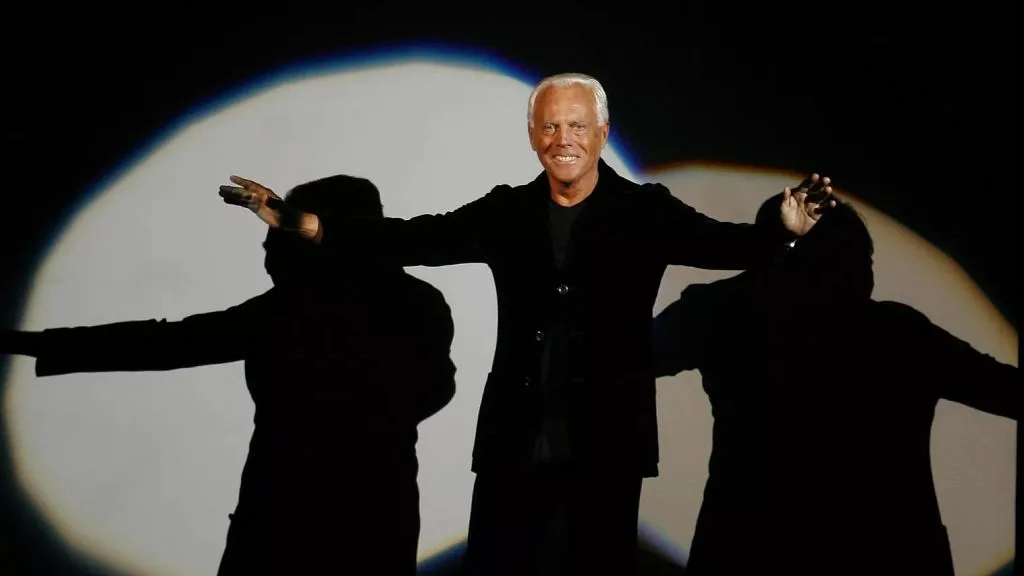
Milan — Employees of late fashion icon Giorgio Armani described him as “like a father” as they bid farewell to the designer whose vision reshaped the global style industry. Armani, who passed away on Thursday at the age of 91, leaves behind not just a fashion empire but a deeply personal bond with those who worked alongside him for decades.
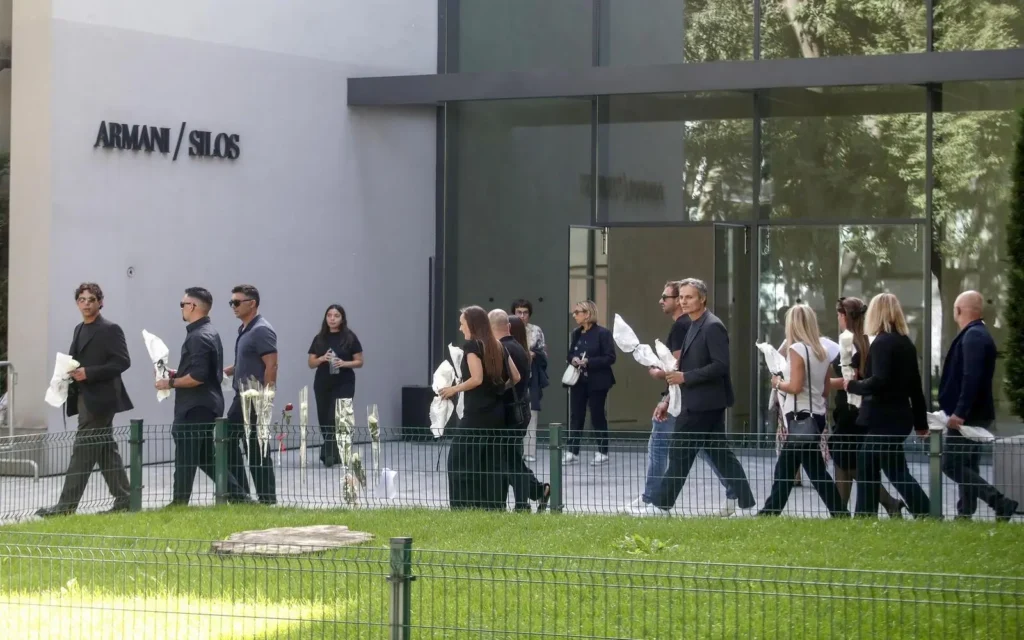
“For all of us, he was like a father, that I can tell you,” said former employee Ornella Gagliolo, who joined other retired staff in paying respects at Armani’s headquarters in Milan. The wooden casket, adorned with white roses and surrounded by dozens of lanterns, became a solemn stage inside the vast exhibition space where his famous catwalks were once held.
A final farewell in Milan
The outpouring of grief following Armani’s death has been immense. From Hollywood stars to Italian political figures, the tributes underline his place not just in fashion but in cultural history.
Among mourners were Santo Versace, brother of the late Gianni Versace, former AC Milan legend Paolo Maldini, and ex-Italian prime minister Mario Monti. Armani’s niece Silvana Armani, who worked closely with him for years, was also present, symbolizing the family continuity expected to guide the brand forward.
The funeral will be held privately in northern Italy on Monday, keeping in line with the designer’s preference for elegance and simplicity.
A father figure beyond the runway
Armani’s staff describe him not as a distant mogul, but as a mentor and protector. Many said working for him was a “privilege” and an “honor,” highlighting how his leadership style went beyond the demands of haute couture.
His empire spanned everything from haute couture to ready-to-wear fashion, perfumes, and even home furnishings. Yet those closest to him insist his most enduring legacy was how he nurtured the people around him.
“He gave us discipline, he gave us pride in our work,” one former seamstress recalled. “But he also gave us kindness, the kind that stays in your heart.”
The empire he leaves behind
Over more than five decades, Armani transformed his name into a symbol of elegant simplicity. His vision stripped away unnecessary flamboyance, giving rise to timeless minimalism that became the hallmark of modern Italian fashion.
His influence extended far beyond Milan. From Hollywood red carpets to global sporting arenas, Armani’s suits and gowns became synonymous with sophistication. Celebrities such as Richard Gere and Cate Blanchett famously wore his designs, further cementing his reputation as the designer of choice for the world’s elite.
Though he had no children, Armani left his brand in the hands of trusted family members and confidants. Insiders say this tight-knit circle is expected to continue running the empire, safeguarding the values of discipline and refinement he held dear.
Global tributes pour in
From Los Angeles to Paris, social media was flooded with tributes. Fans and celebrities remembered Armani not just as a designer but as a cultural architect who changed the way people thought about clothes.
Luxury houses like Prada, Gucci, and Dolce & Gabbana issued statements of respect, acknowledging Armani’s role in keeping Italy at the heart of fashion innovation.
Former Italian Prime Minister Mario Monti described him as “a great ambassador of Italy, who showed the world that elegance and simplicity can co-exist.”
A legacy beyond fashion
Armani was known for his precision and strict control over his brand, but also for his philanthropy. Over the years, he contributed to humanitarian efforts, cultural preservation, and sports sponsorships, including his long-standing support for AC Milan.
For many Italians, Armani embodied the resilience of post-war Italy—rising from modest beginnings in Piacenza to dominate the international stage.
As his coffin left the Milan headquarters, employees whispered tearful goodbyes. To them, he was not just a boss, but a man who became family.
Visit our site for more news www.DailyGlobalDiary.com


World News
Great American State Fair Turns Into a Health Emergency: Several Visitors Critical as Washington Heatwave Forces Shutdown
The Great American State Fair, part of President Donald Trump’s Freedom 250 celebrations, was temporarily closed after extreme temperatures swept through Washington, D.C., leaving multiple attendees in critical condition and raising fresh concerns over public safety at large outdoor events.

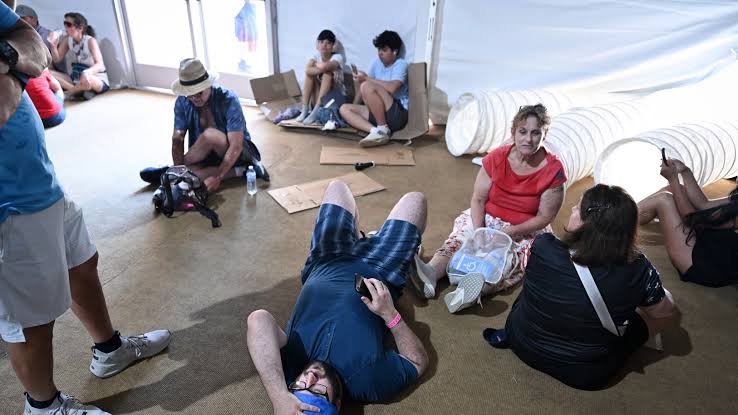
What began as a festive celebration quickly turned into a medical emergency as the Great American State Fair in Washington, D.C. faced a severe heat-related crisis that reportedly left several attendees fighting for their lives.
The fair, organized as part of President Donald Trump’s Freedom 250 initiative, attracted large crowds eager to participate in patriotic celebrations, entertainment programs, food events, and family-friendly activities. However, soaring temperatures transformed the atmosphere from one of celebration to one of concern.
According to reports, emergency medical teams were called into action after numerous visitors experienced symptoms associated with extreme heat exposure. Several individuals reportedly suffered serious medical complications and were placed on life support as healthcare professionals worked to stabilize their conditions.
As temperatures continued to climb, event organizers made the decision to temporarily suspend fair operations on Friday. Officials cited public safety concerns and the need to protect attendees, staff members, and vendors from dangerous weather conditions.
ALSO READ : Emmy Nominations Announcement Gets a Star Twist… Liza Colón-Zayas & Jeff Hiller Set to Reveal 2026 TV Nominees
Witnesses described scenes of confusion as medical personnel rushed across the venue to assist those affected by the heat. Many attendees sought shelter in shaded areas, cooling stations, and air-conditioned facilities as emergency announcements echoed throughout the fairgrounds.
The incident has once again highlighted the growing challenge of hosting large outdoor gatherings during periods of extreme weather. Experts have repeatedly warned that prolonged exposure to high temperatures can lead to dehydration, heat exhaustion, and potentially life-threatening heatstroke, particularly among children, older adults, and individuals with underlying health conditions.
The Freedom 250 celebrations, designed to commemorate America’s approaching 250th anniversary, have featured multiple events across the country. The health emergency at the Great American State Fair, however, has shifted attention toward preparedness measures and emergency response planning at major public events.

Local authorities and medical officials continue to monitor those hospitalized following the incident. While organizers have emphasized that attendee safety remains their top priority, questions are being raised about whether additional precautions could have helped reduce the impact of the intense heatwave.
As Washington, D.C. and several other regions of the United States continue to experience unusually high temperatures, public health experts are urging residents and visitors alike to stay hydrated, avoid prolonged exposure to direct sunlight, and seek immediate medical attention if symptoms of heat-related illness appear.
The incident serves as a stark reminder that extreme weather can quickly transform even the most anticipated public celebrations into serious emergencies.
World News
Delta Pilot Falls Ill Mid-Flight: “I Need to Go to the Hospital” as Boeing 757 Diverts to Detroit
Delta Flight 437 was heading from Los Angeles to Boston when its captain became ill over the Midwest, forcing the aircraft to make a safe diversion to Detroit.


A routine cross-country journey took an unexpected turn Tuesday when the captain of Delta Air Lines Flight 437 became ill while flying from Los Angeles to Boston.
The Boeing 757 was carrying 147 passengers when the crew declared an emergency while flying over the Lake Michigan region. The medical emergency did not involve a passenger. Instead, it was the captain who needed urgent medical attention.
The aircraft was diverted safely to Detroit Metropolitan Airport, with the first officer taking control of the aircraft.
Captain reveals he was the one experiencing the medical emergency
Flight 437 had departed Los Angeles International Airport for Boston, a route that typically takes between five and five-and-a-half hours.
The aircraft was cruising at approximately 39,000 feet when the situation developed. The cockpit crew contacted air traffic control and declared an emergency before changing course toward Detroit.
Initially, the communication referred to a medical episode involving someone aboard the aircraft. The unusual nature of the situation became clear when the captain explained that he was the person who had fallen ill.
Diverting to Detroit allowed the crew to get the captain medical assistance while ensuring the aircraft and passengers could reach the ground safely.
“I’m the one that’s ill”
As the aircraft approached Detroit, the captain communicated with the airport tower and explained what had happened.
“This is the captain,” he told air traffic control. “I’m the one that’s ill. I’m going to taxi the jet to the gate, and then I need to go to the hospital.”
Despite experiencing the medical problem, the captain remained involved in the final stages of the flight. The first officer had taken control during the diversion, allowing the aircraft to make its way safely toward the Detroit hub.
The exchange offered a rare glimpse into how a medical emergency involving a flight crew member can unfold in real time.
The aircraft landed safely in Detroit
Flight 437 arrived safely at Detroit Metropolitan Airport, where the captain could receive medical attention.
According to Delta Air Lines, the flight was subsequently completed by another crew.
The airline has not disclosed the captain’s specific medical condition.
There were no reports in the supplied information of passenger injuries or an aircraft-related problem.

Why having two pilots matters
The incident also highlights one of the fundamental safety features of commercial aviation: having multiple qualified pilots on the flight deck.
When one pilot becomes unable to continue operating the aircraft, the other can assume control, communicate with air traffic control and divert to an appropriate airport.
That is precisely what happened aboard Flight 437.
Rather than continuing the long journey to Boston, the crew chose to divert to Detroit, giving the captain access to medical care while minimizing the risk to everyone aboard.
Passengers ultimately continued their journey
For the 147 passengers aboard the Delta flight, the emergency meant an unexpected stop in Detroit before the journey could continue.
Another crew took over the aircraft after the diversion, allowing the flight to proceed toward Boston.
While medical emergencies involving pilots are rare, aviation procedures are designed to ensure that an unexpected situation does not automatically become a catastrophe.
In this case, the aircraft reached the ground safely, the captain was able to seek medical care and the passengers’ journey continued.
What began as an ordinary flight across the United States ended with an extraordinary cockpit emergency—and a quiet reminder of just how important preparation and teamwork are in commercial aviation.
World News
Colorado’s Moon Is About to Turn Red: Near-Total Lunar Eclipse Could Paint the Night Sky in Blood-Red
The celestial show will be visible across Colorado on Thursday night, with the eclipse expected to reach its peak between 9:45 p.m. and 10:45 p.m.

A dramatic celestial spectacle is set to unfold over Colorado on Thursday night as the Moon takes on a deep reddish tint during a near-total lunar eclipse.
Unlike a normal full Moon, this celestial event will see the Moon move deep into Earth’s shadow, creating the striking red or copper-colored appearance commonly associated with a “blood moon.” The event will be visible to the naked eye across much of the state, provided clouds stay away.
According to Chris Bianchi, a senior meteorologist at 9News, viewing conditions along Colorado’s Front Range are expected to be largely favorable. He estimated that many areas could have a 70% to 80% chance of clear skies around the eclipse’s peak.
However, skywatchers farther south may have a tougher time.
When will the lunar eclipse be visible?
The Moon is expected to begin developing its reddish appearance at around 8:30 p.m. The eclipse will continue for several hours, with the overall event lasting until approximately 1 a.m.
The most impressive phase is expected between 9:45 p.m. and 10:45 p.m., when roughly 92% to 95% of the Moon could be covered by Earth’s shadow over Colorado.
That means the state will come remarkably close to experiencing a total lunar eclipse, even though it will not technically reach totality.
The red color happens because sunlight passing through Earth’s atmosphere is bent toward the Moon. Shorter blue wavelengths are scattered more easily, while longer red and orange wavelengths make their way through the atmosphere and illuminate the lunar surface.

Why Colorado’s viewing conditions could vary
For residents along the Front Range, particularly around the Denver area, the forecast currently looks encouraging. But the farther south viewers travel, the greater the possibility of clouds.
Areas around Colorado Springs, south of the Palmer Divide, as well as La Junta and Lamar, could see more unsettled viewing conditions.
That could make the eclipse a bit of a race against the clouds.
For people determined to get the best possible view, Chris Bianchi recommends moving away from bright city lights. Areas east of Denver International Airport could provide darker skies and a better opportunity to appreciate the Moon as it approaches its deepest stage of the eclipse.
There is one catch: cloud cover could also be more likely in some of those eastern areas.
In other words, eclipse watchers may need to be flexible.
You don’t need a telescope to see it
The good news is that this isn’t an event reserved for professional astronomers.
A telescope or pair of binoculars can make the details on the Moon easier to see, but neither is essential. Anyone standing under a reasonably clear, dark sky should be able to watch the Moon gradually change color.
Unlike a solar eclipse, a lunar eclipse can also be viewed safely with the naked eye.
For the best experience, viewers should find a location away from heavy light pollution, give their eyes time to adjust to the darkness and keep an eye on the clouds.
A nearly red Moon could make for a memorable night
The eclipse may not technically reach totality in Colorado, but with as much as 95% of the lunar surface expected to fall under Earth’s shadow, the difference could be difficult to notice for casual observers.
As the Moon darkens and takes on its reddish glow, the sky could offer one of the most striking natural displays of the night.
For Colorado residents, the message is simple: look up around 9:45 p.m. — and keep the clouds in mind.

How ‘Avengers: Endgame’ Returned to Cinemas and Reclaimed Box Office Glory

Tom Cruise’s ‘Digger’ Faces a Tough Opening: Could ‘Verity’ Take the Lead?

‘Verity’ Could Outopen ‘Digger’: Why Tom Cruise Faces a Tough Contest

‘Endgame’ Returns to No. 1 ‘Avatar’ Loses Its Box Office Throne

Mark Zuckerberg Faces a New Hollywood Reckoning Why Aaron Sorkin’s Film Hits Closer to Home

1-Iran Issues Dire Warning to Israel and Defies Trump on Nukes: “We’re Ready to Strike Deep Inside”

Sen. Elizabeth Warren Calls It a ‘Cesspool of Corruption’ — Here’s Why Senators Are Now Fighting Back Against the DOJ’s Live Nation Deal That Left Every Fan Betrayed…

Gucci bets on Demna to revive fading glamour as Milan fashion week opens with bold film surprise

Donald Trump’s net worth reveals the fortune behind the former US President and business mogul

“Tomás Rodríguez Net Worth 2025: Panama’s Gold Cup Goal‑Machine’s Surprising Fortune Revealed”

Miss Jamaica Suffers Terrifying Fall Off Miss Universe Stage; Rushed to Hospital on Stretcher in Viral Video

Moana Live-Action Teaser Sparks Outrage as Fans Call Disney’s Move a ‘Clear Money Grab’ — What Went Wrong?

Ryan Gosling’s Project Hail Mary Trailer Stuns Fans with a Mysterious Alien Ally and a Mission That Could Save Earth

Apple delays Jessica Chastain thriller The Savant about domestic extremism after recent US violence
