
Technology
93-Year-Old Grandma Takes Tesla FSD on Busy Sunday Drive… What Happened Next Is Surprisingly Calm
A viral ride in a Tesla Model Y shows how Tesla’s Full Self-Driving is quietly redefining independence for seniors


In an age where technology often feels overwhelming, a simple Sunday drive in San Diego County has turned into a powerful story about freedom, dignity, and the future of mobility.
A 93-year-old grandmother recently took the wheel—or rather, let the car take control—of her Tesla Model Y equipped with Full Self-Driving (FSD). What followed wasn’t chaos, confusion, or fear. It was something far more unexpected: calm, confidence, and quiet independence.
A Journey That Felt “Uneventful” — In the Best Way
The drive began as a 13-mile trip to a local church, Mission Valley Christian Fellowship. For most drivers, navigating Sunday traffic can be stressful. But this journey unfolded differently.
The vehicle handled turns, traffic signals, and lane changes with precision. It arrived right on time—10:30 a.m.—without a single hiccup.
When asked how the drive felt, the grandmother’s response was strikingly simple: “uneventful.”
In a world where driving often comes with anxiety, unpredictability, and fatigue, “uneventful” might just be the highest compliment autonomous technology can receive.
Technology Meets Trust
At the heart of this experience is Tesla Full Self-Driving, a system that continues to evolve with real-world data and advanced AI.
While debates around self-driving cars remain ongoing, moments like this highlight a different side of the conversation—one that isn’t about edge cases or technical failures, but about human impact.
For elderly individuals, driving can become physically and mentally exhausting. Reaction times slow, vision changes, and confidence fades. Yet mobility remains essential for independence.
This is where Tesla’s technology steps in—not to replace the human entirely, but to assist, support, and extend their ability to live freely.

From Church Runs to Coastal Drives
The day didn’t end with a single trip. Later, the duo drove across the iconic Coronado Bridge, a route known for its scenic beauty and, on weekends, heavy congestion.
Even in crowded conditions, the car managed traffic smoothly and even handled the notoriously difficult task of finding parking.
Eventually, it located a spot autonomously—something many drivers struggle with on a busy Sunday afternoon.
The reward? A relaxed moment enjoying gelato, while the stress of driving had been completely offloaded to the machine.
More Than Just a Drive
What makes this story resonate isn’t the technology alone—it’s what the technology enables.
For this 93-year-old, the drive wasn’t about testing a feature. It was about reclaiming something deeply personal: independence.
Instead of relying on family members or caregivers for every outing, she was able to experience the day on her own terms. That sense of autonomy is invaluable, especially in later years.
The Bigger Picture: Mobility Without Limits
Companies like Tesla, led by innovators such as Elon Musk, have long positioned autonomous driving as the future.
But beyond futuristic promises, real-world stories like this show its present-day potential.
Autonomous systems could soon become essential tools—not just conveniences—for aging populations worldwide. From reducing accident risks to easing mental strain, the benefits extend far beyond luxury.
A Word of Caution
Of course, even the most advanced systems are not flawless. Experts continue to emphasize that drivers should remain attentive and ready to take control if needed.
In this case, the journey went smoothly—but the broader conversation around safety, regulation, and responsibility is far from over.
“Life Is Good”
As the day wrapped up, the grandmother and her son shared a simple reflection: life is good.
It wasn’t a dramatic ending, nor did it need to be. The real story was in the quiet success of the day—a drive without stress, a moment of independence, and a glimpse into a future where age may no longer limit mobility.
For More Update- DAILY GLOBAL DIARY






Technology
Hollywood Is Panicking About AI Stealing Jobs But This One Startup Says It Has the Answer Nobody Saw Coming…
As writers, directors, and visual effects artists scramble to figure out whether artificial intelligence will rescue or ruin their careers, an online film school called Curious Refuge is quietly becoming the most important classroom in the entertainment industry.


There is a particular kind of dread spreading through Hollywood right now — and it has nothing to do with a writers’ strike, a box office slump, or a streaming platform pulling the plug on a beloved show. It’s quieter than all of that. More existential. It shows up in late-night group chats between editors, in the hushed conversations at studio lots, in the anxious questions asked at industry panels that nobody fully knows how to answer.
The question is always some version of the same thing: Is AI coming for my job?
And for a growing number of film and television professionals, the honest answer is: maybe. But one company believes the more important question isn’t whether AI will change Hollywood — it’s whether you’ll know how to use it when it does.
ALSO READ : “She Never Made It Out…” Albany House Fire Claims Woman’s Life as Family Pleads for Help to Bring Her Home
Meet the Startup Rewriting the Rules
Curious Refuge is an online film school, but calling it that almost undersells what it has quietly become. Founded with the mission of teaching creative professionals how to harness the latest artificial intelligence tools for filmmaking, it has found itself at the absolute center of one of the most disorienting moments in Hollywood’s modern history.
The platform offers courses, tutorials, and hands-on training specifically designed for industry professionals — not hobbyists or tech enthusiasts, but working directors, cinematographers, visual effects artists, editors, and producers who are realizing, often with a jolt of alarm, that the tools reshaping their industry are evolving faster than any traditional film school could ever track.
In a town built on storytelling, Curious Refuge is telling a very specific story: that AI isn’t simply a threat to be feared — it’s a skill to be learned. And the window to learn it, they argue, is narrowing fast.
The Fear Is Real — And So Are the Layoffs
To understand why a platform like Curious Refuge is resonating so deeply, you have to understand the scale of anxiety currently running through the entertainment industry.
Hollywood has already watched AI disrupt visual effects pipelines in ways that would have seemed like science fiction just three years ago. Tools built by companies like Runway, Adobe, OpenAI, and Google DeepMind are now capable of generating footage, de-aging actors, creating digital environments, and even drafting screenplay structure — tasks that once required entire departments of skilled human workers.
The Writers Guild of America fought hard during the 2023 strike to establish protections around AI use in scripted television and film. The SAG-AFTRA strike that same year put the question of digital actor likenesses and AI-generated performances front and center in labor negotiations. Those fights produced agreements — but agreements that many in the industry privately admit feel temporary, like a sandbag wall against a rising tide.
Because the technology didn’t wait for the ink to dry. It kept advancing.
‘Scrambling to Learn’ Is an Understatement
What Curious Refuge has tapped into is something very human beneath all the technical noise: the fear of being left behind.

Industry professionals who spent years — sometimes decades — mastering their craft are now looking at AI-generated reels on social media and feeling something they’re not used to feeling. Vulnerable. Replaceable. Behind.
A veteran visual effects supervisor who has worked on major studio tentpoles doesn’t want to go back to school. A working screenwriter with multiple produced credits isn’t looking to pivot into tech. But both of them are quietly, urgently trying to understand tools they were never trained to use — because they can see, with their own eyes, what those tools are capable of.
This is exactly the gap Curious Refuge is filling. And they are filling it not by replacing the human element of filmmaking, but by arguing that the most dangerous place to be right now is on the sidelines.
The Uncomfortable Truth Hollywood Doesn’t Want to Say Out Loud
Here is the tension that sits at the heart of this entire conversation, and it’s one that even the most thoughtful voices in the industry tend to dance around: AI is not going to stop.
The studios know this. The streaming platforms know this. Netflix, Amazon, Disney, Warner Bros. — all of them are either already investing in AI tools for production or actively exploring partnerships with companies developing them. The economics are simply too compelling to ignore. AI can reduce certain production costs dramatically. For a studio trying to greenlight more content with tighter margins, that is not an abstract benefit.
What that means for the below-the-line workers — the crew members, the background artists, the entry-level assistants who are the backbone of how films and television shows actually get made — is a question the industry has not yet fully reckoned with.
Curious Refuge isn’t solving that structural problem. No single startup can. But what it is doing is giving individual professionals a fighting chance to stay relevant in a landscape that is shifting beneath their feet in real time.
Learning the Tool That Might Take Your Job
There is something almost poignant about the situation Curious Refuge finds itself in. It is teaching people how to use the very technology that some of them fear will eventually make them unnecessary. The courses aren’t cheap — and the students aren’t casual hobbyists. They’re professionals with mortgages and careers and reputations, trying to figure out whether mastering generative AI tools makes them more valuable to studios or simply more complicit in their own industry’s transformation.
It’s a genuinely complicated ethical position. And to their credit, the people behind Curious Refuge don’t pretend it isn’t.
What they argue — persuasively, given the current evidence — is that the professionals who adapt will have a place in whatever Hollywood becomes next. And the ones who wait, hoping this all blows over, are taking the bigger risk.
What Comes Next
Nobody in Hollywood — not the executives, not the labor unions, not the most optimistic tech evangelists — really knows exactly what the entertainment industry looks like in five years. The pace of AI development has made confident predictions feel almost embarrassing in retrospect.
What is clear is that the transition is happening now, not eventually. Films are already being made with significant AI components. Sora, Runway, Midjourney, and a growing ecosystem of production-specific AI platforms are moving from experimental curiosities to genuine production tools at remarkable speed.
Curious Refuge is betting that the most valuable people in that future Hollywood won’t be the ones who fought AI the hardest — they’ll be the ones who understood it the best.
Whether that bet pays off for the industry’s most vulnerable workers, or simply helps the most adaptive ones land safely while others are left behind, is a story Hollywood is only just beginning to tell.
And unlike most of its productions, this one doesn’t have a guaranteed happy ending.
Technology
Fact Check: Has Apple Really Shut All Its Stores Across the UAE? Here’s the Truth Behind the Viral Claim
Social media is flooded with claims that Apple has permanently closed its Dubai and Abu Dhabi stores amid the Iran conflict — but the reality is more nuanced than the viral posts suggest


If your social media feed has been buzzing with claims that Apple has shut down all its stores across the United Arab Emirates (UAE), you are not alone. The claim has gone massively viral — but as is often the case with breaking news in conflict zones, the full picture is more complicated than a single headline can capture.
Here is everything you need to know, fact-checked and laid out clearly.
What Is the Viral Claim?
Unverified posts circulating across platforms like X (formerly Twitter), Instagram and WhatsApp have suggested that Apple has permanently — or indefinitely — closed all of its retail stores across the UAE, including in Dubai and Abu Dhabi, due to security concerns stemming from the ongoing US-Israeli conflict with Iran.
How Many Apple Stores Does the UAE Have?
According to Apple’s official website, there are five Apple stores across the UAE in total — three in Abu Dhabi and two in Dubai. The Abu Dhabi locations are at Al Maryah Island, Yas Mall, and Al Jimi Mall. The Dubai stores are at Mall of the Emirates and Dubai Mall — two of the most visited retail destinations in the entire Middle East.
What Actually Happened?
Here is the verified sequence of events. When Iran launched retaliatory strikes across the Gulf region following the February 28 US-Israeli strikes on Tehran, Apple took a precautionary decision and temporarily shut all five of its UAE stores, along with its corporate offices in the country.
The closures began at 3 pm on February 28 — the same day the conflict escalated significantly. This move was in line with guidance issued by Emirati authorities, which advised private-sector companies to limit employee presence in open areas through March 3.
According to Apple’s website, all five stores were scheduled to remain closed until March 5.
Are the Stores Open Now?
This is the crucial part that viral posts have conveniently left out. According to Apple’s official website, all five UAE stores were scheduled to reopen at their regular operational hours — 10 am — on March 31, which is today.
There has been no official statement from Apple confirming any new or extended closure beyond that date. The closures that did take place were temporary and precautionary — not a permanent exit from the UAE market.
The Ground Reality in Dubai and Abu Dhabi
That said, the security situation in the UAE remains anything but routine. Both Dubai and Abu Dhabi have been actively intercepting missiles and drones since the broader Middle East conflict erupted. Iran’s retaliatory campaign has targeted Gulf cities as part of a wider regional offensive.

The most recent incident involved the Al-Salmi, a Kuwaiti crude oil tanker, which was struck by Iran in an anchorage area of a Dubai port on Tuesday. Kuwait Petroleum Corporation (KPC) confirmed the attack, noting there were no crew injuries but warning of a potential oil spill in surrounding waters. Dubai authorities later confirmed that response teams successfully extinguished the resulting fire.
The Dubai Media Office posted on X: “Relevant teams continue to assess the situation and take the necessary measures, and updates will be shared as they become available.”
The Verdict
| Claim | Verdict |
|---|---|
| Apple has permanently shut all UAE stores | ❌ False |
| Apple temporarily closed UAE stores in early March | ✅ True |
| Closures were due to Iran conflict concerns | ✅ True |
| Apple issued an official statement on permanent closure | ❌ False |
| All stores scheduled to reopen by March 31 | ✅ True |
Bottom line: Apple did temporarily close its UAE stores during the peak of the regional security scare in early March — but the viral claim of a permanent or ongoing closure is not supported by any official statement or current data from Apple’s website. As of March 31, the stores are scheduled to be back open.
In times of conflict and uncertainty, misinformation spreads faster than facts. Always verify directly from official sources before sharing claims that could cause unnecessary panic.
games
Crimson Desert on PS5 Pro Looks “Unbelievably Real”… But Is It Finally the Console Breakthrough Gamers Were Waiting For?
With jaw-dropping visuals, ray tracing across all modes, and near-PC performance, Pearl Abyss’ ambitious open-world epic may redefine what consoles can truly deliver.

When a next-gen game promises to blur the line between console and PC, skepticism usually follows. But after more than 25 minutes of near-final gameplay footage, Crimson Desert on the PlayStation 5 Pro is doing something rare — it’s turning doubters into believers.
Developed by Pearl Abyss, the studio behind the popular MMORPG Black Desert Online, this new title isn’t just another open-world adventure. It’s a technological showcase powered by the studio’s in-house BlackSpace Engine, and it’s already being hailed as a potential game-changer.
A World That Feels Alive — Down to Every Brick
Unlike many modern titles relying heavily on Unreal Engine 5, Crimson Desert takes a different path. The result? A world packed with astonishing detail — from sweeping landscapes to microscopic textures that make every stone, wall, and surface feel tangible.
The secret sauce lies in advanced rendering techniques like ray-traced global illumination. In simple terms, light behaves as it does in the real world — bouncing off surfaces, filling interiors naturally, and reacting dynamically to the environment. Whether it’s sunlight pouring through a window or a lantern casting shadows in a dark cave, the effect is strikingly realistic.
And yes, this isn’t limited to high-end PCs anymore.

PS5 Pro Performance: Three Modes, One Big Question
The big question for console gamers has always been: Can it actually run well?
Here’s where things get interesting. On the PlayStation 5 Pro, Crimson Desert offers three distinct modes:
- Performance Mode (60fps target)
- Balanced Mode (40fps target)
- Quality Mode (30fps target)
What stands out is that ray tracing is enabled across all three modes — a rare move that ensures consistent lighting quality no matter how you choose to play.
Even more impressive is the base resolution strategy. Instead of dipping too low (a common issue this generation), the game targets:
- 1080p (Performance)
- 1440p (Balanced)
- 4K (Quality)
These are then upscaled using PlayStation’s PSSR technology. While the current build uses an early version of this upscaling method, future improvements could significantly enhance clarity and stability.
Where It Still Struggles… Just a Little
Let’s be clear — this isn’t a flawless experience yet.
Performance mode, aiming for 60fps, occasionally dips during intense moments with many on-screen elements. This is likely due to CPU limitations, something even modern consoles still grapple with compared to high-end PCs.
There’s also a minor issue with VRR (Variable Refresh Rate). While the feature is supported, the absence of proper low frame-rate compensation can lead to occasional screen tearing when performance dips below certain thresholds.
Still, these aren’t deal-breakers — more like final polish points before launch.
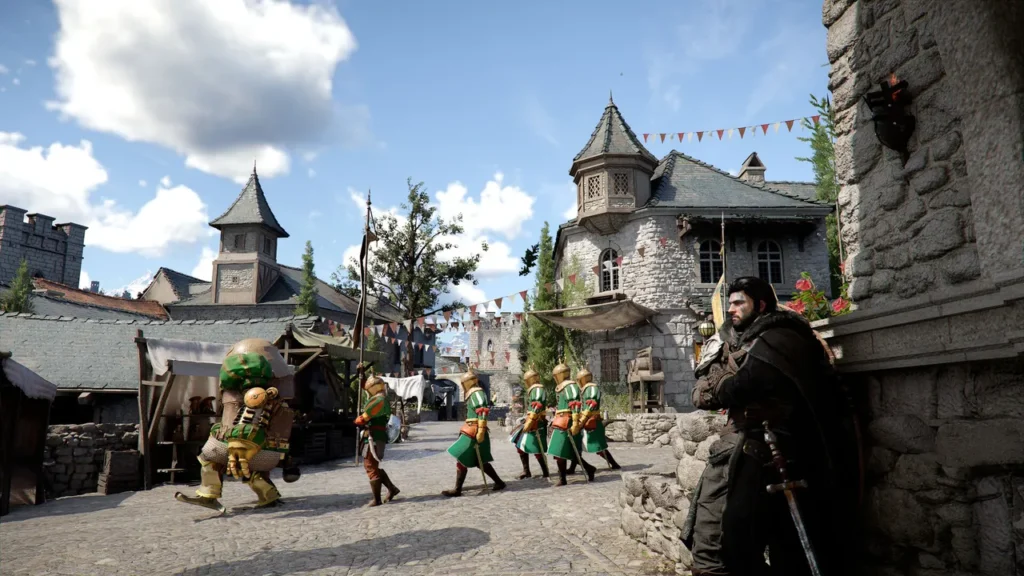
Console vs PC: Has the Gap Finally Closed?
For years, PC has been the gold standard for visual fidelity and performance. But Crimson Desert on PS5 Pro suggests that gap is shrinking — fast.
From massive open-world scale to intricate environmental detail, the console version holds remarkably close to what we’ve seen on PC builds. That’s no small achievement, especially for a game this ambitious.
And while we’re still waiting to see how it performs on base PS5 or other platforms, one thing is already clear: PS5 Pro owners are in for something special.
Why This Game Matters More Than You Think
This isn’t just about one game looking good. It’s about what it represents.
If Crimson Desert delivers on its promise at launch, it could signal a shift in how developers approach console optimization — proving that with the right engine and design philosophy, consoles can handle experiences once thought exclusive to PCs.
In an era where many titles struggle with performance compromises, this feels like a bold step forward.
For More Update- DAILY GLOBAL DIARY

New Kids on the Block Bring Vegas to Its Feet at AMAs 2026 With ‘You Got It (The Right Stuff)’… And Fans Are Calling It a Nostalgia Explosion

‘Star Wars’ Roars Back After 7 Years: The Mandalorian and Grogu Stuns Box Office With $100M Opening While Indie Thriller ‘Obsession’ Defies Hollywood Logic

‘Pinky Up Goes Global’: KATSEYE Ignite AMAs 2026 Stage With Explosive, No-Stop Dance Performance

‘No Breaks, Just Beats’: KATSEYE Set AMAs 2026 Stage on Fire With High-Energy ‘Pinky Up’ Dance Performance

‘This Is Where It All Began…’: Billy Idol’s Emotional Lifetime Honor Speech Ends AMAs 2026 With Explosive Hit Medley

1-Iran Issues Dire Warning to Israel and Defies Trump on Nukes: “We’re Ready to Strike Deep Inside”

Donald Trump’s net worth reveals the fortune behind the former US President and business mogul

“She Never Made It Out…” Albany House Fire Claims Woman’s Life as Family Pleads for Help to Bring Her Home

“Tomás Rodríguez Net Worth 2025: Panama’s Gold Cup Goal‑Machine’s Surprising Fortune Revealed”

Younghoe Koo Explains Botched Field Goal After Slip: “The Ball Was Moving So I Pulled Up”

Miss Jamaica Suffers Terrifying Fall Off Miss Universe Stage; Rushed to Hospital on Stretcher in Viral Video

Moana Live-Action Teaser Sparks Outrage as Fans Call Disney’s Move a ‘Clear Money Grab’ — What Went Wrong?

Ryan Gosling’s Project Hail Mary Trailer Stuns Fans with a Mysterious Alien Ally and a Mission That Could Save Earth

Apple delays Jessica Chastain thriller The Savant about domestic extremism after recent US violence

Avatar 3, Fire and Ash trailer reveals Jake Sully’s family facing terrifying new Na’vi enemies with deadly fire powers
-

 Entertainment1 week ago
Jennifer Aniston Suddenly Appears on ‘The Comeback’ Podcast… and Valerie Cherish’s Reaction Has Fans Talking
-

 World News1 week ago
“Pentagon, Do Better…”: Why the Latest UFO Videos Are Raising More Frustration Than Fear
-

 World News1 week ago
Cannes 2026 Faces a Political Storm: Will Gaza, Iran and Trump Overshadow the Movies Again?
-

 Entertainment4 days ago
NBC Finally Reclaims TV’s Biggest Crown After 22 Years and Hollywood Didn’t See This Ratings Comeback Coming
-

 Entertainment6 days ago
Amazon’s ‘Off Campus’ Tries to Deliver the Next Big Hockey Romance… But Fans Say One Thing Is Missing
-

 Entertainment1 week ago
After ‘Emilia Pérez’ Storm, Karla Sofía Gascón Returns as a Ruthless Villain in ‘Trinidad’… and Cannes Is Already Watching
-

 Entertainment1 week ago
Rossy de Palma Turns Airport Glam Into High Fashion in New Rimowa Campaign And Fashion Fans Can’t Stop Talking About It
-

 Entertainment2 days ago
Michael Jackson’s Upcoming Biopic Reportedly Avoids His Darkest Controversies but Netflix’s New Docuseries Refuses to Stay Silent