
Entertainment
‘Dark Winds’ Wrapped Up Season 4 Perfectly Then a Single Phone Call Murdered Everyone’s Peace…
Joe Leaphorn escaped the bunker, Vaggan went to prison, Chee found peace — and then the phone rang. And everything changed.


Just when you thought Dark Winds was going to hand you a rare, clean, satisfying ending — the kind where the good guys win and everyone gets to exhale — the show did what it does best. It waited until the very last moment, then sucker-punched you straight in the chest.
Season 4 of AMC’s acclaimed Navajo crime drama wrapped on Sunday, April 5, 2026, and the finale was everything loyal fans had come to expect: tense, emotionally layered, rooted in Indigenous culture and tradition, and quietly devastating. But it was those final few seconds — a phone call, a name, two words — that turned a satisfying conclusion into one of the most shocking cliffhangers in the show’s history.
The Bunker. The Villain. The Escape.
All season long, the central threat looming over Lt. Joe Leaphorn — played with extraordinary restraint and depth by Zahn McClarnon — was Irene Vaggan, a German assassin hired by crime boss Dominic McNair to clean up loose ends in a federal investigation.
After being kidnapped by Vaggan in the previous episode, Joe awakens in an underground shelter with Billie. Unlike other villains of Dark Winds’ past, Vaggan’s form of torture lives in a false reality. CBR
ALSO READ : Younghoe Koo Explains Botched Field Goal After Slip: “The Ball Was Moving So I Pulled Up”
Irene Vaggan, played by Franka Potente, held Leaphorn and Billie in her bunker as a sort of dollhouse family, trying to manipulate them into pretending the kind of filial bonds she’d never experienced. The Hollywood Reporter
Potente described her character’s twisted psychology with chilling clarity: “She has all these ideas of family, which she never had. In her mind, she’s just fabricating this narrative… It’s like a play that she’s putting on where she’s like, ‘You’re going to be the dad and I’m going to be the mom, and she’s going to be the kid, and we’re going to live here in this weird bunker situation.'” The Hollywood Reporter
It was deeply unsettling television. And it worked.
A perverted attempt by Vaggan to play house in her bunker with kidnapped Joe and teen Billie ended with a severely burnt Vaggan telling Joe to kill her — as he’s sending her to prison instead. Gold Derby
Justice, of a sort. The case is closed. McNair may walk free — so even though Joe and the FBI had strong evidence against Vaggan for all the murders she committed throughout Season 4, they couldn’t tie any of it to McNair DM Talkies — but Vaggan is behind bars. The immediate threat is over. Billie is safe.
You could almost feel the audience breathe out.
Chee’s Healing. Bern’s Future. Emma’s Goodbye.
In between the thriller beats, the finale made room for something quieter and more human. Jim Chee, played by Kiowa Gordon, who has battled Ghost Sickness all season, finally finds his path to healing.
Chee takes part in a ceremony to help get rid of his Ghost Sickness. Many people from the community show up, as well as Chee’s old FBI buddy, Toby Shaw. Chee’s well on his way to becoming a man of belief, and his relationship with Bernadette appears to be going strong. CBR
Bernadette Manuelito, played by Jessica Matten, continues stepping into her own power throughout the episode — no longer just part of the trio, but increasingly essential to its survival.
And then there’s Emma. After returning to the reservation for Chee’s Ghostway ceremony, Emma tells Joe she’s heading back to Los Angeles. He informs her that Navajo Nation will always be her home and her family. The Hollywood Reporter It was a bittersweet moment — two people who love each other choosing different paths, with grace, not bitterness.
Joe doesn’t chase after her. He doesn’t retire and follow her to Los Angeles. He stays. He chooses his people and his post. And in that choice, you see the character’s full arc — a man who has finally stopped running from himself.
Then Came the Call That Changed Everything
In the final moment, Leaphorn received a call that relayed shocking news: Retired Sheriff Gordo Sena — played by A Martinez — has been murdered. Gold Derby
Just like that, the clean ending evaporated.
By far the biggest shock of Dark Winds Season 4’s finale was the news that Gordo Sena, former sheriff of Scarborough County and longtime friend of Joe Leaphorn, was murdered. As the episode came to its final moments, instead of revealing whether Leaphorn had decided to retire or continue working as a lieutenant, Joe told Bernadette that Gordo had been murdered. ScreenRant
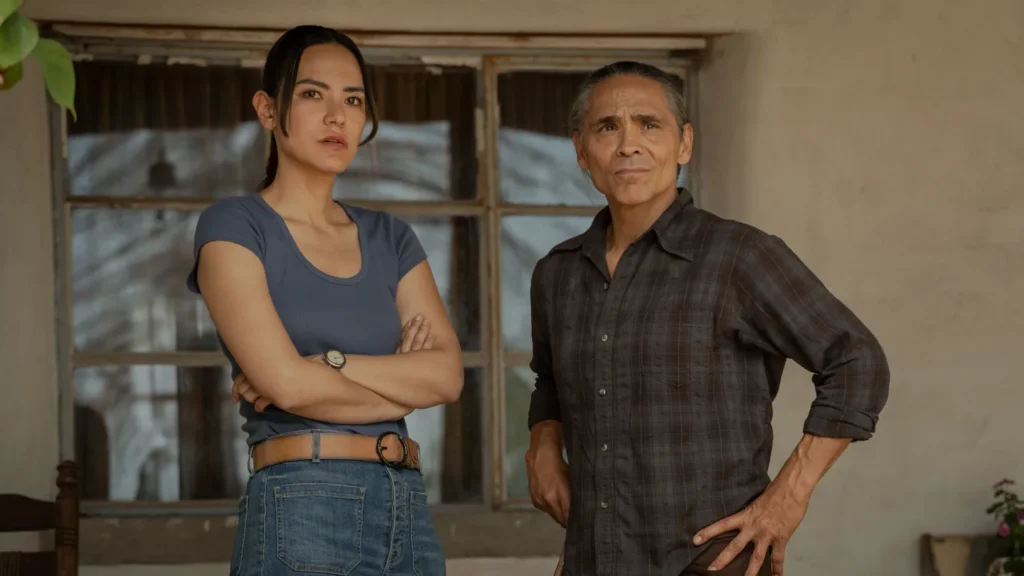
This is the first time the show has ended on a true cliffhanger. Past seasons have had their loose ends, but they solved all the most pressing mysteries. This time, however, fans of the show will have to wait another season to find out who killed Gordo. ScreenRant
The suspect list is already tantalizing. Could it be Gordo’s wife, played by Linda Hamilton? She was introduced at the start of the season and was known to have memory issues — but could confusion have had some deadly results? TV Insider
Gordo’s wife couldn’t recognize Joe at the beginning of Dark Winds Season 4, and she also forgot her own son. That means that even if Barbara witnessed Gordo’s murder, her fading memory will make it hard to get any information out of her. ScreenRant
It’s the kind of mystery that feels personal. Gordo wasn’t just a case. He was Joe’s friend, his sounding board, his anchor in the non-Navajo world. His murder isn’t just a plot twist — it’s a wound.
What This Means for Season 5
AMC has confirmed a fifth season, with cameras set to roll from March 2026 in Santa Fe, New Mexico. The next chapter is slated to run for eight episodes, with a 2027 premiere currently on the cards. Tonboriday
The show’s music throughout the finale was also singled out for special praise. The show’s music supervisor Rick Clark nailed his song selections, including the use of Willie Nelson’s “Medley: These Are Difficult Times / Remember the Good Times” for a montage of Joe getting dressed for what could have been his final day with the tribal police force before learning of Gordo’s murder. Gold Derby
Showrunner Vince Wirth teased that Season 5 will weave the Gordo murder mystery into the adaptation of another Tony Hillerman novel, promising a season that feels both fresh and deeply personal for Leaphorn and the team.
Dark Winds Season 4 is now fully streaming on AMC+. Whether you watched it live or binged it in one go — that final phone call hit the same way. Like a door slamming shut on one chapter, and an unknown hand quietly turning the knob on the next.


Entertainment
Lisa Kudrow Reveals Unexpected Reason Behind Casting Her Son in ‘The Comeback’ Final Season… Fans Call It ‘Most Personal Twist Yet’
The Hollywood star opens up about why she brought real-life family into the world of The Comeback, casting her son as an AI troubleshooter in the show’s final season.

Veteran Hollywood actress Lisa Kudrow has once again captured public attention—this time not for a revival of her iconic comedic timing, but for a deeply personal creative decision tied to the final season of her cult-favorite series The Comeback.
In recent discussions around the show’s production, Kudrow revealed that she chose to cast her real-life son in a key role as an AI troubleshooter, a decision she says was driven by both practicality and emotional grounding during the intense final phase of filming.
A surprising family connection behind the camera
The final season of The Comeback, which airs on HBO, is known for its satirical look at Hollywood, fame, and the entertainment industry’s ever-changing relationship with technology.
ALSO READ : Sen. Elizabeth Warren Calls It a ‘Cesspool of Corruption’ — Here’s Why Senators Are Now Fighting Back Against the DOJ’s Live Nation Deal That Left Every Fan Betrayed…
But what fans did not expect was the introduction of Kudrow’s son into this already meta narrative. According to Kudrow, the idea was not initially planned as a headline-making move. Instead, it evolved organically during production as the storyline began incorporating artificial intelligence as part of its creative satire.
She explained that having someone she trusted deeply on set made the demanding production environment more grounded, especially while dealing with complex scenes involving AI-driven plot elements and rapid improvisational comedy.
AI meets satire in true ‘Comeback’ style
The final season reportedly leans heavily into the modern obsession with artificial intelligence, blending satire with emotional storytelling. The character played by Kudrow’s son serves as an “AI troubleshooter,” a role that humorously reflects Hollywood’s growing dependence on automation and digital problem-solving tools.
Industry insiders note that the show’s writing team intentionally used this character to explore how technology is reshaping creativity, decision-making, and even personal relationships in entertainment.

The decision to cast family in such a role has sparked conversation across Hollywood circles, with many praising Kudrow for blurring the line between reality and fiction in a way that aligns perfectly with the show’s DNA.
A personal touch in a show built on reality distortion
Lisa Kudrow has long been admired for her ability to balance comedy with emotional depth, from her global breakthrough in Friends to her critically acclaimed work in The Comeback.
By bringing her real-life son into the production, Kudrow has added a new layer of authenticity to a show already known for its self-aware storytelling style.
Fans have reacted with curiosity and admiration, with many noting that the casting choice feels less like a stunt and more like an extension of the show’s core idea—life and performance constantly blending into one another.
What this means for the final season
While full plot details remain tightly guarded, the inclusion of AI-focused storylines and real-family casting suggests that the final season will push boundaries even further than before. Entertainment analysts believe this could mark one of the most experimental conclusions in modern television comedy.
As anticipation builds, one thing is clear: The Comeback is staying true to its reputation—unpredictable, self-aware, and deeply personal.
For Kudrow, this final chapter is not just about closing a series, but about reimagining how storytelling itself can evolve when real life becomes part of the script.
Entertainment
‘Beast’ Director Tyler Atkins Breaks Silence on MMA Drama Exploring Identity, Family… and the Raw Fight for Survival
Filmmaker Tyler Atkins opens up about shaping Beast into more than a fight story—revealing a deeper emotional layer of identity, trauma, and human survival inside the world of MMA.

When audiences think of MMA films, they often expect bruising fight sequences, training montages, and high-stakes championship drama. But director Tyler Atkins wanted something far more intimate when shaping his latest project.
His film Beast is not just about combat inside the cage—it is about the battles that begin long before a fighter steps into the ring.
In a recent discussion, Atkins reflected on how the project evolved into a layered emotional drama exploring identity, fractured families, and survival instincts that extend far beyond physical fighting.
Beyond punches and championships
While MMA has grown into a global phenomenon, Atkins said his intention was never to simply glorify violence or athletic dominance. Instead, he wanted to show what happens when personal trauma, ambition, and survival instincts collide.
ALSO READ : Sen. Elizabeth Warren Calls It a ‘Cesspool of Corruption’ — Here’s Why Senators Are Now Fighting Back Against the DOJ’s Live Nation Deal That Left Every Fan Betrayed…
At the center of Beast lies a story that reflects how fighters often carry invisible battles—family pressure, emotional isolation, and the constant need to redefine themselves outside the cage.
Actor-led storytelling plays a crucial role in this vision, especially through performances that highlight vulnerability rather than just physical strength.
A director shaped by human complexity
Tyler Atkins has often spoken about his interest in grounded, character-driven narratives. With Beast, he leans heavily into the emotional contradictions of fighters who appear strong on the outside but struggle internally with identity and belonging.
Atkins explained that the film’s core theme revolves around one simple but powerful question: Who are you when the fight ends?

That question drives much of the narrative tension, as characters are forced to confront not just their opponents, but their past decisions and broken relationships.
MMA as a metaphor for survival
Rather than treating MMA as just a sport, the film uses it as a metaphor for survival itself. Every fight becomes symbolic—representing emotional endurance, personal redemption, and the struggle to reclaim control over one’s life.
Industry observers note that this approach helps distinguish Beast from traditional sports dramas, placing it closer to character studies like psychological thrillers than standard athletic films.
Atkins’ direction focuses heavily on silence, tension, and emotional pauses—moments that reveal more about the characters than any knockout sequence ever could.
Family, identity, and the cost of ambition
One of the most compelling layers in the film is its exploration of family dynamics. Characters are not just fighting opponents—they are also fighting expectations placed on them by parents, mentors, and society.
This emotional weight adds depth to the narrative, making each decision inside the cage feel like a consequence of something much larger outside it.
Atkins emphasized that this was intentional: he wanted viewers to understand that ambition often comes at a personal cost, especially in physically and mentally demanding sports like MMA.
A fresh direction for sports cinema
With Beast, Atkins joins a growing list of filmmakers redefining what sports cinema can look like. Instead of focusing solely on victory and defeat, the film dives into the psychological aftermath of competition.
As audiences continue to respond to more emotionally layered storytelling, Beast positions itself as a reminder that the most intense battles are not always fought in front of crowds—but often within the self.
For Tyler Atkins, the goal was never just to make a fight film. It was to tell a human story disguised as one.
Entertainment
“Evolve or Die…” Sam Levinson Explains Shocking Creative Shift Behind ‘Euphoria’ Season 3 Return
Creator Sam Levinson opens up about the intense reinvention of Euphoria Season 3, revealing why the hit HBO series had to change its identity to survive.

After a long gap that left fans speculating about its future, the hit teen drama Euphoria is officially moving forward with its highly anticipated third season. And according to its creator, the return was anything but simple.
Series creator Sam Levinson has described the new season as a necessary reinvention, shaped by a brutally honest creative philosophy he summed up in three words: “Evolve or die.”
A bold reset for one of television’s most talked-about shows
Since its debut on HBO, Euphoria has been known for its visually striking storytelling, raw emotional depth, and unfiltered portrayal of teenage life in the modern digital age.
But behind the scenes, the gap between seasons led to mounting expectations, cast scheduling challenges, and growing pressure to either reinvent the show or risk creative stagnation.
Levinson, in recent remarks, suggested that Season 3 was never going to be a simple continuation. Instead, it became a full-scale rethinking of tone, structure, and emotional direction.
ALSO READ : Sen. Elizabeth Warren Calls It a ‘Cesspool of Corruption’ — Here’s Why Senators Are Now Fighting Back Against the DOJ’s Live Nation Deal That Left Every Fan Betrayed…
“Evolve or die”: the philosophy behind Season 3
For Sam Levinson, the message was clear: the world had changed, and the show needed to reflect that shift or lose its relevance.
The phrase “evolve or die” reportedly became a guiding principle in the writers’ room, influencing everything from character arcs to visual storytelling choices.
Industry insiders suggest that Season 3 of Euphoria will lean into more mature themes, with characters confronting consequences of their past actions rather than simply navigating adolescence.
A shifting cast, a changing world
Much of Euphoria’s success has been tied to its ensemble cast, including breakout performances from stars like Zendaya, whose portrayal of Rue became central to the show’s emotional core.
However, as the cast has grown into global stardom, scheduling conflicts and evolving career paths have reportedly influenced how Season 3 is structured.

Levinson has acknowledged that the series must adapt to these realities, shaping storylines that reflect both character growth and real-world change.
HBO’s high-stakes bet on reinvention
For HBO, Euphoria remains one of its most valuable modern franchises. But with rising production expectations and shifting audience habits, Season 3 represents more than just a continuation—it is a test of long-term relevance.
The decision to push forward with a creative reset reflects a broader trend in television, where long gaps between seasons often force shows to either reinvent themselves or fade from cultural conversation.
A darker, more reflective future?
While official plot details remain tightly guarded, early indications suggest Season 3 will move toward a more introspective and consequence-driven narrative. Rather than focusing solely on teenage excess, the series is expected to explore the long-term impact of trauma, addiction, and identity.
Fans have already begun speculating online about how returning characters will evolve—and whether the show’s signature visual style will shift along with its storytelling tone.
The pressure of cultural expectation
Since its debut, Euphoria has sparked widespread cultural debate, influencing fashion trends, music aesthetics, and online discourse.
Now, with Season 3, the pressure is higher than ever. For Sam Levinson, the challenge is not just to continue the story—but to justify why it should continue at all.
And if his philosophy is any indication, the new season won’t play it safe.
Instead, it will push forward with the same risk-taking energy that made Euphoria a global phenomenon in the first place.

Lisa Kudrow Reveals Unexpected Reason Behind Casting Her Son in ‘The Comeback’ Final Season… Fans Call It ‘Most Personal Twist Yet’

‘Beast’ Director Tyler Atkins Breaks Silence on MMA Drama Exploring Identity, Family… and the Raw Fight for Survival

“Evolve or Die…” Sam Levinson Explains Shocking Creative Shift Behind ‘Euphoria’ Season 3 Return

Justin Bieber’s “Low-Key” Coachella Set Sparks Heated Debate… Fans Accuse Double Standards After Sabrina Carpenter Comparison

“Evolve or Die…” Sam Levinson Reveals How ‘Euphoria’ Season 3 Was Rebuilt After ‘The Idol’ Experiment

1-Iran Issues Dire Warning to Israel and Defies Trump on Nukes: “We’re Ready to Strike Deep Inside”

Donald Trump’s net worth reveals the fortune behind the former US President and business mogul

“She Never Made It Out…” Albany House Fire Claims Woman’s Life as Family Pleads for Help to Bring Her Home

“Tomás Rodríguez Net Worth 2025: Panama’s Gold Cup Goal‑Machine’s Surprising Fortune Revealed”

Caitlin Clark Sidelined with Quad Strain, Set to Miss Two Weeks of WNBA Action

Miss Jamaica Suffers Terrifying Fall Off Miss Universe Stage; Rushed to Hospital on Stretcher in Viral Video

Moana Live-Action Teaser Sparks Outrage as Fans Call Disney’s Move a ‘Clear Money Grab’ — What Went Wrong?

Ryan Gosling’s Project Hail Mary Trailer Stuns Fans with a Mysterious Alien Ally and a Mission That Could Save Earth

Apple delays Jessica Chastain thriller The Savant about domestic extremism after recent US violence

Avatar 3, Fire and Ash trailer reveals Jake Sully’s family facing terrifying new Na’vi enemies with deadly fire powers
-
 Entertainment1 week ago
Dark Winds Season 4 Finale Just Solved the Big Case Then Dropped a Murder Bombshell in the Final Seconds That No One Saw Coming…
-

 Entertainment1 week ago
Dan Levy Breaks Down in Tears Revealing He Was ‘Thinking About’ a Schitt’s Creek Sequel Until Catherine O’Hara’s Death Changed Everything…
-

 Entertainment6 days ago
Phoebe Dynevor Battles Sharks While Giving Birth ‘Thrash’ Review Reveals Netflix’s Wildest Survival Drama Yet
-

 Entertainment5 days ago
‘By Any Means’ Locks Release Date: Mark Wahlberg & Yahya Abdul-Mateen II Team Up for a Crime Thriller That Could Shake 2026…
-

 Entertainment1 week ago
No Superheroes No Problem The Devil Wears Prada 2 Set to Rule Summer Box Office With Pure Style Power
-

 Entertainment5 days ago
Justin Bieber Turns Coachella Into a ‘Swag-Fueled’ Spectacle… Surprise Guests Set the Stage on Fire
-

 Entertainment5 days ago
Natasha Lyonne Reveals Airport Ordeal: “ICE Had Other Plans…” After Being Escorted Off Plane Post ‘Euphoria’ Premiere
-

 Entertainment6 days ago
Dan Levy Finally Admits He Had a Schitt’s Creek Sequel in Mind — Then He Said Her Name and the Room Went Silent…