
Automobile
Tesla Cybercab Launch in Austin Sparks Fresh Buzz: Driverless Robotaxi Could Hit Public Roads Within Days…
Tesla is preparing an Austin launch event for its steering-wheel-free Cybercab, with employees reportedly set to be among the first passengers as the company moves closer to fully autonomous ride-hailing.


The wait for a purpose-built driverless taxi may finally be entering a new phase. Tesla has begun teasing a Cybercab Launch Event in Austin, signalling that its highly anticipated autonomous vehicle could soon make its debut on public roads.
The development comes as reports suggest that Tesla Cybercab rides could initially be offered to company employees before the service is gradually opened to the wider public. While Tesla has not officially announced a precise launch date, the latest developments suggest that the company is preparing for a major step forward in its robotaxi ambitions.
Cybercab launch event teased in Austin
Tesla is promoting a “Cybercab Launch Event” in Austin. The company has also offered existing Robotaxi customers a chance to attend through a promotional sweepstakes.
Customers completing Robotaxi trips between August 17 and August 23 could be automatically entered into the sweepstakes, with five winners expected to be notified on August 25.
Interestingly, Tesla has not revealed the exact date of the launch event, adding another layer of curiosity around its Austin plans.
Employees could be first Cybercab passengers
Reports indicate that Tesla could initially allow its employees to ride in the Cybercab on Austin’s public roads.
The reported plan is for employee rides to begin by the end of August, followed by the introduction of the vehicles into the company’s existing Robotaxi service a few days later.
The company has reportedly spent recent weeks preparing for the rollout. Production versions of the Cybercab have been tested on public roads, while employees have also experienced rides on private roads.
Tesla has additionally been working with Austin-area first responders, helping them understand how to interact with the autonomous vehicle in emergency situations.

What makes the Tesla Cybercab different?
The Tesla Cybercab is not simply another Tesla adapted for autonomous driving. It has been designed specifically for driverless ride-hailing.
The vehicle features a two-seat layout and, notably, does not have a conventional steering wheel or pedals. That means there is no human driver sitting behind the controls waiting to take over.
This makes the Cybercab significantly different from the Tesla Model Y, which is currently being used for Robotaxi operations.
Tesla describes the Cybercab as a purpose-built fully autonomous vehicle designed to eventually provide rides without a human driver.
Cybercab vs Tesla Full Self-Driving
One important distinction is between the Cybercab and Tesla Full Self-Driving (Supervised) technology.
Tesla’s Full Self-Driving system is available on regular vehicles, but the company makes clear that it is not an autonomous driving system. Drivers are still required to remain attentive and ready to take control.
The Cybercab represents a different ambition altogether.
If Tesla’s plans progress as intended, passengers inside the Cybercab would not need to take over the vehicle because there would be no traditional human driver in the first place.
That is potentially a much bigger shift for the company than simply adding another model to its lineup.
Austin becomes a key testing ground
Austin has increasingly become an important market for Tesla’s autonomous driving ambitions. The company’s Robotaxi service already operates in the city, alongside other locations including Dallas and Houston.
The existing service primarily uses Model Y vehicles, while the Cybercab is expected to become the dedicated vehicle for Tesla’s longer-term autonomous ride-hailing strategy.
The transition will be closely watched because operating a purpose-built autonomous vehicle on public roads brings a different set of challenges from testing the technology in controlled environments.
Tesla has not confirmed the full launch timeline
Despite the growing signs, Tesla has not officially confirmed the exact Cybercab launch date described in reports.
The company’s own event announcement confirms that an Austin event is being planned, but several details about the rollout remain unclear, including when ordinary customers will be able to book Cybercab rides.
For now, the clearest takeaway is that Tesla is moving closer to putting its dedicated autonomous taxi into real-world service.
If the reported timetable holds, Austin could soon witness a striking sight: passengers climbing into a Tesla with no steering wheel, no pedals and no human driver.
And that could be the moment Tesla’s robotaxi experiment moves from an ambitious promise to a much more visible reality.


Automobile
Volkswagen Tukan Pickup Takes Aim at the Ford Maverick: This Cute Compact Truck Could Be a Big Deal…
Designed and developed in Brazil, Volkswagen’s new Tukan compact pickup is expected to arrive in 2027 with single- and dual-cab versions and a focus on practical utility.
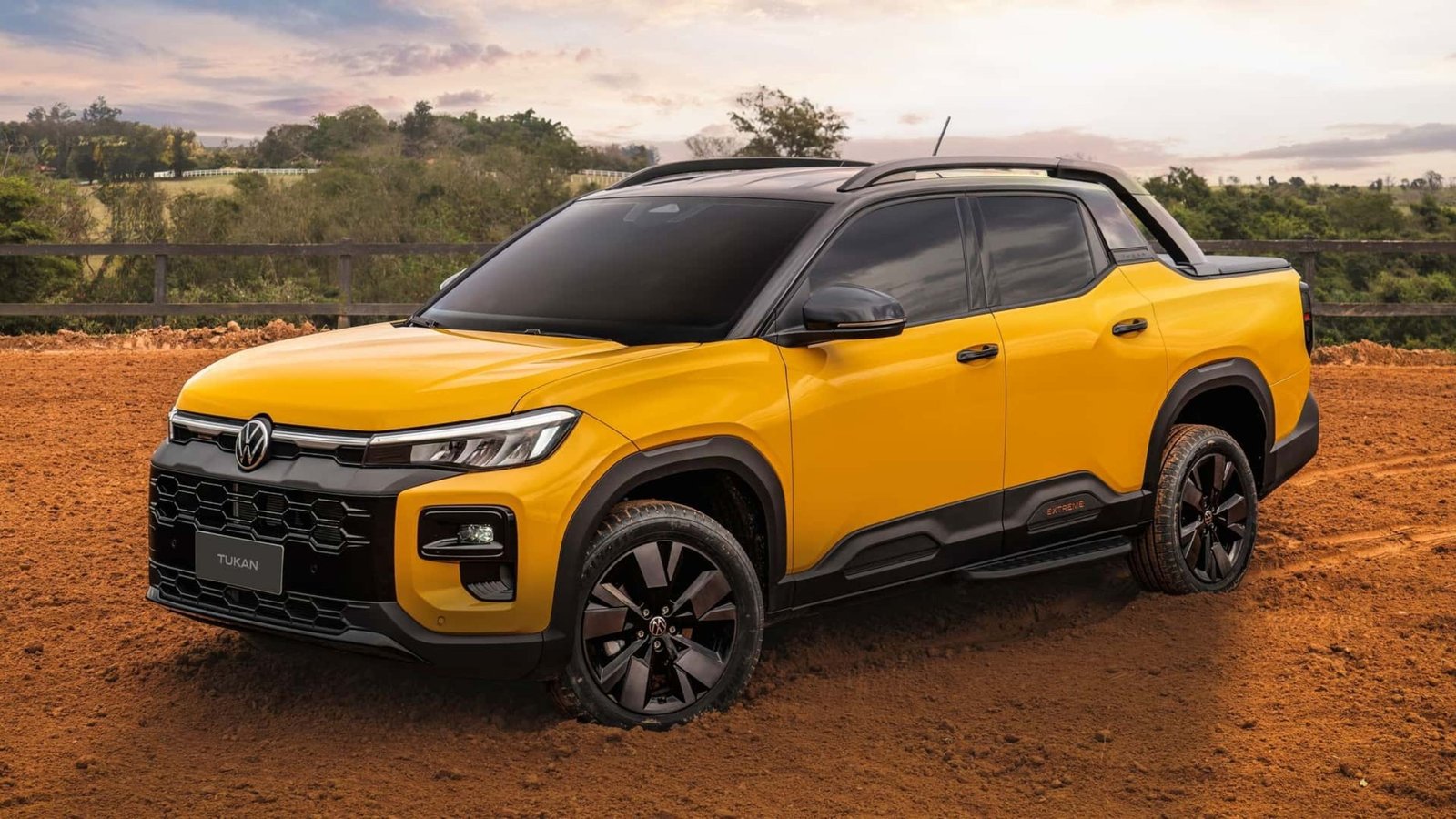
Volkswagen is taking another shot at the rapidly growing compact pickup segment, and its latest truck could give the Ford Maverick some serious competition — at least in markets where the new model is sold.
Called the Volkswagen Tukan, the compact pickup is being developed specifically for Brazil, with production expected to begin ahead of sales in the first half of 2027. While details remain limited, the new truck already stands out for its small dimensions, practical design and choice of single- and dual-cab configurations.
For American buyers, however, there is an important catch: the Tukan is not currently planned for the US market.
Volkswagen Tukan: A compact pickup with a clear target
Volkswagen already has experience with pickup trucks in South America. The company sells the long-running Saveiro compact pickup and the larger Amarok.
The Tukan takes the concept in a different direction, targeting the growing market for smaller lifestyle and work-oriented trucks.
That puts it in the same general conversation as the Ford Maverick, which has helped establish the compact pickup as a compelling alternative to larger, more expensive trucks.
The Tukan could potentially stand out by offering something the Maverick does not: both single-cab and dual-cab body configurations.
A single-cab version could appeal particularly to small businesses and customers who want an affordable vehicle primarily for carrying equipment, tools and other loads.
Built in Brazil, with local parts
The Tukan is being fully designed and developed in Brazil, where Volkswagen also plans to manufacture it.
According to the information available, as much as 76% of the vehicle’s components could be locally sourced. That reflects the truck’s strong focus on the Brazilian market and Volkswagen’s broader plans to expand its presence across South America.
The company is reportedly planning major investments in the region, including the introduction of numerous new models in the coming years.
The Tukan uses Volkswagen’s MQB platform
Underneath the compact pickup is Volkswagen’s MQB platform, a flexible architecture already used across several vehicles from the automaker.
The platform has been associated with cars and SUVs including the Volkswagen Golf, Tiguan and Atlas.
The Tukan would become the first production pickup to use this architecture.
Interestingly, Volkswagen has experimented with MQB-based pickup concepts before. The Tanoak concept, unveiled in 2018, was developed with the US market in mind but never entered production.
The Tukan, meanwhile, is taking a much more realistic route, with Brazil firmly at the centre of its development and manufacturing strategy.
Why does the Tukan use leaf springs?
One of the more interesting engineering choices is at the rear suspension.
Rather than using the coil-spring setup commonly associated with Volkswagen’s MQB vehicles, the Tukan is expected to use leaf springs at the rear.
That choice makes sense for a pickup designed to carry loads. Leaf springs have long been used in trucks because of their ability to handle heavier cargo.
The trade-off is ride comfort. With little or no weight in the cargo bed, a leaf-spring suspension can result in a firmer and less comfortable ride.
For buyers who see their pickup primarily as a work vehicle, however, that compromise could be worthwhile.
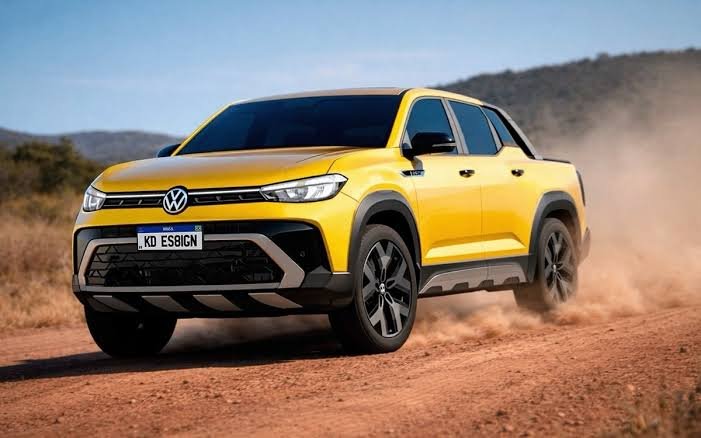
What could power the Volkswagen Tukan?
Volkswagen has not yet revealed the complete powertrain lineup.
One expected option is a turbocharged 1.5-litre four-cylinder engine.
There is also speculation that Volkswagen could use its turbocharged 1.4-litre engine, which is already produced in Brazil and used in vehicles such as the T-Cross.
The lack of confirmed specifications means performance, fuel economy and towing figures remain unknown for now.
A design that looks surprisingly familiar
The Tukan’s exterior design is arguably one of its most interesting elements.
The rugged styling, body cladding and prominent yellow finish of the flagship Extreme version evoke memories of the Subaru Baja, the unconventional pickup that appeared in the early 2000s.
There is one major difference, though.
Unlike the Baja, the Tukan is expected to give buyers a choice between single-cab and dual-cab layouts, potentially broadening its appeal.
Volkswagen has not yet revealed the cabin design, so the interior remains one of the biggest unanswered questions surrounding the truck.
Could the Tukan ever come to America?
This is where things become complicated.
Although the compact pickup could theoretically be an interesting rival to the Ford Maverick, bringing the Tukan to the United States would involve major challenges.
The truck is being developed for Brazil, and trade-related costs could make importing it into the US difficult. The well-known Chicken Tax, which imposes a 25% tariff on imported light trucks, is another major hurdle.
As things stand, American buyers should not expect to see the Tukan at Volkswagen dealerships anytime soon.
That could change in the future, especially as Volkswagen continues to rethink its strategy for the US market.
Volkswagen’s bigger pickup ambitions
The Tukan is arriving at an interesting moment for Volkswagen.
The company is investing heavily across the Americas as it attempts to expand beyond its traditional strengths. In South America, Volkswagen has announced plans for billions of dollars in investment and a large number of new models through 2028.
In the United States, meanwhile, the Volkswagen Group is developing the rugged Scout Motors brand, which is focused on trucks and SUVs.
Reports have also suggested that Volkswagen could eventually approve a pickup specifically for the US market, alongside a larger SUV positioned above the Atlas.
That means the Tukan may not be the truck American Volkswagen fans ultimately get — but it could be an important sign of where the company’s global pickup strategy is heading.
For now, the little Brazilian-built pickup has one clear mission: take on the compact truck market with a practical, flexible design that puts the Ford Maverick firmly in its sights.
Automobile
Nearly 3 Million Teslas Recalled in China Over Hidden Door Handles: Safety Fix Revealed After Crash Concerns
Tesla is recalling around 2.98 million China-made vehicles over concerns that concealed door handles could be difficult to operate during emergencies, with a software update and warning labels planned.

A design feature once seen as a symbol of modern electric vehicles is now at the centre of a major safety recall in China. Tesla is recalling nearly 3 million China-made vehicles because their hidden door handles could become difficult to identify or operate in certain emergency situations.
The recall forms part of a much wider action involving more than 4 million vehicles from several automakers, including Chinese manufacturers XPeng, Xiaomi and Geely.
The concern is particularly serious in situations where a vehicle’s low-voltage electrical system stops functioning after a severe collision.
Why are Tesla’s hidden door handles under scrutiny?
Tesla’s concealed door handles have become one of the company’s most recognisable design features. However, the minimalist approach can create a problem when occupants need to leave a vehicle quickly.
According to the recall information, some Tesla models have door handles whose colour is similar to the surrounding interior trim, making them harder to identify and operate.
The company said that in an extreme situation, such as a major crash that causes a failure of the vehicle’s low-voltage system, occupants could struggle to open the doors quickly.
That could potentially delay evacuation and also make it harder for rescuers outside the vehicle to gain access.
Which Tesla models are affected?
The recall covers certain China-made examples of several Tesla models, including:
- Tesla Model 3
- Tesla Model Y
- Tesla Model S
- Tesla Model X
The source material states that approximately 2.98 million Chinese-made Teslas are included in the recall.
Tesla plans to address the issue through a combination of a physical warning and a software-based measure.
What will Tesla do to fix the problem?
Affected vehicles will receive warning labels inside the vehicle to make the door-release mechanism easier to identify.
Tesla will also introduce a software update designed to automatically lower the vehicle’s windows following a collision.
The intention is to provide another way for occupants to exit the vehicle if conventional door operation becomes difficult following a crash.
However, automotive consultant Tu Le of Sino Auto Insights described the measures as more of a temporary solution than a permanent answer to the underlying design concern.

FILE PHOTO: Tesla China-made Model 3 vehicles are seen during a delivery event at its factory in Shanghai, China January 7, 2020. REUTERS/Aly Song
Hidden handles have become an industry-wide issue
The controversy isn’t limited to Tesla.
Hidden and flush-fitting door handles became increasingly popular among electric vehicle manufacturers because they contribute to a cleaner, more aerodynamic exterior design.
The style became particularly influential after Tesla introduced its Model S sedan, with other manufacturers subsequently adopting similar designs.
Chinese brands including XPeng, Xiaomi and Geely are also involved in the broader recall action.
The issue gained further attention following two fatal crashes in China involving Xiaomi electric vehicles, where power failures were suspected of making it difficult to open the doors.
The source material does not establish that the door-handle design was the sole cause of those fatalities, but the incidents have intensified scrutiny of emergency door-release systems.
China is preparing tougher rules
China has already moved towards stricter regulations surrounding hidden door handles.
Authorities announced a ban on certain hidden door-handle designs in February. Under rules scheduled to take effect from January 1, 2027, new cars sold in China will be required to have a mechanical release on both the inside and outside of the doors.
The regulatory change could force manufacturers to rethink one of the design trends that has become increasingly common across modern EVs.
For automakers, the challenge will be balancing sleek styling and aerodynamic efficiency with a simple question: Can someone get out of the car immediately when the electronics fail?
Tesla’s door handles have faced scrutiny before
This is not the first time Tesla’s door handles have attracted regulatory attention.
The company’s door-handle systems have previously been examined by US safety regulators following reports that some handles stopped functioning and allegedly left children trapped inside vehicles.
In July, the National Highway Traffic Safety Administration (NHTSA) also suggested developing a new formal safety standard covering door-release systems across the automotive industry.
The latest Chinese recall could therefore become part of a broader international debate about how emergency exits should work in increasingly software-dependent vehicles.
A design trend now facing a safety test
For years, flush and hidden door handles have represented the futuristic image of the modern EV. They look clean, reduce visual clutter and fit the minimalist design language adopted by several manufacturers.
But the latest recall highlights a less glamorous side of that design philosophy.
When everything is working normally, a hidden handle may look elegant. In a serious crash, however, the priority is very different.
The Chinese recall could push manufacturers towards a new generation of door systems that retain modern styling while ensuring that emergency mechanical releases remain easy to find, easy to understand and available even when the vehicle loses electrical power.
For Tesla and other EV makers, that could prove to be one design trend that needs a rethink.
Automobile
2027 Rivian R2 Stuns in 117°F Heat: This Electric SUV Kept Launching at Full Speed Without Breaking a Sweat
The 2027 Rivian R2 Performance delivered blistering acceleration and remarkable consistency during repeated high-temperature testing, proving that extreme heat is no obstacle for the new electric SUV.
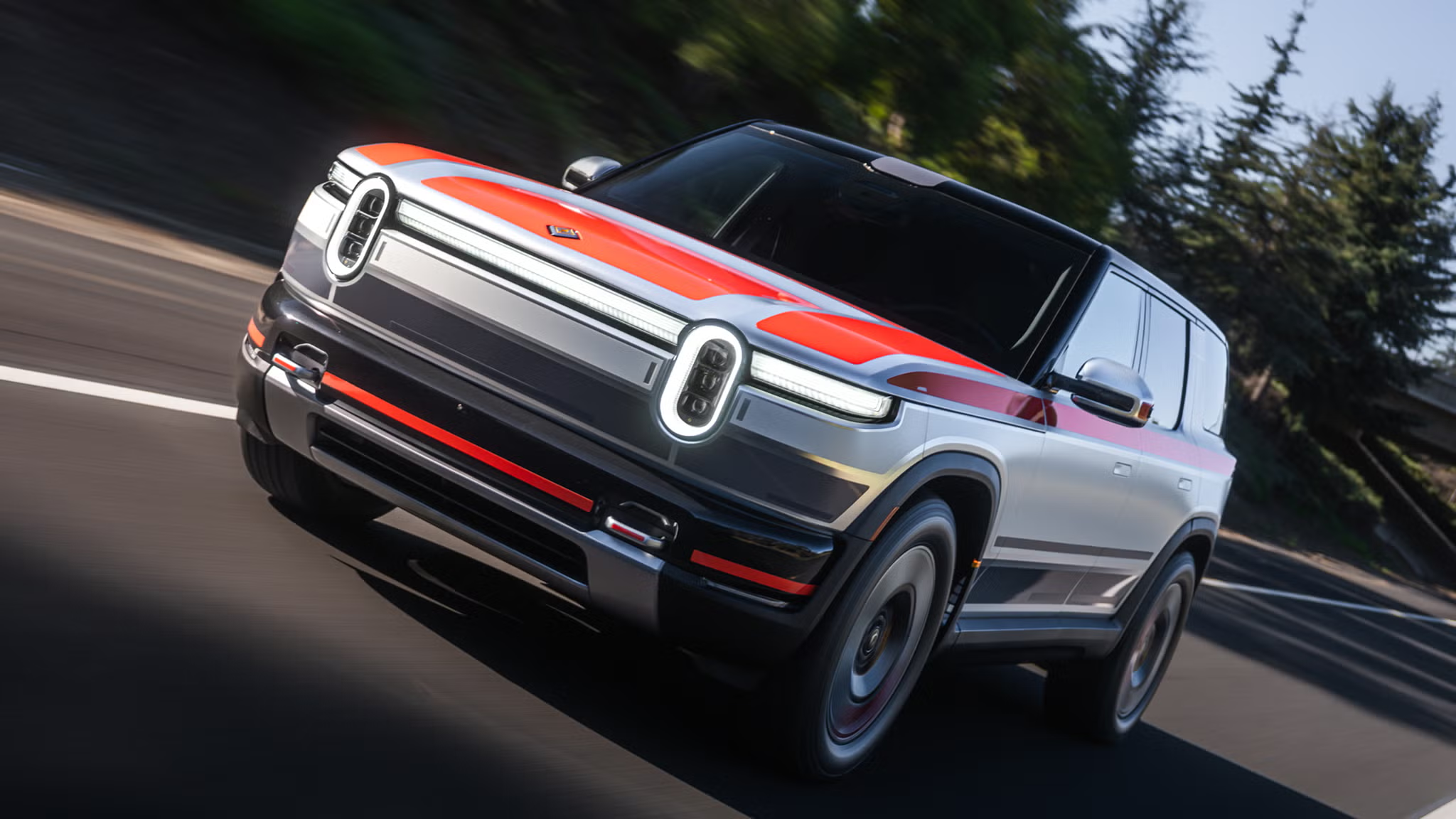
2027 Rivian R2 Delivers Supercar-Like Acceleration Even in Desert Heat
The upcoming Rivian R2 Performance is shaping up to be one of the most exciting electric SUVs on the horizon. Fresh acceleration testing has revealed that the all-electric SUV maintains impressive performance even after multiple launch-control runs in scorching desert temperatures.
Tested in the Mojave Desert, where the outside temperature climbed to a blistering 117°F (47°C), the 2027 Rivian R2 consistently delivered rapid acceleration with virtually no signs of performance degradation.
Lightning-Fast Performance
Equipped with a dual-motor all-wheel-drive setup, the Rivian R2 Performance produces an impressive 656 horsepower and 609 lb-ft of torque.
During testing, the electric SUV sprinted from 0 to 60 mph in just 3.4 seconds, placing it among the quickest electric SUVs in its segment.
Quarter-mile performance was equally impressive, with the R2 completing the run in:
- 0–60 mph: 3.4 seconds
- Quarter mile: 11.6 seconds at 128.6 mph
Rather than delivering a sudden jolt, the SUV’s acceleration was described as smooth and relentless, providing continuous power throughout the run.

Launch Control Designed for Performance
Preparing the R2 for launch is straightforward. Drivers simply activate Sport Mode, disable traction and stability control, and engage Launch Control through the infotainment system.
One playful touch comes from Rivian’s animated character Gary, who appears on the display with wind-blown hair while launch mode is activated.
Once both pedals are pressed and the brake is released, the R2 unleashes its full electric performance almost instantly.
How the Rivian R2 Compares Against Its Rivals
The latest performance figures put the Rivian R2 in direct competition with some of the fastest electric SUVs currently available.
| Vehicle | 0–60 mph | Quarter Mile |
|---|---|---|
| 2027 Rivian R2 Performance | 3.4 sec | 11.6 sec @ 128.6 mph |
| Tesla Model Y Performance (2026) | 3.3 sec | 11.8 sec @ 122.3 mph |
| Ford Mustang Mach-E GT (2023) | 3.6 sec | 12.4 sec @ 103.8 mph |
While the Tesla edges ahead by a tenth of a second in the 0–60 mph sprint, the Rivian posts a faster quarter-mile time and significantly higher trap speed, highlighting its strong power delivery at higher speeds.
Consistency Is the Real Story
Raw speed is only part of the equation for an electric performance vehicle. Sustaining that performance repeatedly can be far more challenging, especially under extreme weather conditions.
During six consecutive launch-control tests, the Rivian R2 recorded an astonishing 0.08-second variation between runs.
Such consistency is particularly noteworthy considering the vehicle was tested under one of the harshest environments for battery-powered vehicles.
To ensure maximum performance, testers also switched off the air conditioning during every acceleration run, allowing the SUV to utilize its full available power.
Electric Motors Provide Their Own Soundtrack
Unlike several modern performance EVs that generate artificial engine sounds through speakers, the Rivian R2 keeps things authentic.
Instead of digital sound effects, occupants hear the natural high-pitched whir of the dual electric motors working under full load, creating an experience many EV enthusiasts are likely to appreciate.
A Strong Statement Ahead of Launch
The latest testing reinforces Rivian’s ambitions in the rapidly growing electric SUV market. Beyond outright speed, the R2 demonstrates the kind of thermal management and performance consistency that buyers increasingly expect from next-generation EVs.
If these early figures translate into production models, the 2027 Rivian R2 Performance could emerge as one of the most capable electric SUVs available, offering sports-car acceleration while maintaining dependable performance even in some of the hottest conditions imaginable.

Cubs Cruise Past Diamondbacks 7-0 as Conforto and Kelly Go Back-to-Back: Gausman Delivers a Statement Start

Cal Raleigh Explodes for 3 Home Runs as Mariners Crush Phillies 9-2: ‘Hard to Fathom’ Night in Seattle

NBC4 Anchor Joseph Olmo Announces Exit After Nearly a Decade: “I’ve Got Just One More Story for You”

Taylor Swift Looks Back at Her Country Roots: “I Want to Honor Them More and More”

Target Apologizes and Pulls Halloween Costume After Backlash: “We Know We Got This Wrong”

1-Iran Issues Dire Warning to Israel and Defies Trump on Nukes: “We’re Ready to Strike Deep Inside”

Sen. Elizabeth Warren Calls It a ‘Cesspool of Corruption’ — Here’s Why Senators Are Now Fighting Back Against the DOJ’s Live Nation Deal That Left Every Fan Betrayed…

Donald Trump’s net worth reveals the fortune behind the former US President and business mogul

“Tomás Rodríguez Net Worth 2025: Panama’s Gold Cup Goal‑Machine’s Surprising Fortune Revealed”

“She Never Made It Out…” Albany House Fire Claims Woman’s Life as Family Pleads for Help to Bring Her Home

Miss Jamaica Suffers Terrifying Fall Off Miss Universe Stage; Rushed to Hospital on Stretcher in Viral Video

Moana Live-Action Teaser Sparks Outrage as Fans Call Disney’s Move a ‘Clear Money Grab’ — What Went Wrong?

Ryan Gosling’s Project Hail Mary Trailer Stuns Fans with a Mysterious Alien Ally and a Mission That Could Save Earth

Apple delays Jessica Chastain thriller The Savant about domestic extremism after recent US violence

Avatar 3, Fire and Ash trailer reveals Jake Sully’s family facing terrifying new Na’vi enemies with deadly fire powers
-

 Entertainment1 week ago
‘Reacher’ Star Alan Ritchson Sparks Debate With Bold Remarks on Epstein Files Controversy
-

 Entertainment1 week ago
Disney+ Officially Orders ‘Afterlife With Archie’ Series From ‘Riverdale’ Creators
-

 Entertainment1 week ago
Michael J. Fox Confirms ‘Shrinking’ Return, Says Acting “Prolonged My Life” Amid Parkinson’s Battle
-

 Entertainment4 days ago
Ben Folds Says Trump-Era Kennedy Center Changes Led to His Exit
-

 Entertainment1 week ago
Apple TV+ One Tony Away From Historic EGOT Achievement With Schmigadoon!
-

 Entertainment1 week ago
Locarno to Honor James Gray With Career Leopard: Why the Festival Calls Him ‘The Last Great Novelist of American Cinema’…
-

 Entertainment1 week ago
‘It’s Become a Tradition’: Kevin Feige Reveals Adam Driver Has Turned Down Multiple Marvel Roles…
-

 Entertainment4 days ago
Jennifer Aniston Joins Peter Dinklage in Olivia Wilde’s ‘Naughty’… Universal’s Unconventional Santa Movie Already Has Hollywood Talking