
Motorsports
Pfaff Motorsports Does It Again at VIR: Lamborghini Takes GTD PRO Glory as Winward Mercedes Seals Third Straight Win
Andrea Caldarelli and Sandy Mitchell delivered back-to-back GTD PRO victories, while Philip Ellis and Russell Ward completed a remarkable comeback with their third consecutive GTD triumph.


ALTON, Virginia — The Michelin GT Challenge at VIR produced another memorable weekend in the IMSA WeatherTech SportsCar Championship, with Pfaff Motorsports and Winward Racing taking the spotlight.
Andrea Caldarelli and Sandy Mitchell drove the No. 9 Pfaff Lamborghini Temerario GT3 to its second consecutive GTD PRO victory, continuing the momentum that began at Road America earlier this month.
The victory was particularly impressive because Caldarelli and Mitchell controlled virtually the entire 2-hour, 40-minute race. Caldarelli started from pole before handing the Lamborghini over to Mitchell, with the No. 9 car maintaining the lead through its pit stops.
Lamborghini continues its VIR success
The latest victory also brought another significant milestone for Lamborghini Squadra Corse.
Lamborghini had previously won GTD races at VIR in 2016 and 2017. The 2026 result, however, marked the manufacturer’s first WeatherTech Championship victory at the circuit since 2017.
The No. 9 Temerario GT3 has now become one of the most talked-about cars in the GTD PRO field. After working through development challenges earlier in the season, Pfaff Motorsports and Lamborghini have found a winning formula at precisely the right time.
Ford Racing completes the podium
Ford Racing enjoyed a strong weekend as well.
Ben Barker and Dennis Olsen finished second in the No. 64 Ford Mustang GT3.
Their teammates Frederic Vervisch and Christopher Mies completed the GTD PRO podium in the No. 65 Ford.
The result has also tightened the championship battle, with Caldarelli and Mitchell moving firmly into title contention with only two races remaining.
Winward Racing steals the GTD spotlight
While Pfaff dominated GTD PRO, the GTD class produced its biggest drama during the closing stages.
Philip Ellis made a late-race move on Tom Gamble with just minutes remaining, putting the No. 57 Mercedes-AMG GT3 into the lead.
Gamble attempted to fight back at Turn 4, but contact followed and Race Control eventually handed the Heart of Racing driver a drive-through penalty for responsibility for the incident.
That opened the door for Ellis and teammate Russell Ward to claim their third consecutive GTD victory.

From 300 points behind to championship leaders
Winward Racing’s turnaround has been one of the biggest stories of the season.
The team had been 300 points behind following Watkins Glen International. After three straight wins, Ellis and Ward have now moved to the top of the GTD championship standings, holding a 36-point advantage.
That transformation has completely changed the championship picture heading into the final stages of the season.
Turner Motorsport and Inception Racing complete GTD podium
Robby Foley and Patrick Gallagher finished second in the No. 96 Turner Motorsport BMW M4 GT3 EVO.
Third place went to Frederik Schandorff and Brendan Iribe in the No. 70 Inception Racing Ferrari 296 GT3 EVO.
Eduardo “Dudu” Barrichello and Gamble finished fourth for Heart of Racing Team, while Danny Formal and Trent Hindman completed the top five for Wayne Taylor Racing.
Two championship battles, one crucial weekend
The VIR weekend has left both GT classes with plenty to fight for.
For Pfaff Motorsports, the consecutive victories of Caldarelli and Mitchell have transformed the No. 9 Lamborghini into a genuine GTD PRO title contender. Meanwhile, Winward Racing’s incredible three-race winning streak has put Ellis and Ward in control of the GTD championship.
With just two races left, the pressure is now firmly on the championship contenders.


Motorsports
Honda’s New F1 Engine Looked Like a Setback at Zandvoort — But Fernando Alonso’s 2.5-Second Clue Tells a Different Story
Aston Martin’s Dutch GP sprint qualifying disaster raised questions about Honda’s upgraded Spec 2 power unit, but Fernando Alonso’s rear-wing failure may have hidden the engine’s real potential.

The first appearance of Honda’s upgraded Spec 2 Formula 1 power unit at the Dutch Grand Prix did not exactly go according to plan. On the timing sheets, the upgrade looked almost invisible as both Aston Martin drivers were eliminated in SQ1.
But the numbers tell a more complicated story.
Aston Martin arrived at Zandvoort hoping to build on the encouraging pace it had shown at the Hungaroring. Instead, Lance Stroll finished 19th while Fernando Alonso was classified 22nd and last after his opening run went badly wrong.
For a team hoping to understand the benefits of Honda’s more powerful engine specification, it was hardly the clean debut anyone wanted.
Alonso’s radio message raised an early alarm
Things looked particularly worrying for Fernando Alonso after his first attempt.
The two-time world champion reported heavy vibrations on the straights over team radio, suggesting that one of Honda’s previous reliability concerns may have returned.
“Huge vibrations on the straights. And not from the tyres, eh….”
At that stage, it would have been easy to assume that the much-anticipated Spec 2 power unit had failed to deliver.
But the real explanation turned out to be elsewhere.
The rear wing problem changed everything
The biggest issue with Alonso’s car was not the Honda engine.
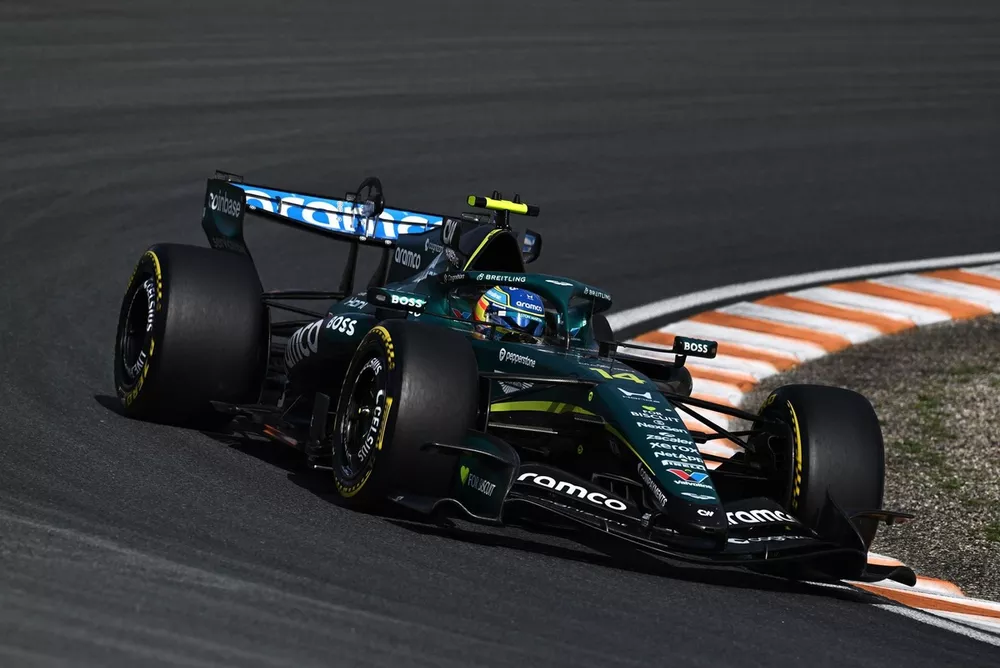
His active rear wing had failed, leaving the aerodynamic system stuck in its corner configuration while the car was travelling down the straights.
That created a serious drag penalty.
Instead of opening for the straights and allowing Alonso to build maximum speed, the rear wing remained closed. The result was a substantial loss of top speed and additional battery consumption.
The impact was dramatic.
On the run towards Turn 1, Alonso was around 20km/h slower than he had been on his best practice lap. By the time he reached the apex, the deficit had grown to approximately 2.3 seconds.
Another two-tenths were lost between Turns 10 and 11, where Alonso was around 15km/h slower.
Put those losses together and the picture changes considerably.
Could Alonso have made SQ2?
Based on the estimated time lost through the rear-wing failure, removing roughly 2.5 seconds from Alonso’s qualifying lap would have put him somewhere around the 1m13.5s mark.
That would have been comfortably competitive enough to escape SQ1.
In other words, the result on the timing screen did not necessarily represent the performance of the upgraded Honda power unit.
That is the important distinction.
Honda Racing Corporation still has to prove that the extra performance from its Spec 2 engine translates into genuine lap-time gains, but Alonso’s troubled run cannot be used as a straightforward verdict on the upgrade.
Stroll’s result remains the bigger question
There is, however, one uncomfortable detail for Honda.
Unlike Alonso, Lance Stroll did not suffer from the same rear-wing problem, yet he also failed to progress beyond SQ1.
Stroll finished 19th and was around six-tenths away from the cutoff for SQ2.
That means Aston Martin still had a genuine pace problem, even if Alonso’s result can largely be explained by the aerodynamic failure.
It also suggests that the Spec 2 engine’s additional power may not immediately translate into a dramatic improvement in overall lap time.
Formula 1 performance is rarely about one component working in isolation. Power-unit gains need to work alongside aerodynamics, tyre preparation, energy deployment and the overall car balance.
Honda’s Spec 2 upgrade needs a cleaner test
The Dutch Grand Prix sprint qualifying session therefore offered a misleading first impression of Honda’s upgraded engine.
Alonso’s failure made the situation look considerably worse than it might actually have been, while Stroll’s result showed that Aston Martin still has work to do.
For Honda, the real test will come when the power unit can be evaluated during a clean qualifying session without an aerodynamic failure distorting the numbers.
The Spec 2 engine may indeed provide the extra performance Aston Martin has been hoping for. But Zandvoort did not provide the perfect conditions to demonstrate it.
And that is perhaps the most intriguing part of this story: Honda’s new engine may have looked disappointing on paper, while the biggest problem affecting its headline result was sitting at the back of Alonso’s car rather than underneath it.
Motorsports
Carl Fogarty returns to racing spotlight as Team Principal in shocking new British Superbikes venture
The legendary four-time WorldSBK champion teams up with Lee Khouri and Ducati for a 2026 British Superbike Championship debut that’s already turning heads.

Carl Fogarty is strapping back into the heart of motorcycle racing — but this time, from the pit wall.
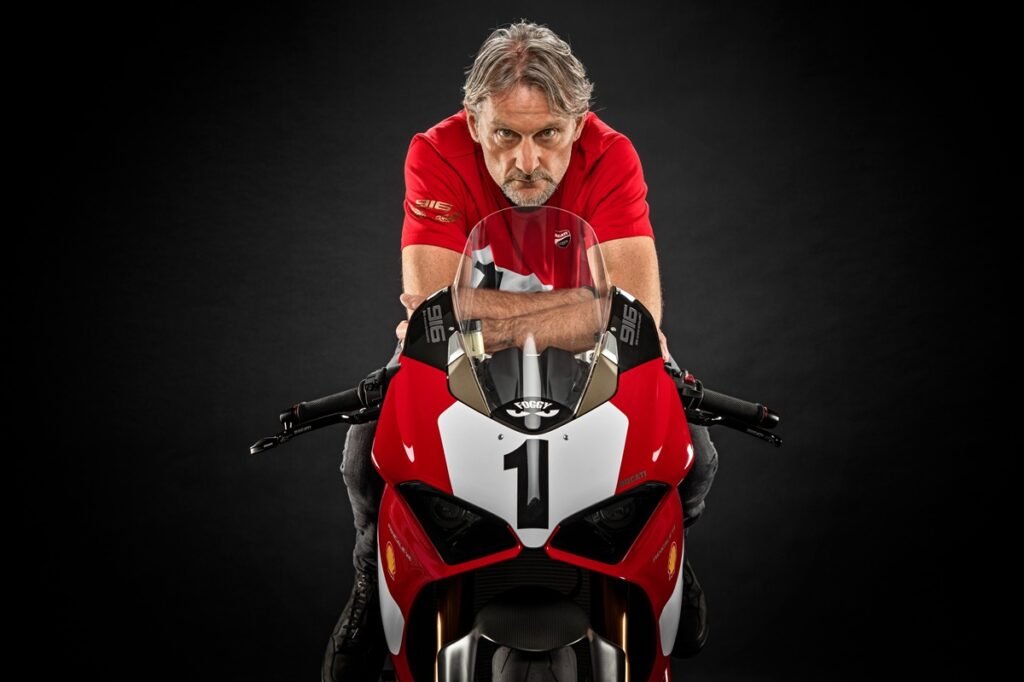
The legendary four-time World Superbike Champion and Ducati icon will take on a brand-new role as Team Principal of Superbike Advocates Racing, a fresh entrant into the British Superbike Championship (BSB) for the 2026 season. Backed by Ducati, this new team is already gaining momentum and intrigue before a single tire has hit the BSB tarmac.
“Carl Fogarty is a number one name in the motorcycle racing world,” said Lee Khouri, founder of Supercar Advocates and co-Team Principal for the project. “With what he achieved with Ducati and WorldSBK, what better fit than having myself and Foggy leading this together?”
Table of Contents
A Passion Project Fueled by Champions
The announcement marks a stunning return for Fogarty (Wikipedia), one of the most decorated racers in motorcycle racing history, whose bond with Ducati remains legendary. His remarkable achievements — including 59 wins and four world titles — transformed Ducati’s image in the late 1990s and solidified his status as one of racing’s all-time greats.
This new team isn’t just about nostalgia; it’s about building something with ambition, experience, and pedigree.
The technical side of the operation will be handled by Alan Jackson, a familiar and respected figure in British racing circles, who will serve as Team Manager. The race effort will operate under the Jackson Racing Team umbrella, known for its history of grooming talent and achieving results on both national and international stages.
“We’re taking this seriously, step by step,” Khouri explained. “We’ll start with one rider in our debut year, feel things out, build the chemistry, and ensure everything operates smoothly before expanding.”

Ducati’s Stamp of Approval
The Ducati brand’s alignment with this team further elevates its profile. With Fogarty’s historical link to the Italian manufacturer — and his legendary battles in WorldSBK — the partnership feels less like a business deal and more like a full-circle moment.
The team plans to announce its first rider and unveil its livery and full plans before the end of 2025, building anticipation for the 2026 grid.
“We’re aiming to have an official team launch by the end of the year,” Khouri said. “Watch this space.”
How Did This All Come Together?
According to Khouri, the idea was born across continents and fuelled by passion. While Supercar Advocates had already dipped its wheels into Australian Superbike circuits — and even eyed WorldSBK wildcard entries — it was a conversation with UK-based logistics head Neil Young that kicked things into motion.
“Neil suggested with all the bikes and infrastructure we have, why not start something in British Superbikes?” Khouri recalled. “And that got me excited. He spoke with Foggy, who was up for it, and before long, we were shaking hands and planning the whole thing.”

A Fogarty Renaissance?
For fans, the biggest headline isn’t just the formation of a new team — it’s Carl Fogarty’s return to the paddock in a leadership role. While he has maintained a media presence and held influence in racing circles post-retirement, this marks his most significant re-entry into the competitive racing scene.
It could also signal a broader trend of racing legends returning in executive or advisory capacities, bringing a deep understanding of rider psychology, race craft, and the politics of the paddock.
“We’ve put it into motion, we’re deep into it all, everything’s established and we are good to go,” Khouri concluded.
And with Ducati power, a proven race team, and Foggy at the helm, Superbike Advocates Racing isn’t just a new entry. It’s a statement of intent.
For more Update http://www.dailyglobaldiary.com
Motorsports
This Racing Scandal Has Left Fans Furious and Drivers Helpless at WEC 2025
Toyota is silenced, Ferrari is slowed, and fans are calling it a farce — here’s why Balance of Performance has pushed the World Endurance Championship to the brink.


After the dust settled on the 2025 World Endurance Championship (WEC) São Paulo 6 Hours, what remained wasn’t just a finish line — it was a storm of controversy. A quiet but telling remark from the Alpine Endurance Team summed it up:

“We told ourselves if we could fight Ferrari and Toyota in the second half of the season, we’d done well… We didn’t expect that fight to be for 15th place on the grid.”
This single line reflects a wider crisis that’s turning the WEC — once a showcase of elite engineering and raw racing — into a heavily manipulated performance dictated by one contentious system: Balance of Performance (BoP).
The BoP Controversy: When Parity Becomes a Prison
Let’s address the elephant in the pit lane. BoP is no longer a technicality — it’s the villain of the season. Introduced to level the playing field between manufacturers with differing car architectures and budgets, BoP adjusts weight, power, and other metrics to theoretically ensure tight competition. It was supposed to democratize racing, not destroy it.
But at Interlagos, where Cadillac emerged victorious, something felt off. Not just to the fans — to the teams themselves.
📌 Learn more about the controversial Balance of Performance concept that’s shaping global motorsport.
Table of Contents
Toyota, Ferrari, Alpine: The Victims of Their Own Excellence?
Let’s be honest — Toyota and Ferrari have built dominant machines. The Toyota GR010 Hybrid and the Ferrari 499P are marvels. Yet, instead of rewarding their innovation, BoP shackled them. Both were lapped before a third of the São Paulo 6 Hours was complete.
📌 The Toyota GR010 Hybrid — reigning world champion, now powerless to fight due to BoP.
📌 The Ferrari 499P, which dominated early 2025, was turned into an also-ran by a rulebook, not a rival.
“From the exit of the last corner to the start-finish line, we lose five to six tenths,” said David Floury, Technical Director of Toyota Gazoo Racing.
“Raceability? Forget about it. This is survival mode.”

That’s not racing. That’s regulation warfare.
A Broken Formula: Fans and Teams United in Frustration
What was supposed to be the golden era of endurance racing — with eight manufacturers competing and potentially 12 by 2027 — now feels like a scripted act.
Instead of edge-of-the-seat action, Interlagos was a parade, with no safety cars, no drama, and no real contest. The #12 Cadillac only lost the lead briefly during pit stops and penalties. Without intervention, there was no shake-up, just a slow procession dictated by… spreadsheets.
Even Peugeot’s Olivier Jansonnie admitted it bluntly:
“It was just the intrinsic pace of the car that made the difference.”
And that “intrinsic pace” was entirely determined by BoP.
A Regulation That’s Gagging the Sport
If you’re wondering why more drivers and teams aren’t speaking up — it’s because they can’t.
Article 6.2.1 of the WEC Sporting Regulations bars competitors and teams from publicly commenting on BoP decisions.
This gag order has created a culture of passive frustration. But the whispers are getting louder.
BMW M Team WRT boss Vincent Vosse held back little:
“I’m proud of my team, but also sad, angry, and frustrated… Countless months go into just making it to the grid.”
Even Porsche’s vice president Thomas Laudenbach admitted after the Spa 6 Hours that
“There is a massive need for action outside our organisation.”
And perhaps most vocally, Toyota’s Floury made it clear that the manipulation is no longer subtle:
“When you receive the BoP table before the weekend, you already know what’s going to happen.”

Explore the legacy of Porsche Motorsport — now forced to settle for mid-pack results due to BoP.
How Did We Get Here?
BoP is not new. It exists in GT3, Super GT, and even rallying, but nowhere has its misuse felt more dramatic than in the WEC this year.
The manufacturer compensation formula — a data-driven algorithm to reassign advantages — was tweaked mid-season. At Interlagos, it only counted the last two races, instead of three. This change boosted Cadillac, who performed well in Qatar but suffered earlier in the season.
The same data game boosted Ferrari early in 2025, after its poor finish to 2024. So, the script isn’t even consistent.
In a sport where excellence should be celebrated, the FIA and Automobile Club de l’Ouest (ACO) are penalizing success. Instead of racing toward innovation, teams are now racing toward balance — a soul-crushing irony.
What Now?
The WEC is at a crossroads. If this continues, the series risks losing not just credibility, but fans, manufacturers, and the essence of competition itself.
It’s time to rewrite the rules — not the results.
“We urgently need to find a solution,” said Floury. “What we’ve proposed this year is not good for the sport.”
In 2025, we have the cast for a legendary saga — Cadillac, Ferrari, Toyota, Porsche, Peugeot, BMW, Alpine, and Lamborghini.
But if BoP keeps writing the plot, the story won’t be worth watching.

Shelley Fabares Dies at 82: ‘Johnny Angel’ Singer and ‘Coach’ Star Leaves Behind a Remarkable Hollywood Legacy

Anne Hathaway, Dakota Johnson and Josh Hartnett’s ‘Verity’ Just Dropped Its First Teaser — And It’s Darker Than Anyone Was Prepared For…

Pfaff Motorsports Does It Again at VIR: Lamborghini Takes GTD PRO Glory as Winward Mercedes Seals Third Straight Win

Washington, D.C. Enacts the Nation’s Toughest Anti-Scalping Ticket Resale Law

‘I Will Find You’ Climbs To No. 1 On Streaming Charts: Thriller Series Becomes Viewers’ Latest Obsession…

1-Iran Issues Dire Warning to Israel and Defies Trump on Nukes: “We’re Ready to Strike Deep Inside”

Sen. Elizabeth Warren Calls It a ‘Cesspool of Corruption’ — Here’s Why Senators Are Now Fighting Back Against the DOJ’s Live Nation Deal That Left Every Fan Betrayed…

Donald Trump’s net worth reveals the fortune behind the former US President and business mogul

“Tomás Rodríguez Net Worth 2025: Panama’s Gold Cup Goal‑Machine’s Surprising Fortune Revealed”

“She Never Made It Out…” Albany House Fire Claims Woman’s Life as Family Pleads for Help to Bring Her Home

Miss Jamaica Suffers Terrifying Fall Off Miss Universe Stage; Rushed to Hospital on Stretcher in Viral Video

Moana Live-Action Teaser Sparks Outrage as Fans Call Disney’s Move a ‘Clear Money Grab’ — What Went Wrong?

Ryan Gosling’s Project Hail Mary Trailer Stuns Fans with a Mysterious Alien Ally and a Mission That Could Save Earth

Apple delays Jessica Chastain thriller The Savant about domestic extremism after recent US violence

Avatar 3, Fire and Ash trailer reveals Jake Sully’s family facing terrifying new Na’vi enemies with deadly fire powers
-

 Entertainment7 days ago
Disney+ Officially Orders ‘Afterlife With Archie’ Series From ‘Riverdale’ Creators
-

 Entertainment7 days ago
‘Reacher’ Star Alan Ritchson Sparks Debate With Bold Remarks on Epstein Files Controversy
-

 Entertainment7 days ago
Michael J. Fox Confirms ‘Shrinking’ Return, Says Acting “Prolonged My Life” Amid Parkinson’s Battle
-

 Entertainment7 days ago
Apple TV+ One Tony Away From Historic EGOT Achievement With Schmigadoon!
-

 Entertainment7 days ago
Locarno to Honor James Gray With Career Leopard: Why the Festival Calls Him ‘The Last Great Novelist of American Cinema’…
-

 Entertainment7 days ago
‘It’s Become a Tradition’: Kevin Feige Reveals Adam Driver Has Turned Down Multiple Marvel Roles…
-

 Entertainment3 days ago
Hunter Biden’s Media Comeback Takes an Unexpected Turn With Candid New Interview
-

 Sports2 days ago
Nick Chubb Retires at 30: Browns Star Walks Away After Injuries Cut Short a Career That Looked Hall of Fame-Bound