
India
‘Indoor air is most important’: US woman reveals how she protects her family from Delhi pollution
Living in India for four years, American expat Kristen Fischer explains why multiple air purifiers are her survival tool during Delhi’s worst pollution months

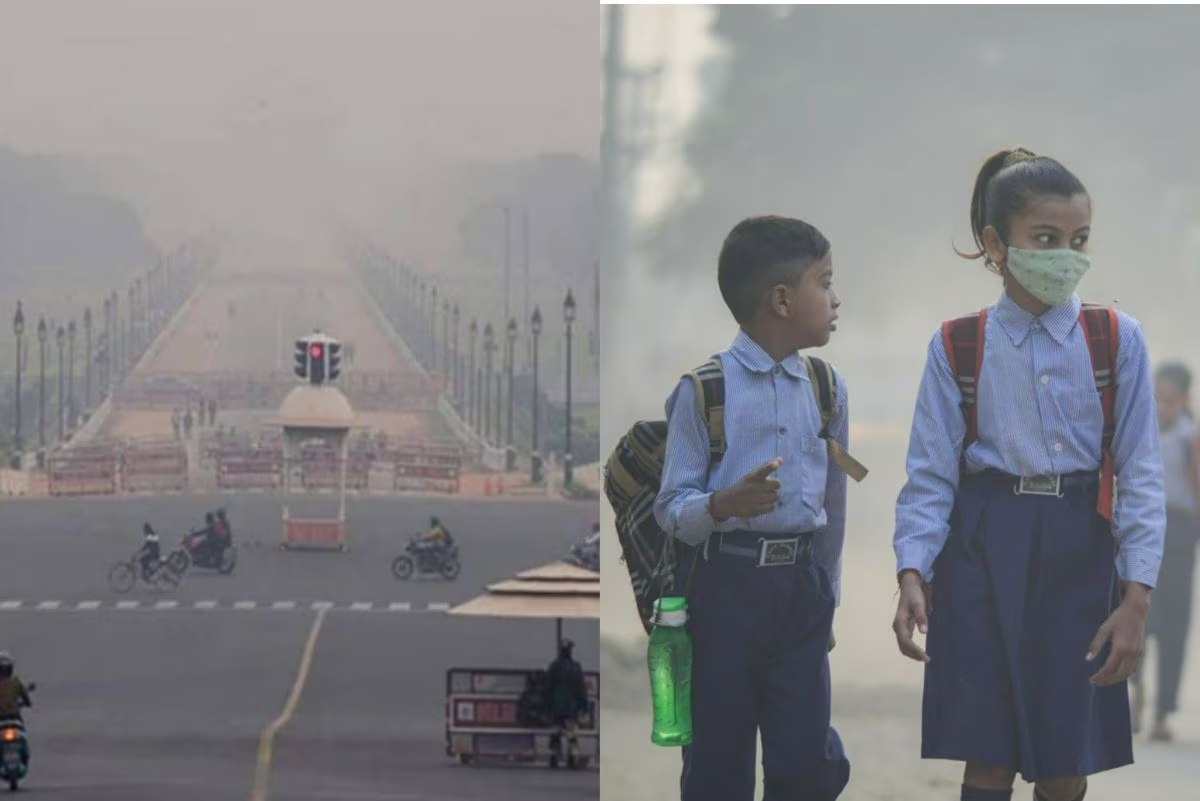
As Delhi grapples with its annual winter pollution crisis, an American woman living in the city has shared a practical and eye-opening account of how she keeps her family safe — by focusing on what she can control indoors.
US expat Kristen Fischer, who has been living in India for the past four years, recently took to Instagram to answer a question she says she is asked repeatedly: How do you manage Delhi’s air quality?
In her video, Fischer demonstrated the stark difference between outdoor and indoor air. Using an air quality monitor, she showed an outdoor AQI reading of 210, a level considered unhealthy. Moments later, she carried the same device inside her home, where the AQI dropped sharply to 48.
Explaining the reason, she said plainly, “This is because we have air purifiers in our house.”
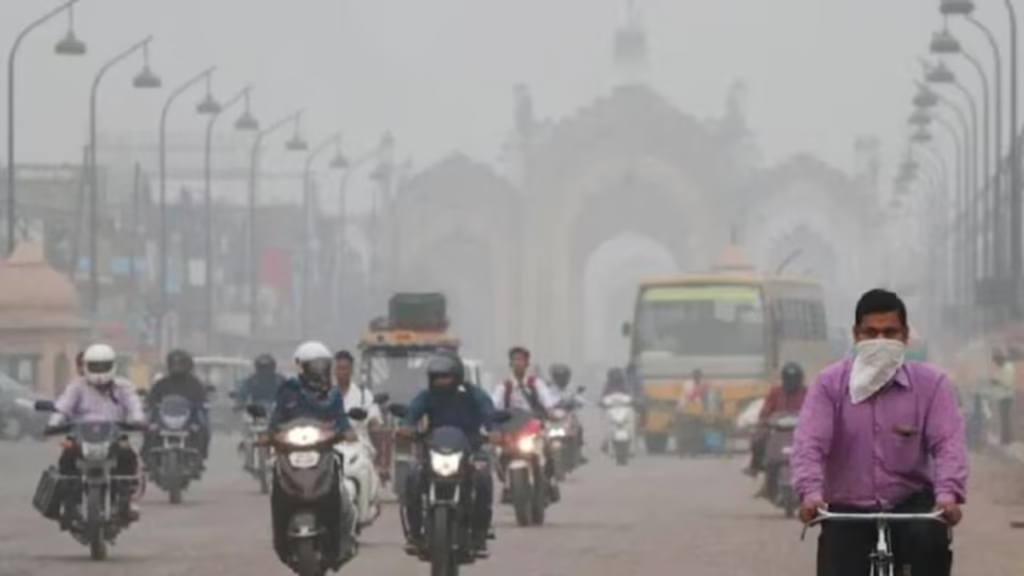
‘We run four air purifiers full time’
Fischer revealed that her family runs four air purifiers continuously, a decision she says has made a significant difference to their daily lives.
“They allow our indoor air quality to stay nice and clean,” she explained, adding that while Delhi’s outdoor pollution can be severe, especially in winter, controlling indoor air offers real protection.
“So we use air purifiers and our indoor air quality is usually quite good. This is how we handle the hard, high-pollution months living here in Delhi,” she said.
Her message struck a chord with many residents who struggle through the city’s smog season every year.
‘Indoor air is the most important’
In a detailed caption accompanying the post, Fischer emphasised that indoor air quality should be the top priority, especially for families.
“Indoor air is the most important,” she wrote. “While I can’t change the condition outside, I can maintain a safe indoor environment for my family.”
She noted that during winter months, her family spends more time indoors and ensures they sleep in what she described as “controlled and clean air.” According to Fischer, limiting outdoor exposure and keeping time outside brief helps manage the health risks associated with pollution.
Delhi pollution is seasonal, she says
Fischer also highlighted an important nuance often overlooked in discussions about Delhi’s air crisis — that the worst pollution is seasonal, not year-round.
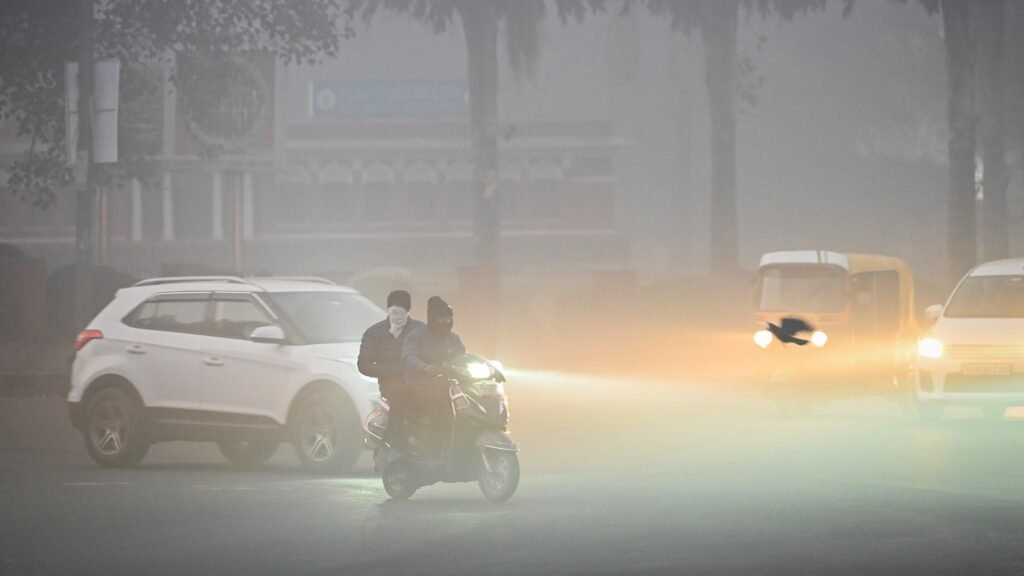
“The high pollution months are not all year,” she wrote. “Mostly just November through January is bad. Otherwise, the air is much better in Delhi the rest of the year.”
However, she was quick to caution that clean indoor air does not happen automatically.
“Indoor air quality is not always good like this,” Fischer explained. “It is only due to the air purifiers we run full time. Without those, the indoor air can be just as bad, or even worse than outside.”
She ended her post with a simple reminder to followers:
“Stay safe out there all.”
As Delhi residents continue to search for ways to cope with hazardous air during winter, Fischer’s experience adds a practical, lived-in perspective — one that underscores the importance of indoor air management when outdoor conditions remain beyond individual control.


World
Brace Yourself! A Powerful Western Disturbance Is Coming — Rain, Hailstorms and Cold Blast to Hit North and West India This Week
Weather experts warn of ‘U-shaped’ jet streams driving a severe Western Disturbance across Northwest India from April 3, bringing hailstorms, heavy rain, and a sharp drop in temperatures — while summer may only begin after April 15.

Just when parts of India were beginning to feel the first hints of summer, nature has thrown a curveball. A powerful Western Disturbance is heading toward Northwest India, and weather experts say it could bring some of the most intense unseasonal weather the region has seen this season — with hailstorms, heavy rain, thunderstorms, and a significant drop in temperatures all on the cards.
What Is Coming and When?
According to the India Meteorological Department (IMD), the active Western Disturbance is expected to hit peak activity on April 3 and 4, with isolated heavy rainfall over the Kashmir Valley on April 3 being the primary concern. The wet spell — accompanied by thunderstorms and lightning — is likely to extend across central parts of the country until April 6, with day temperatures expected to remain near normal to below normal across Northwest India during this period.
This comes on the heels of an already colder-than-usual stretch for many parts of the country, where rare weather systems have been bringing unseasonal rain since the second half of March — including a previous Western Disturbance that brought down temperatures sharply across Delhi-NCR and northwest India.
‘Powerful’ System With ‘U-Shaped’ Jet Streams
Climate scientist Dr. Pradeep, who is widely followed on X for his weather updates, described this as a “powerful Severe Western Disturbance” that will track critically close to the Gujarat and Rajasthan border. He warned it would “trigger a significant spell of extreme weather across multiple states.”
According to Dr. Pradeep, the primary impact zones will be:
- Jammu & Kashmir and Ladakh — Intense rain and heavy mountain snowfall
- Punjab and Rajasthan — Widespread thunderstorms and gusty winds
- Gujarat — Significant impact along northern borders and interior regions
Beyond these primary zones, isolated to scattered thunderstorms are also expected across north and central Haryana, Delhi NCR, West Uttar Pradesh, Himachal Pradesh, and West Madhya Pradesh. Even central and south Maharashtra (Vidarbha and Marathwada), Chhattisgarh, Telangana, parts of Odisha and West Bengal may see rain and thunderstorm activity as the system moves through.
Amateur weatherman Navdeep Dahiya added on X that the “jet streams [are] perfectly U-Shaped for the upcoming Western Disturbance starting from 3rd April.” He called it “too much weather action for the third driest month of the year” and noted that the entire north and west India would face cold front rains, hailstorms, and storms, while states in central and southern India brace for intense evening storms.
Wheat Farmers on Alert

The timing of this weather system has raised serious concern among farmers — particularly wheat growers in Haryana and Punjab, where rain and hailstorms already lashed several places on Tuesday. The wheat crop in these states is ripe and ready for harvesting, making it extremely vulnerable to hailstorm damage at this critical stage.
Why Is This Happening?
Mahesh Palawat, Vice President of Climate and Meteorology at Skymet Weather, explained that when the westerly jet stream becomes particularly wavy, it tends to increase the impact of Western Disturbances at lower latitudes. He linked this unusual waviness to the rapid warming of the Arctic — a climate pattern that is becoming more common and more disruptive.
Western Disturbances are moisture-laden cyclonic systems that originate over the Mediterranean Sea and travel eastward along the jet stream — the narrow, high-altitude band of fast-moving winds that circles the globe at around 30,000 feet. This March alone saw eight Western Disturbances against a normal of five to six, and at least three more are expected through mid-April. January and February, by contrast, had seen far fewer than usual, resulting in low snowfall across the Himalayas.
When Will Summer Finally Arrive?
Despite all this cold and stormy weather, Dr. Pradeep and Navdeep Dahiya both agree that summer will eventually make its presence felt — but not before mid-April. Dahiya specifically said the delayed summer season is “likely to pick up after April 15 only.”
So if you were hoping to put away your jacket and pull out the summer clothes, you might want to wait just a little longer. For now, the forecast is clear — it is going to get cold, stormy, and dramatic before it gets warm.
World
Three Indian Breakfasts Just Ranked Among the World’s Top 50 and the Internet is Drooling
Taste Atlas crowns Misal Pav, Paratha, and Chole Bhature as global breakfast icons in its 2025 rankings


In a delicious moment of global recognition, three beloved Indian breakfast dishes have found their rightful place on the international culinary map. According to Taste Atlas’ newly released Top 50 Best Breakfasts in the World list for June 2025, Misal Pav, Paratha, and Chole Bhature have emerged as standout staples — proving yet again that India doesn’t just wake up, it wakes up hungry and flavorful.
Ranked at an impressive No. 18, Misal Pav from Maharashtra stole hearts with its vibrant palette and fiery punch. Known for its crunchy base, spicy gravy, and riot of toppings, this local hero isn’t just food — it’s an experience. As Taste Atlas poetically described it, a true misal is “mandatory to be spicy,” and must look like “a work of art” splashed in shades of red, brown, orange, and green. It’s a dish that defines both breakfast and boldness.
Coming in at No. 23, Paratha — the North Indian flatbread that rules breakfast tables — is more than just a category. Stuffed or plain, drenched in butter or paired with curd, this humble yet hearty delight has countless regional variations, from Punjab to Bihar. Whether it’s the aloo paratha of dhabas or the paneer-stuffed version served at posh brunch spots, its versatility and soul-satisfying flavor have earned it global fans.
And at No. 32, Delhi’s street food royalty Chole Bhature got its well-deserved spotlight. This indulgent pairing of fluffy, deep-fried bread with spicy chickpea curry is not just a breakfast—it’s a feast. While it originated in North India, Chole Bhature has transcended state borders and can now be found sizzling in every corner of the country.
What’s even more exciting is that this isn’t India’s first global food triumph. Earlier, Indian classics like Shrikhand, Palak Paneer, and Nihari also found mention in the extended list of Taste Atlas’ rankings, which features dishes beyond the top 50. It’s clear that the world is waking up to the irresistible flavors of Indian cuisine—one bite at a time.
From the streets of Delhi to the kitchens of Maharashtra, these dishes reflect the deep connection between food, culture, and community. They’re more than breakfast — they’re edible heritage. And thanks to platforms like Taste Atlas, the world is finally giving Indian breakfasts the recognition they’ve long deserved.
India
India Unveils the World’s Highest Rail Bridge Built as Part of a $5.5 Billion Mega Project and It’s an Engineering Marvel You Must See
Indian Prime Minister Narendra Modi inaugurates the breathtaking Chenab Bridge and Vande Bharat trains in Jammu and Kashmir, reshaping connectivity and national pride.

In what is being hailed as a monumental moment for Indian infrastructure, the Indian Prime Minister inaugurated the world’s highest railway bridge, the Chenab Bridge, during a landmark visit to Jammu and Kashmir. Standing taller than the Eiffel Tower and part of a massive ₹46,000 crore (approx. $5.5 billion USD) infrastructure push, this achievement isn’t just a symbol of engineering brilliance—it’s a transformative leap in connecting the Kashmir Valley to the rest of India.
The Chenab Bridge, rising 359 meters (1,177 feet) above the riverbed and stretching over 1.3 kilometers, is now officially the tallest railway bridge in the world. Built at a cost of ₹1,486 crore, it took over two decades of precise planning, international collaboration, and sheer grit to complete. Its height exceeds the Eiffel Tower by 35 meters and it’s designed to withstand wind speeds of up to 266 km/h, major earthquakes, and extreme Himalayan weather conditions.
During the inauguration, Indian PM Narendra Modi called the project a dream come true and emphasized its strategic and economic importance: “Now, Kashmir’s apples will reach bigger markets at lower costs and on time.” He also flagged off two Vande Bharat Express trains connecting Katra to Srinagar, reducing travel time significantly and promising smooth connectivity even during the harshest winters.
This project is part of the 272-km-long Udhampur-Srinagar-Baramulla Rail Link (USBRL), a game-changer for the region that includes 36 tunnels, 943 bridges, and India’s first cable-stayed railway bridge at Anji Khad. The rail line now offers all-weather, seamless connectivity through mountainous terrain, allowing not only faster transportation of goods like Pashmina shawls and Kashmiri apples but also boosting tourism and pilgrim travel.
Modi’s visit to the region was his first since Operation Sindoor, a military response to a recent terror attack. It underlined the Indian government’s commitment to long-term peace and development in a historically conflict-prone region. The Prime Minister also took time to meet engineers and workers who had dedicated years of effort to the project’s success, praising their dedication in making what he called “one of India’s greatest civil-engineering achievements.”
Jammu and Kashmir Chief Minister Omar Abdullah also praised the efforts, stating that even the British during colonial rule couldn’t bring rail to Kashmir, but today, thanks to this effort, the region has entered a new era of modern connectivity. “What once felt like a distant dream has now become a living reality,” he said.
The new Vande Bharat Express trains are also packed with state-of-the-art features like silicon heating pads, bio-toilets, anti-spall protection, and an auto-draining mechanism that ensures uninterrupted service even in sub-zero temperatures. With this development, India not only strengthens its transport network but also showcases its growing capability to take on complex infrastructure challenges on a global scale.

How ‘Avengers: Endgame’ Returned to Cinemas and Reclaimed Box Office Glory

Tom Cruise’s ‘Digger’ Faces a Tough Opening: Could ‘Verity’ Take the Lead?

‘Verity’ Could Outopen ‘Digger’: Why Tom Cruise Faces a Tough Contest

‘Endgame’ Returns to No. 1 ‘Avatar’ Loses Its Box Office Throne

Mark Zuckerberg Faces a New Hollywood Reckoning Why Aaron Sorkin’s Film Hits Closer to Home

1-Iran Issues Dire Warning to Israel and Defies Trump on Nukes: “We’re Ready to Strike Deep Inside”

Sen. Elizabeth Warren Calls It a ‘Cesspool of Corruption’ — Here’s Why Senators Are Now Fighting Back Against the DOJ’s Live Nation Deal That Left Every Fan Betrayed…

Gucci bets on Demna to revive fading glamour as Milan fashion week opens with bold film surprise

Donald Trump’s net worth reveals the fortune behind the former US President and business mogul

“Tomás Rodríguez Net Worth 2025: Panama’s Gold Cup Goal‑Machine’s Surprising Fortune Revealed”

Miss Jamaica Suffers Terrifying Fall Off Miss Universe Stage; Rushed to Hospital on Stretcher in Viral Video

Moana Live-Action Teaser Sparks Outrage as Fans Call Disney’s Move a ‘Clear Money Grab’ — What Went Wrong?

Ryan Gosling’s Project Hail Mary Trailer Stuns Fans with a Mysterious Alien Ally and a Mission That Could Save Earth

Apple delays Jessica Chastain thriller The Savant about domestic extremism after recent US violence

Avatar 3, Fire and Ash trailer reveals Jake Sully’s family facing terrifying new Na’vi enemies with deadly fire powers
-

 Entertainment1 week ago
The Story Behind ‘Artificial’: Amazon’s Withdrawal and Neon’s Rescue
-

 Entertainment1 week ago
Why Neon Stepped In to Save Andrew Garfield’s ‘Artificial’
-

 Entertainment1 week ago
Aaron Sorkin Takes On Mark Zuckerberg Again in ‘The Social Reckoning’
-

 Entertainment7 days ago
‘Avatar’ Overtaken: ‘Avengers: Endgame’ Is Back on Top
-

 Entertainment1 week ago
Meet David Ellison’s Leadership Picks for Hollywood’s New Giant
-

 Entertainment1 week ago
Years after ‘The Social Network,’ Zuckerberg’s story offers Hollywood a different set of questions about power.
-

 Entertainment1 week ago
The Social Reckoning: Sorkin Takes On Mark Zuckerberg
-

 Entertainment1 week ago
With Neon on board, Guadagnino’s film moves forward as its makers speak out about the freedom to tell challenging stories.