
Entertainment
David Ellison Names Paramount–Warner Bros. Leadership Team: Who’s in Charge?
David Ellison’s executive lineup brings together familiar names from Paramount and Warner Bros. to lead the combined business.


The next chapter for Paramount and Warner Bros. Discovery now has a leadership roster — and several familiar names will be taking on considerably bigger responsibilities.
David Ellison and Ynon Kreiz announced their senior executive team on October 5, ahead of the anticipated completion of Paramount’s acquisition of Warner Bros. Discovery. The combined company will be called Skydance, with executives from both businesses overseeing its film, television, streaming and news operations. The appointments are contingent on the transaction closing.
The approximately $110 billion deal is expected to close on October 6, according to TheWrap. The announcement offers a clearer picture of how Ellison intends to run the enlarged business: retain established creative leaders while placing them within a new corporate structure.
ALSO READ : Emmy Nominations Announcement Gets a Star Twist… Liza Colón-Zayas & Jeff Hiller Set to Reveal 2026 TV Nominees
Bigger responsibilities for film and streaming chiefs
Dana Goldberg and Josh Greenstein will become co-chairs of the Skydance Motion Picture Group, overseeing a film portfolio that brings together Paramount Pictures and Warner Bros..
Meanwhile, Casey Bloys will serve as co-chair and chief content officer of Skydance’s direct-to-consumer division. George Cheeks will hold the corresponding creative leadership position at Skydance TV.
JB Perrette will span both divisions as co-chair and chief business officer, pairing the content leaders with an executive responsible for the commercial side of television and streaming.
For audiences, these appointments matter because the executives will help shape what gets commissioned, produced and distributed. The announcement itself does not establish changes to subscription prices, release schedules or individual programmes.
CNN and CBS News keep separate leadership
One closely watched decision concerns the company’s newsrooms.
Mark Thompson will remain chairman and editor-in-chief of CNN Worldwide, while Bari Weiss stays editor-in-chief of CBS News. Both will report directly to Ellison and Kreiz.

Reuters reported that the arrangement addresses concerns about Weiss potentially overseeing CNN. Thompson also told employees that he expected to retain his existing editorial responsibilities. Questions remain about how the news operations will function within the combined business, including the practical authority of an editorial independence board agreed under an antitrust settlement.
DC leadership stays in place
For DC Studios, the announcement preserves the partnership of James Gunn and Peter Safran as co-chairmen.
At the corporate level, Ellison will concentrate on long-term strategy, creative direction and investment decisions. Kreiz will handle day-to-day management and integration, with Andy Gordon serving as president. Paramount said a fuller executive leadership list would follow after closing.
The roster provides continuity at several prominent brands. The harder work begins when those leaders must turn a combined organisation into a functioning business — balancing creative ambitions with the demands of integration.









Entertainment
With ‘Lanterns’ and ‘Man of Tomorrow’ ahead, Fillion teases fresh layers to DC’s most unpredictable Green Lantern.
From ‘Lanterns’ to ‘Man of Tomorrow’: Nathan Fillion Teases Guy Gardner’s Future

Nathan Fillion has offered fresh insight into Guy Gardner’s transformation from intergalactic peacekeeper to corporate-sponsored celebrity—and teased how Man of Tomorrow will take a different path from Superman.
Fillion’s bowl-cut Green Lantern first entered the new DC Universe as a member of the Justice Gang in Superman. He later appeared in Peacemaker before making the jump to HBO’s darker, detective-driven Lanterns.
Despite the dramatic differences between those projects, Fillion believes the character can remain consistent while adapting to each story’s atmosphere.
He compared the experience to spending one weekend in colourful Metropolis and another in shadowy Gotham. The individual would remain the same, he explained, but the two weekends would feel entirely different.
Guy Gardner turns superhero status into a business
In Lanterns, Guy is not merely a superhero. He has become a carefully packaged product supported by LordTech and its billionaire founder, Maxwell Lord.
ALSO READ : Cynthia Nixon’s Support Draws Attention as Christine Marinoni Secures NYC Education Post
The series drives that point home when John Stewart returns to Rushville and spots a promotional display featuring Guy advertising an energy drink. It is an image that immediately separates him from fellow Green Lanterns Hal Jordan and John Stewart.
Hal is too unpredictable to become a polished spokesman, while John treats the responsibilities of the ring far too seriously to turn himself into a corporate mascot. Guy, however, appears perfectly comfortable mixing heroism with advertising.
Fillion said Guy enjoys being recognised as someone special and believes marketing naturally accompanies that position. His financial ambitions also play a role: Guy dreams of opening his own bar, and achieving that goal requires money.
“For that, you need corporate sponsorship,” Fillion explained.
In other words, Guy does not see commercial partnerships as compromising his heroic identity. He considers branding another tool—one that can build his public profile while funding the future he wants.
Fillion described him as someone who understands both the superhero business and the actual business surrounding superheroes.
Rushville remains haunted by Hal and John’s decisions
Guy’s polished public image exists in stark contrast to the painful history surrounding the Green Lantern name.
A decade earlier, Hal Jordan and John Stewart became caught in the devastating Battle of Rushville.
Hal, played by Kyle Chandler, was desperate to prevent his younger partner from replacing him. His decisions helped bring an extraterrestrial confrontation directly into Rushville, placing both John and the town’s population in danger.
A disillusioned John, portrayed by Aaron Pierre, eventually took Hal’s ring before abandoning the very object he had spent years trying to earn. The destruction left Rushville’s residents deeply suspicious of Green Lanterns and permanently damaged the organisation’s public image.
When the Guardians selected Guy as Earth’s next Green Lantern, he inherited more than a powerful ring. He also inherited a reputation in need of repair.
That is where LordTech’s public-relations machine apparently became useful.

Was Guy’s Green Lantern beacon really an apology?
In Episode 6, titled “Bad Optics,” Guy installs a Green Lantern beacon in Rushville resembling Gotham’s famous Bat-Signal.
The symbol is presented as an attempt to rebuild trust following the destruction caused by his predecessors. Fillion believes Guy genuinely wanted the beacon, but he suspects the decision was also influenced by LordTech’s damage-control specialists.
The actor described it as the likely product of a team working to improve the Green Lantern brand rather than a purely personal act of compassion.
John eventually uses the beacon to summon Guy and asks him to obtain Hal’s decommissioned ring from the Guardians of the Universe. He believes the ring could help him investigate Hal’s death.
Guy initially resists, but John reminds him of an uncomfortable truth: Guy only received his current position because John rejected it ten years earlier.
According to Fillion, John deliberately pulls on that thread to secure Guy’s cooperation. By helping him retrieve the ring, Guy can consider the old debt repaid.
The relationship between the two men is therefore built on pride rather than friendship. They understand one another and share the rare experience of being selected by the Corps, but they do not truly regard themselves as colleagues.
‘Man of Tomorrow’ will explore Lex Luthor more deeply
Fillion will return as Guy Gardner in Man of Tomorrow, the 2027 follow-up to James Gunn’s Superman.
The actor stopped short of revealing specific plot details but explained the most important difference between the two films.
While Superman allowed audiences to understand who Clark Kent truly is, Fillion believes Man of Tomorrow will reveal considerably more about Lex Luthor.
“In this movie, I think we’ll learn more about who Lex Luthor is,” he said, adding that such an exploration is equally important.
The new film brings back David Corenswet as Superman and Nicholas Hoult as Lex Luthor. Rachel Brosnahan will also return as Lois Lane, alongside Fillion, Isabela Merced and Edi Gathegi.
The story is expected to place Superman and Luthor in an uneasy alliance against the highly intelligent alien threat Brainiac, played by Lars Eidinger. The film is scheduled to arrive in theatres on July 9, 2027.
Nathan Fillion and James Gunn’s trusted partnership continues
Fillion’s journey through the DCU is the latest chapter in his long creative relationship with writer-director James Gunn.
Their collaboration began with Slither in 2006 and has since expanded across approximately a dozen projects.
Fillion said Gunn remains fundamentally the same person he first worked with, despite the enormous expansion in the size and scope of his productions. He praised the filmmaker’s love of storytelling, ability to think on several creative levels and enthusiasm for his work.
That trust may explain why Guy Gardner has quietly become one of the connective figures holding Gunn’s developing DC Universe together.
He is arrogant, commercially ambitious and frequently difficult—but he is also fearless enough to wear the ring. In Fillion’s hands, those contradictions make Guy far more interesting than a conventional hero trying to do everything for the right reasons.
Entertainment
Alex Gibney’s ‘Musk’ Makes North American Premiere at TIFF
‘Stand Up and Resist’: Alex Gibney Sends Strong Message at ‘Musk’ Premiere

Oscar-winning filmmaker Alex Gibney brought his ambitious documentary Musk to North America on Monday evening, using its Toronto International Film Festival premiere to deliver a forceful message about the unchecked power of technology billionaires.
The documentary, which runs for approximately three hours and 45 minutes with a 10-minute intermission, examines the extraordinary rise and increasingly controversial influence of Elon Musk.
During the festival appearance, Gibney urged audiences to look beyond the mythology surrounding the billionaire and question how much power society has allowed technology executives to accumulate.
His message was direct: ordinary people must be prepared to “stand up and resist” when private wealth begins to exercise influence traditionally held by democratic institutions.
ALSO READ : Sen. Elizabeth Warren Calls It a ‘Cesspool of Corruption’ — Here’s Why Senators Are Now Fighting Back Against the DOJ’s Live Nation Deal That Left Every Fan Betrayed…
What does Alex Gibney’s ‘Musk’ explore?
Musk follows its subject from his childhood in South Africa and early years in Silicon Valley to his leadership roles at Tesla and SpaceX, as well as his turbulent acquisition of Twitter, which he later renamed X.
Rather than presenting a conventional biography, the documentary studies the construction of Musk’s public image—the visionary entrepreneur, space pioneer and self-described defender of free expression.
Gibney then examines the people, companies and political relationships hidden behind that carefully maintained persona.
The filmmaker said the documentary is ultimately about power: how it can corrupt, how it can expose a person’s character and how easily the public can surrender it to charismatic business leaders.
Musk was initially planned as a considerably shorter production. Gibney expanded its scope after Musk endorsed Donald Trump and became more deeply involved in American politics.
What began as a two-hour examination of an influential businessman eventually grew into a far broader investigation of wealth, government and technological control.
Documentary includes voices from Musk’s personal and professional life
Musk declined to participate directly in the production, despite what Gibney described as numerous formal attempts to contact him.
To build the portrait without direct access, the filmmakers interviewed people who had witnessed different stages of Musk’s personal and professional journey.
The participants include his former wife Justine Musk, his father Errol Musk, former Tesla chief executive and co-founder Martin Eberhard, technology journalist Kara Swisher and artificial-intelligence researcher Geoffrey Hinton.
The film also features Ashley St. Clair, who has publicly discussed her personal relationship with Musk.
Their interviews allow the documentary to approach its central figure from several directions rather than accepting the version of events presented through corporate publicity, social media or sympathetic biographies.
Gibney challenges the mythology of individual genius
During a question-and-answer session following the TIFF screening, an audience member asked Gibney whether he would prefer a world without Musk’s accomplishments.
The director challenged the wording of the question.
He argued that major companies such as Tesla and SpaceX were built by teams of engineers, executives and early founders whose contributions are frequently overshadowed by Musk’s personal brand.
Gibney acknowledged Musk’s ability to promote ambitious ideas and attract talent and investment. However, he questioned the popular belief that every breakthrough associated with his companies should automatically be treated as his personal invention.
The exchange reportedly drew applause from the Toronto audience and reflected one of the documentary’s larger themes: modern business culture often turns corporate leaders into near-mythical figures while thousands of employees disappear from the story.
Musk rejected the film without participating
Although Musk did not sit for an interview, he has not remained completely silent about the project.
After the documentary’s premiere at the Venice Film Festival, Musk criticised Gibney on X and dismissed the production as a “hit piece.” His attorney also sent a letter challenging the filmmakers’ approach and suggesting that Musk’s perspective had not been fairly represented.
Gibney disputed that account, saying his team repeatedly sought Musk’s participation but received no meaningful response during production.
The director also noted the contradiction of someone closely associated with free-speech arguments threatening legal action against a critical documentary.
The film uses an animated version of Musk, constructed from statements he has previously made in public. The unconventional device allows the documentary to create the impression of a conversation without fabricating new comments or claiming Musk participated.
From Venice to North American theatres
Musk received its world premiere at the Venice Film Festival before making its North American debut at TIFF.
The documentary was produced by Jigsaw Productions alongside Closer Media, Anonymous Content and Double Agent. It includes music by Daniel Pemberton and carries a running time of 225 minutes.
Distributor Bleecker Street moved its theatrical release forward amid growing interest in the documentary. It is scheduled to open in New York and Los Angeles on October 9, followed by a wider release.
For Gibney, however, the documentary is not intended to provide the final word on Musk. He hopes it will start a larger international conversation about who controls essential technology, public communications and political decision-making.
The director’s argument reaches beyond one billionaire. Musk may be the subject on screen, but the film’s real question is aimed at the audience: How much power should any private individual be allowed to hold—and what happens when the public finally decides to take some of it back?
Entertainment
‘Carrie’ Returns to Haunt a New Generation—but Is Eight Episodes Too Much?
Amazon’s adaptation revisits teenage isolation, religious terror and revenge through a longer narrative.

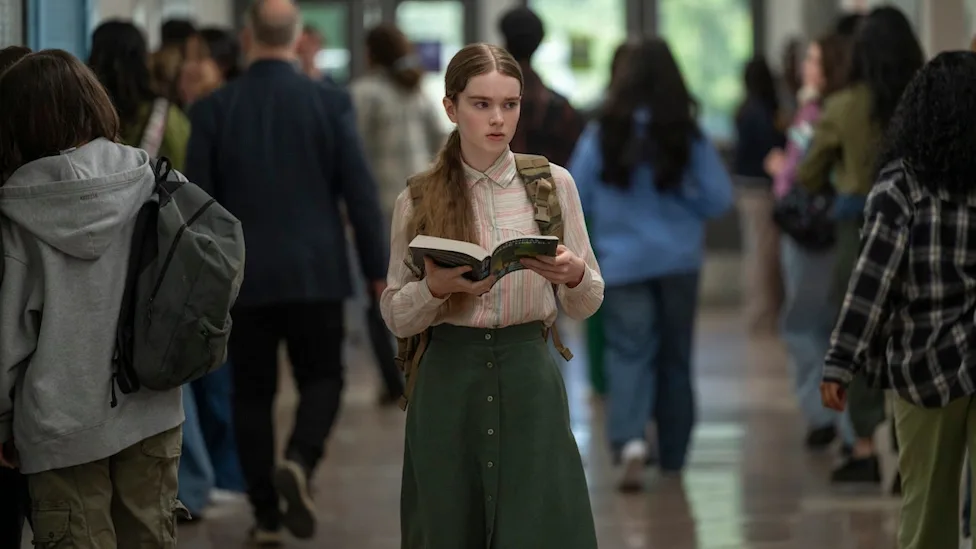
The frightening thing about Carrie has always been how much of its horror feels ordinary. Before the supernatural powers come the humiliation, the isolation and the adults who make a vulnerable teenager’s life unbearable.
Now, Mike Flanagan is bringing that story to Prime Video as an eight-episode series, scheduled to premiere on October 7, 2026. His adaptation revisits Stephen King’s 1974 novel with a contemporary setting and more room to explore the people surrounding its troubled protagonist.
The early critical discussion turns on a familiar problem for streaming adaptations: a longer story can offer greater depth, but does greater depth necessarily make it more compelling?
Summer H. Howell and Samantha Sloyan lead the new adaptation
Summer H. Howell plays Carrie White, the sheltered teenager whose telekinetic abilities emerge amid bullying and abuse. Samantha Sloyan portrays Margaret White, her controlling, religiously fanatical mother.
ALSO READ : Emmy Nominations Announcement Gets a Star Twist… Liza Colón-Zayas & Jeff Hiller Set to Reveal 2026 TV Nominees
The Daily Beast’s review praises the adaptation’s emotional approach, describing a Carrie who has more social confidence and a Margaret whose fears incorporate contemporary conspiracy thinking. It also highlights the use of a documentary-style framework to revisit the tragedy.
Those changes suggest an adaptation interested in the environment that produces Carrie’s suffering, as well as the suffering itself. The mother-daughter relationship remains central to that story: home offers Carrie another source of fear when she desperately needs protection.
The bullying follows Carrie onto her phone
One of the clearest updates involves social media harassment.
According to The Verge, an anonymous Instagram account becomes a tool for tormenting Carrie. The review argues that this digital dimension gives the familiar story renewed relevance.
The implication is unsettling. Cruelty that once depended on a school corridor or a crowded classroom can now travel further, gather an audience and remain visible long after the original incident.
For a story built around public humiliation, that is a meaningful change in setting rather than a merely cosmetic update.
More time means more possibilities—and more scrutiny
The longer format also gives supporting characters greater attention. The New York Post’s review welcomes the additional development of figures including Margaret White and Chris Hargensen, while noting that some new material could divide viewers.
The Hollywood Reporter’s review headline, meanwhile, acknowledges Flanagan’s ability to expand the classic while questioning whether expansion was necessary.
That distinction matters. Explaining more about a character can enrich a tragedy; it can also interrupt its momentum. An adaptation of Carrie must balance the desire to understand its world with the pressure of a story moving towards catastrophe.
There are reservations about the supernatural additions, too. The Verge questions a subplot connecting Carrie’s abilities to King’s wider fictional universe, arguing that it weakens her agency.
A familiar tragedy with a contemporary question
Flanagan arrives with substantial experience adapting King, including Gerald’s Game and Doctor Sleep. His latest project gives him a different challenge: finding fresh emotional territory in a story many viewers already know.
Early reviews offer reasons for interest, particularly the modern treatment of bullying and the expanded character work. They also leave a question hanging over the series: will eight episodes bring viewers closer to Carrie, or put more distance between them and the devastating simplicity of her story?

With ‘Lanterns’ and ‘Man of Tomorrow’ ahead, Fillion teases fresh layers to DC’s most unpredictable Green Lantern.

Alex Gibney’s ‘Musk’ Makes North American Premiere at TIFF

‘Carrie’ Returns to Haunt a New Generation—but Is Eight Episodes Too Much?

Is Tom Cruise’s Star Power Enough to Give ‘Digger’ a Winning Start?

David Ellison Names Paramount–Warner Bros. Leadership Team: Who’s in Charge?

1-Iran Issues Dire Warning to Israel and Defies Trump on Nukes: “We’re Ready to Strike Deep Inside”

Sen. Elizabeth Warren Calls It a ‘Cesspool of Corruption’ — Here’s Why Senators Are Now Fighting Back Against the DOJ’s Live Nation Deal That Left Every Fan Betrayed…

Gucci bets on Demna to revive fading glamour as Milan fashion week opens with bold film surprise

Donald Trump’s net worth reveals the fortune behind the former US President and business mogul

“Tomás Rodríguez Net Worth 2025: Panama’s Gold Cup Goal‑Machine’s Surprising Fortune Revealed”

Miss Jamaica Suffers Terrifying Fall Off Miss Universe Stage; Rushed to Hospital on Stretcher in Viral Video

Moana Live-Action Teaser Sparks Outrage as Fans Call Disney’s Move a ‘Clear Money Grab’ — What Went Wrong?

Ryan Gosling’s Project Hail Mary Trailer Stuns Fans with a Mysterious Alien Ally and a Mission That Could Save Earth

Apple delays Jessica Chastain thriller The Savant about domestic extremism after recent US violence

Avatar 3, Fire and Ash trailer reveals Jake Sully’s family facing terrifying new Na’vi enemies with deadly fire powers
-

 Entertainment1 week ago
Toronto Film Festival Picks ‘Being Heumann’ as Its Opener… Is Sian Heder About to Deliver Another Awards Season Sensation?
-
 Entertainment1 week ago
Anne Schedeen, ‘ALF’ Star and Beloved TV Mom, Dies at 77… Fans Remember Her Wit and Legacy
-

 Entertainment6 days ago
One Big Win for Taylor Swift, Seven for Madonna: Inside the 2026 VMAs
-

 Entertainment1 week ago
Emmy Rossum Says Her Shameless Role Followed Her Into Real-Life Dates
-

 Entertainment1 week ago
‘Resident Evil’ Star Austin Abrams Opens Up About the Film’s Daring Finale
-

 Entertainment1 week ago
‘Abbott Elementary’ and ‘Shrinking’ Dominate AAFCA TV Honors… But Two New Categories Are Stealing Attention
-
 Entertainment1 week ago
Dead by Daylight Film in the Works… Thordur Palsson to Direct Cult Horror Game Adaptation
-
 Entertainment1 week ago
Paul Verhoeven Warns Trump Over ‘Starship Troopers’-Inspired Space Force Uniforms: ‘They Should Be Aware…’