
U.S. News
Donald Trump Stuns the World: Orders Pentagon to ‘Immediately’ Resume U.S. Nuclear Weapons Testing After 33 Years
President Donald Trump’s sudden directive ends America’s 33-year testing freeze — citing China’s and Russia’s growing nuclear arsenals as justification.

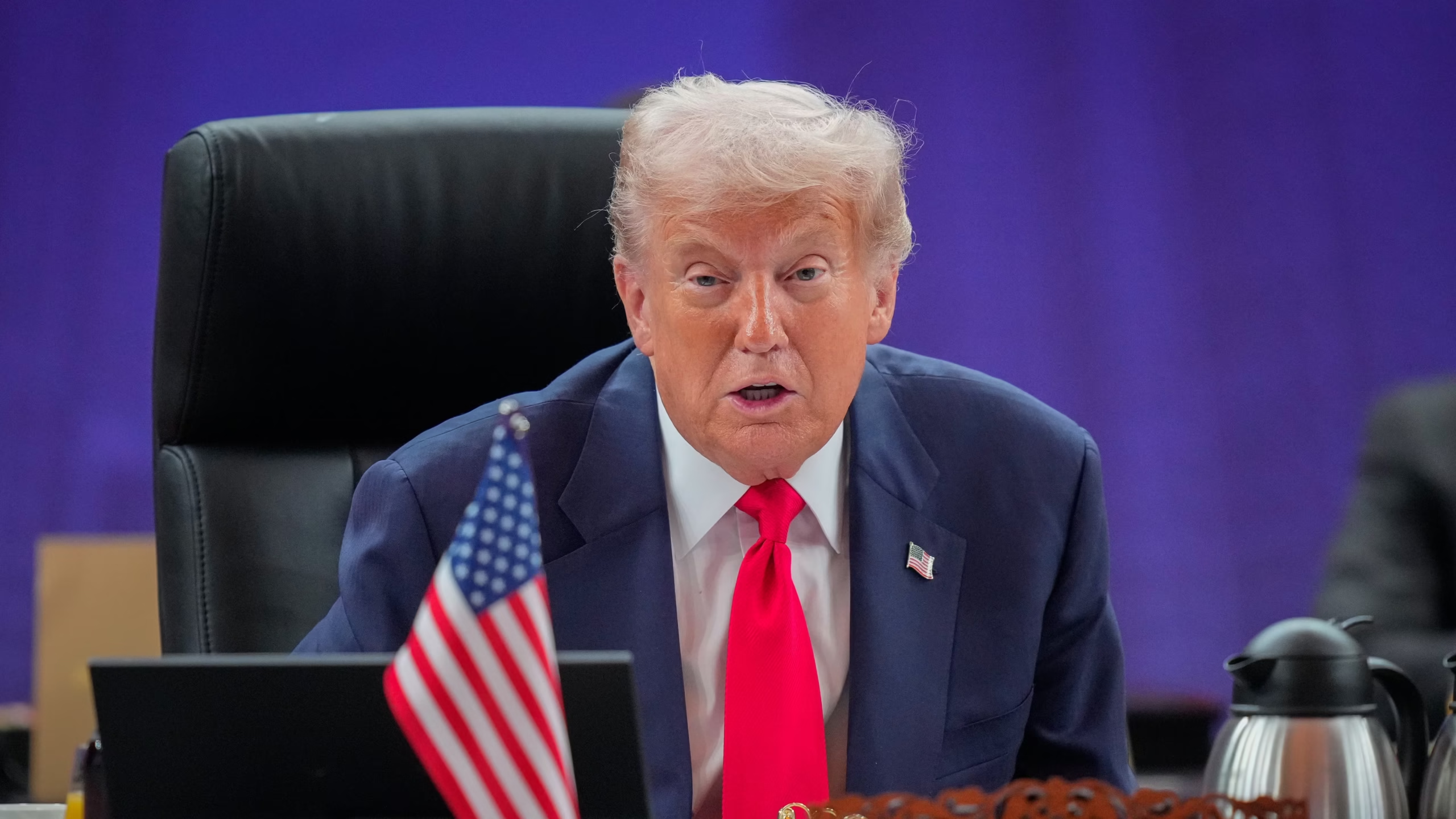
In a move that has shocked the international community, Donald Trump announced on October 29, 2025, that the United States will “immediately” resume nuclear weapons testing — effectively ending a 33-year moratorium on nuclear detonations.
The announcement, posted on his social media platform Truth Social, signals a new era of military assertiveness as global rivalries intensify.
“Because of other countries’ testing programs, I have instructed the Department of War to start testing our nuclear weapons on an equal basis. That process will begin immediately,”
wrote Trump in his online post.
The message came just hours before his meeting with Xi Jinping in Busan, South Korea — a summit that was already drawing international attention for its potential to reshape U.S.–China relations.
ALSO READ : Trump family linked American Bitcoin seals Nasdaq debut after merger with Gryphon shareholders say yes
A Dramatic Policy Reversal
Trump’s order ends a 33-year period of restraint that began under George H. W. Bush in 1992, when the U.S. halted nuclear explosive tests amid the Cold War thaw. The Comprehensive Nuclear Test Ban Treaty (CTBT) was later signed in 1996, but the U.S. Senate declined to ratify it — leaving the door technically open for a resumption.
Trump, who has long positioned himself as a champion of American military dominance, framed the decision as a response to the accelerating nuclear modernization efforts of Vladimir Putin’s Russia and Xi Jinping’s China.
He warned that Beijing’s rapid weapons buildup could place China’s arsenal “on equal footing with the U.S. and Russia within five years.”
The Global Context
Earlier this month, Russian officials confirmed the testing of a new nuclear-powered cruise missile, Burevestnik, described by Moscow as having “unlimited range.”
At the same time, Western intelligence sources indicate that China is constructing hundreds of new missile silos across its western deserts — part of a major nuclear expansion program.
Experts from the Arms Control Association, including executive director Daryl G. Kimball, warned that the U.S. resuming tests could trigger a global chain reaction:
“If the United States breaks its own moratorium, it will give political cover for Russia, China, and possibly even North Korea to follow suit. It’s a dangerous precedent.”
Uncertainty Inside the Pentagon
The Pentagon, led by Lloyd Austin, has not released specific details about what “testing” will entail.
Officials within the National Nuclear Security Administration (NNSA) are reportedly reviewing options ranging from sub-critical underground experiments to full-scale detonations at the Nevada National Security Site.
The decision is expected to reignite debates in Congress, where both Republicans and Democrats are deeply divided over the wisdom and risks of restarting tests.
Analysts note that the move could undermine decades of non-proliferation efforts and unravel the international consensus against explosive testing.
Timing and Symbolism
The timing of Trump’s announcement — just before his face-to-face with Xi Jinping at the APEC 2025 Summit — raised eyebrows worldwide.
It underscored his belief in “peace through strength,” a slogan dating back to his first presidency.

For Trump supporters on X (formerly Twitter), the announcement was framed as an act of leadership. His critics, however, called it reckless.
Foreign policy commentator Fareed Zakaria described it as “a return to Cold War theatrics in an already volatile world.”
International Fallout
The response from global powers was swift.
- Russia called the move “provocative,” accusing Washington of undermining stability.
- China’s Foreign Ministry said it was “deeply concerned,” urging restraint and dialogue.
- The United Nations reiterated that all nuclear-armed states should “uphold their testing moratoria in both spirit and practice.”
Even some of America’s allies, including France and Japan, voiced concern that renewed tests could legitimize similar actions by authoritarian regimes.
Environmental and Ethical Questions
Beyond geopolitics, the decision has raised fears about environmental fallout and the moral implications of reviving tests.
Activist groups like the Union of Concerned Scientists and Greenpeace warned of irreversible ecological damage if underground testing resumes.
Nuclear engineer Lisa Gordon-Hagerty, former NNSA head, argued that modern simulations and computer modelling already ensure U.S. deterrence without explosive tests:
“We have the technology. We don’t need to blow up the desert to prove it.”
A Political and Historical Gamble
For Trump, the announcement reinforces his narrative of strength ahead of potential 2026 midterm challenges. It echoes his earlier decisions to withdraw from the Intermediate-Range Nuclear Forces Treaty and question the New START Treaty.
Supporters argue it demonstrates decisive leadership; critics see it as political theatre with catastrophic risks.
As historian Michael Beschloss put it:
“If the first nuclear age ended with Reagan and Gorbachev, Trump may have just declared the beginning of the second.”
What Happens Next
- The Pentagon and NNSA are expected to outline test parameters within weeks.
- Congress may attempt to delay implementation via funding restrictions
- Nuclear watchdogs, including the International Atomic Energy Agency (IAEA), are preparing response frameworks in anticipation of potential aftershocks.
The world now waits to see whether America’s test order is symbolic posturing — or a genuine return to nuclear brinkmanship.
Final Word
In the words of one former U.S. diplomat:
“When the world’s largest democracy starts testing again, the rest won’t stay silent.”
President Donald Trump has thrown open the doors to a new nuclear debate — one that could define the 21st century’s balance of power.







U.S. News
Thanksgiving Chaos or Convenience? Here’s What’s Actually Open Today — And What Isn’t…
From grocery runs to fast-food cravings and Black Friday madness — your complete Thanksgiving 2025 guide to what stays open, what shuts down, and where Americans can still grab a last-minute lifeline.


Thanksgiving morning in the United States often begins with the aroma of roasting turkey — and sudden panic when someone realizes they’re missing cranberries, stuffing mix, or that one essential ingredient grandparents swear by. But before Americans get in the car to hunt down an open store, 2025’s holiday schedules may surprise them.
A number of major retailers, including giants like Target and Costco, have opted to keep their doors firmly shut this Thanksgiving, continuing a trend that began during the pandemic years. Others, however, are offering limited hours — just enough for those last-minute grocery emergencies.
Here’s the complete breakdown of what’s open, what’s closed, and what Americans can expect before Black Friday officially kicks off tomorrow.
Major Retailers Staying Closed Today
If you’re planning a big-box last-minute run, these stores won’t be an option:
- Target – Fully closed nationwide
- Costco – Entire chain closed
- Home Depot – Closed
- IKEA – Closed
- TJ Maxx, Marshalls, HomeGoods, Sierra, Homesense – All closed
- Petco – Closed
- Hy-Vee – Closed
- Aldi and Trader Joe’s – Closed
The nationwide shutdown of these brands reflects a growing cultural shift: Americans want employees to spend Thanksgiving with their families — a sentiment echoed across social media.
Grocery Stores Open — But With Short Hours
Some grocery chains are throwing consumers a lifeline — but only for a few hours:
- Food Lion – Most stores open until 3 p.m. (some Virginia stores until 4 p.m.)
- H-E-B – 6 a.m. to noon
- Kroger – Open until 12 p.m.
- Wegmans – Open until 4 p.m., reopening at 6 a.m. Friday
- Whole Foods – Most stores 7 a.m. to 1 p.m., except those in Massachusetts, Maine, Rhode Island (closed)
- Stop & Shop – CT, NY, NJ locations open until 3 p.m. (MA & RI stores closed)
Anyone needing a last-minute pumpkin pie? Better set an alarm.
Pharmacies & Retail Chains: Mixed Status
Some essential services remain partially available:
- CVS – Open, but with reduced hours depending on location
- Dollar General – Mostly regular hours
- Walgreens – Most stores closed; 24-hour branches remain open for emergencies
If you need medication, calling ahead could save you a disappointing trip.

Fast-Food & Restaurants: Hungry? Here’s Where You CAN Go
For those skipping the cooking — or grabbing a quick breakfast while the turkey thaws:
Open
- Burger King
- Dunkin’ – Many open
- KFC – Varies by location
- Starbucks – Some stores open, hours vary
Closed
- Chick-fil-A
- Most Subway stores
Pro tip: Starbucks’ holiday drinks may be available — if your nearest store didn’t adjust its hours.
Stock Market & Deliveries: No Movement Today
The U.S. financial system takes a breather:
- NYSE & Nasdaq – Closed
- Black Friday schedule: close early at 1 p.m. EST
Mail & parcel services also take a break:
- USPS – Closed (only Priority Mail Express delivered)
- UPS – Closed
- FedEx – Closed (except FedEx Custom Critical)
Black Friday: Which Stores Are Opening Early Tomorrow?
With holiday shopping season officially beginning Friday, many retailers are gearing up to open their doors before sunrise:
- JC Penney – 5 a.m.
- Kohl’s – 5 a.m.
- Best Buy – 6 a.m.
- Macy’s – 6 a.m.
- Target – 6 a.m.
- Walmart – 6 a.m.
- Michaels – 7 a.m.
- TJ Maxx/Marshalls/HomeGoods – 7 a.m. to 10 p.m.
Retail experts predict some of the heaviest Black Friday foot traffic in recent years, especially as inflation has pushed consumers to hunt aggressively for deals.
A Thanksgiving of Changing Traditions
Once upon a time, Thanksgiving meant crowded malls and early-bird deals. Today, the shift toward family time — and away from Thanksgiving Day shopping — has become more pronounced.
Still, whether Americans choose family, football, feasting, or deal-hunting, knowing what’s open today might save them a lot of frustration… and maybe even their holiday dinner.
For more Update DAILY GLOBAL DIARY
U.S. News
Panic at Joint Base Andrews after ‘suspicious package’ triggers evacuation… here’s what really happened inside the Air Force One base
Authorities at Joint Base Andrews, home to Air Force One and some of America’s most sensitive military operations, ordered an evacuation after a mysterious package was delivered on November 6.

A tense few hours unfolded on Wednesday at Joint Base Andrews — one of the most secure military facilities in the United States — after officials reported receiving a “suspicious package”, prompting an immediate evacuation and large-scale emergency response.
The base, located in Prince George’s County, Maryland, just southeast of Washington, D.C., is famously home to Air Force One — the presidential aircraft used by the President of the United States — and serves as a vital hub for national defense operations.
According to a base spokesperson quoted by USA TODAY, the incident began when an individual inside one of the base’s administrative buildings opened a package that appeared suspicious. Within minutes, security protocols kicked in.
“A building and a connecting building were evacuated as a precaution,” the spokesperson confirmed. “A cordon was established around the area, and first responders were dispatched to the scene.”
Emergency sirens rang out across parts of the base as specialized units, including explosive ordnance disposal teams and fire services, arrived to assess the situation.
ALSO READ : Taylor Swift and Gigi Hadid’s Coordinated NYC Dinner Looks Are Giving Major Fall Fashion Inspiration
No Immediate Threat Found, But Investigation Ongoing
By late afternoon, base officials reported that first responders had “determined there were no immediate threats,” allowing personnel to return to their duties. However, an official investigation into the source and nature of the package is now underway.
“Joint Base Andrews first responders were dispatched to the scene, determined there were no immediate threats, and normal operations have resumed,” the spokesperson said. “An investigation is currently ongoing.”
Authorities have not released details about the sender or contents of the package, citing security concerns. Officials have also not clarified whether the Federal Bureau of Investigation (FBI) or the U.S. Secret Service — both of which have jurisdiction over potential threats to presidential assets — are directly involved.
Why Joint Base Andrews Is So Sensitive
Joint Base Andrews, operated by the United States Air Force, is home to the 316th Wing and houses the aircraft that transport top U.S. leaders, including the President, Vice President, and senior defense officials.
It also plays a critical role during national emergencies, serving as a coordination point for NORAD operations and air defense missions over the capital region.

Because of this, even a minor security incident can trigger widespread concern. The base’s proximity to Washington, D.C., makes it a frequent target for heightened alert protocols.
A History of High-Alert Incidents
This is not the first time Joint Base Andrews has faced a security scare.
In 2021, an intruder gained unauthorized access to a C-40 aircraft parked on the base, prompting the U.S. Air Force to overhaul some of its security procedures. In another 2023 incident, the base briefly went into lockdown after reports of gunfire — which later turned out to be a false alarm.
Given this background, Thursday’s response to the suspicious package was swift and comprehensive, reflecting just how seriously base officials treat even the slightest anomaly.
“When it comes to protecting personnel and national assets, there’s no such thing as overreacting,” said a retired Air Force security officer in a phone interview with CNN.
Inside the Rapid Response
Sources familiar with the incident told local media that hazardous materials (HAZMAT) teams and bomb technicians conducted a controlled assessment before declaring the area safe.
All affected buildings were cleared within hours, and no injuries or illnesses were reported among staff or first responders. Operations involving Air Force One were not disrupted, according to officials.
Military analysts say the quick restoration of normal activity underscores the efficiency of Andrews’ Emergency Management and Security Forces teams, who regularly train for such contingencies.
Public Reaction and Online Buzz
As news of the evacuation broke, social media platforms lit up with speculation. Several users on X (formerly Twitter) shared photos of fire trucks and police vehicles lining the base perimeter, while others questioned whether the package might have been linked to recent protests or hoaxes targeting government institutions.
Base officials quickly moved to calm the speculation, emphasizing that “no credible threat” had been found.
Still, the event served as a reminder of how even a single suspicious object can disrupt life at a military installation that hosts some of the most important aircraft and personnel in the world.
A Routine Day Turns Into a Security Lesson
By Thursday evening, operations had fully resumed at Joint Base Andrews, but questions remain: Who sent the package? What was inside? And could it have bypassed initial screening procedures?
The investigation continues, but officials remain confident in the base’s safety protocols.
“Our teams acted exactly as they were trained to do,” one Air Force spokesperson said. “Safety and readiness will always come first.”
For now, the “suspicious package” appears to be a false alarm — but one that served as a crucial stress test for one of America’s most high-stakes military environments.
U.S. News
Dick Cheney’s Cause of Death: A Look at the Former Vice President’s Long Struggle with Health Issues
Dick Cheney, former U.S. Vice President, passed away at 84 after battling pneumonia and multiple heart conditions, including a heart transplant in 2012.


Dick Cheney, the 46th Vice President of the United States, passed away on Monday night at the age of 84. His family confirmed his death in a statement on Tuesday, revealing that Cheney died due to complications from pneumonia and cardiac and vascular disease. Cheney’s health had been a concern for decades, with multiple heart attacks and a heart transplant marking significant milestones in his medical history.
A Legacy of Service Despite Health Struggles
Dick Cheney had an extensive political career, serving in roles such as White House Chief of Staff, Wyoming Congressman, Secretary of Defense, and most notably, Vice President under George W. Bush from 2001 to 2009. He was a key figure in shaping U.S. policy during the post-9/11 era, especially regarding national security and military decisions. However, Cheney’s life was also deeply marked by his health challenges, which he bravely endured alongside his public service.

Cheney’s Health History: From Heart Attacks to a Heart Transplant
Cheney’s first heart attack came in 1978, at the age of 37, while he was campaigning for Congress in Wyoming. This was the beginning of a long and challenging battle with heart disease. His second heart attack occurred in 1988 during his tenure as a Wyoming congressman, which required an angioplasty to treat.
As Cheney rose to national prominence, his health continued to be a concern. In 2000, just before the presidential election, Cheney suffered his third heart attack, yet he was still selected as George W. Bush’s running mate. After taking office as Vice President in 2001, Cheney had a cardioverter-defibrillator implanted to regulate his irregular heartbeat and prevent sudden cardiac arrest.
Multiple Heart Attacks and Heart Transplant
Cheney’s health deteriorated further in the 2000s, suffering his fourth and fifth heart attacks between 2007 and 2010. The fifth heart attack in 2010 left him with severe congestive heart failure, forcing him to use a wheelchair temporarily. His condition required a left ventricular assist device (LVAD) to be implanted in July 2010 to help support his failing heart.
After being on the transplant list for 20 months, Cheney finally received a heart transplant in 2012 at the age of 71. The procedure, which lasted seven hours, marked a new chapter in his battle with heart disease, allowing him to live several more years despite his health challenges.

Living with Health Challenges and Co-Authoring a Memoir
Even after the heart transplant, Cheney continued to manage health issues related to atrial fibrillation and vascular complications throughout the 2010s. He maintained a strict regimen of medication and regular monitoring to manage his condition.
In 2013, Cheney co-authored a memoir titled “Heart: An American Medical Odyssey” with his **co-author, Dr. Jonathan Reiner. The memoir detailed his journey through heart disease, including the medical procedures he underwent and his experience with life-saving medical technologies. Cheney’s ability to continue his public life and political commentary despite his health struggles was seen as a testament to his resilience and determination.
Cheney’s Final Years and Legacy
As a former Vice President and Secretary of Defense, Cheney’s impact on American politics is profound. However, his long history with heart disease was equally significant, with medical advances such as the heart transplant and LVAD providing him with years of additional life. Cheney remained active in politics and public life even after leaving office, and his views, particularly on national security, continued to influence policy debates.
He is survived by his wife, Lynne Cheney, their two daughters, and grandchildren. Cheney’s passing marks the end of a long chapter in American politics, and his legacy as both a public servant and a figure who battled significant health challenges will not soon be forgotten.

Liverpool vs Brighton, Chelsea vs Everton and More — Live Football Action as Premier League Drama Unfolds

Bryant Haines Set to Become One of College Football’s Highest-Paid Assistants After Indiana’s Dream Season

Sherrone Moore Fired and Arrested — Why Michigan Athletics Is Facing Its Biggest Culture Crisis Yet

League of Legends 2026 Swiftplay Gets a Massive Overhaul With Faster Games and Shocking Jungle Changes

Olivia Rodrigo Leaves Her Idol ‘Mind Blown’ With Stunning A Cappella Christmas Cover

1-Iran Issues Dire Warning to Israel and Defies Trump on Nukes: “We’re Ready to Strike Deep Inside”

Donald Trump’s net worth reveals the fortune behind the former US President and business mogul

Caitlin Clark Sidelined with Quad Strain, Set to Miss Two Weeks of WNBA Action

Elon Musk Breaks Ranks with Trump Over ‘Big, Beautiful’ Tax Bill

Golden Glory: Team USA Wins First Standalone Ice Hockey World Championship in 91 Years

Miss Jamaica Suffers Terrifying Fall Off Miss Universe Stage; Rushed to Hospital on Stretcher in Viral Video

Moana Live-Action Teaser Sparks Outrage as Fans Call Disney’s Move a ‘Clear Money Grab’ — What Went Wrong?

Ryan Gosling’s Project Hail Mary Trailer Stuns Fans with a Mysterious Alien Ally and a Mission That Could Save Earth

Apple delays Jessica Chastain thriller The Savant about domestic extremism after recent US violence

Avatar 3, Fire and Ash trailer reveals Jake Sully’s family facing terrifying new Na’vi enemies with deadly fire powers
-

 US News1 week ago
“She Never Made It Out…” Albany House Fire Claims Woman’s Life as Family Pleads for Help to Bring Her Home
-

 Entertainment6 days ago
XG Star Cocona Shares a Brave Truth at 20 — “I Was Born Female, But That Label Never Represented Who I Truly Am…”
-

 Entertainment6 days ago
Samba Schutte Reveals the Surprise Cameo in Pluribus That “Nobody Saw Coming”… and Why John Cena Was Perfect for the Role
-
 Entertainment1 week ago
Nika & Madison stuns global audiences as director Eva Thomas reveals why “resilience, not fear, drives Indigenous women on the run”
-

 Tech1 week ago
After Losing Over $70 Billion, Mark Zuckerberg Finally Admits His Biggest Bet Is “Not Working” – Meta Plans Massive Cuts to Metaverse Budget
-

 Sports5 days ago
Dodgers Stun MLB With Blockbuster Move, Sign Elite Closer Edwin Díaz to Three-Year, $69 Million Deal
-

 Entertainment4 days ago
Teyana Taylor wakes up to a Golden Globe call at 5 a.m.… ‘Am I dreaming right now?’ — and why she’s already begging Paul Thomas Anderson for more
-

 Politics5 days ago
“Billions and Billions Have Watched Them…” Trump Makes History Hosting Kennedy Center Honors and Praising Stallone, Kiss, and More