
Entertainment
Hollywood’s Red Scare Reawakens: Why Jane Fonda Just Revived Her Father’s 1947 Freedom Committee
Seventy-eight years after its historic stand against censorship, Hollywood’s Committee for the First Amendment is reborn — with Jane Fonda, Viola Davis, Ben Stiller and Billie Eilish leading a new generation’s fight for free expression.


In 1947, as the Red Scare gripped the United States, Hollywood faced one of its darkest chapters. Writers, directors, and actors were being blacklisted, accused of communist sympathies, and dragged before the House Un-American Activities Committee (HUAC). In that climate of fear, a group of industry icons came together to defend free expression — forming the Committee for the First Amendment (CFA).
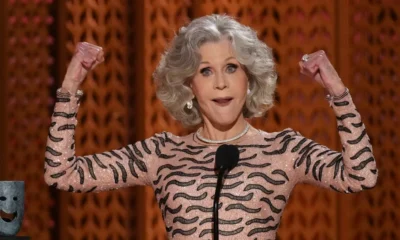
Now, seventy-eight years later, that same committee has been revived by Jane Fonda — whose father, Henry Fonda, was among its original founders. The revival comes as Hollywood once again grapples with questions of censorship, political pressure, and the balance between creative freedom and corporate control.
ALSO READ : Rockets Guard Fred VanVleet Tears ACL and Likely to Miss 2025-26 Season
From 1947 to 2025: A Legacy of Resistance
The original CFA was formed in September 1947 by screenwriter Philip Dunne, actress Myrna Loy, and filmmakers John Huston and William Wyler. Their mission was clear: defend freedom of speech and protest the HUAC’s treatment of the Hollywood Ten — a group of writers and directors who refused to testify about alleged communist ties.
Among the CFA’s original supporters were some of the era’s most luminous names: Humphrey Bogart, Lauren Bacall, Katharine Hepburn, Frank Sinatra, and Judy Garland.
Their first major act of defiance came on October 27, 1947, with a radio broadcast titled “Hollywood Fights Back.” The broadcast condemned the HUAC hearings and urged Americans to resist fear-driven censorship. But as blacklists expanded and careers were destroyed, public opinion shifted — and even some original members, like Bogart and Bacall, were pressured to distance themselves from the movement.
Jane Fonda’s Revival: History Repeats, with New Voices
In October 2025, Jane Fonda — an Academy Award-winning actress and lifelong activist — revived the Committee for the First Amendment with the support of over 500 Hollywood figures. Among them are Jamie Lee Curtis, Ben Stiller, Viola Davis, and Billie Eilish — artists from across generations united under one cause: protecting creative freedom from political and institutional interference.
Thousands of additional supporters have since requested to join, reflecting a growing unease within the entertainment community about censorship in modern media.

Fonda told The Hollywood Reporter that plans for the committee’s revival were already in motion before Jimmy Kimmel Live! was briefly suspended following comments from FCC chair Brendan Carr. Still, that controversy, she noted, underscored the need to speak out.
“We can’t afford to be silent,” Fonda said. “My father stood for artistic freedom when it was dangerous to do so — now it’s our turn.”
Echoes of McCarthyism in the Modern Age
The reformation of the CFA isn’t just symbolic. In an era where media companies face pressure from both political sides — from state regulation to cancel culture — artists are finding themselves navigating a minefield of speech and sponsorship.
Fonda’s move evokes parallels with the McCarthy era, but with a digital-age twist. Instead of government hearings, today’s blacklists are often algorithmic or corporate. “It’s no longer HUAC interrogating us,” said one anonymous producer who signed the new CFA charter. “It’s algorithms, advertisers, and fear of backlash.”
The committee’s modern mission is to safeguard “artistic integrity, free expression, and open discourse” — principles it hopes to uphold through education, advocacy, and direct communication with government bodies like the U.S. Congress and the Federal Communications Commission.
A New Generation Takes the Torch
That so many younger stars — from Billie Eilish to emerging directors and TikTok creators — have joined the cause shows that free speech concerns have transcended age and medium. As streaming giants and studios consolidate power, the CFA’s revival comes as a rallying cry to resist creative homogenization.
“This isn’t about left or right,” said a spokesperson for the revived committee. “It’s about the First Amendment — and the right to tell stories without fear.”
The Committee’s public re-launch, timed near the 78th anniversary of “Hollywood Fights Back”, carries both historical resonance and modern urgency.
Why This Revival Matters Now
As Hollywood’s creative class confronts AI-generated content, corporate censorship, and polarized audiences, Fonda’s initiative is more than nostalgia — it’s a warning flare. Freedom of expression, long considered untouchable in the entertainment industry, is being tested in real time.
The rebirth of the Committee for the First Amendment serves as both tribute and challenge: to remember a generation that risked everything for artistic integrity — and to ensure that silence never wins again.






Entertainment
‘We Were Liars’ Season 2 Just Added Six Powerhouse Stars and the Sinclair Family Will Never Be the Same Again…
Prime Video drops a jaw-dropping casting announcement as Josh Dallas, Peyton List, and four others step into younger versions of the iconic Sinclair family — and what they’re hiding from 1999 could change everything.

Just when you thought you had the Sinclairs figured out, We Were Liars is about to pull the rug from under you — again.
Prime Video has officially announced six new series regulars joining the second season of its hit psychological thriller We Were Liars, and the names on that list are nothing short of exciting. The show, which captivated audiences with its sun-soaked secrets and devastating twists in Season 1, is gearing up for a chapter that promises to be even more layered, more personal, and more haunting. Deadline
So who exactly is walking back onto Beechwood Island? Let’s break it down.
The Sinclairs, But Younger — and Arguably More Dangerous
Josh Dallas (Manifest, Once Upon a Time) will step into the role of a young Harris Sinclair, while Peyton List (Gotham, Mad Men) takes on a younger Tipper Sinclair. If you watched Season 1 knowing these two as the composed, patrician heads of the Sinclair dynasty — played by David Morse and Wendy Crewson — prepare yourself. Seeing them young, flawed, and fully unraveling might be the most unsettling thing the show has done yet. Variety
ALSO READ : Younghoe Koo Explains Botched Field Goal After Slip: “The Ball Was Moving So I Pulled Up”
Parker Lapaine (House of the Dragon) plays a young Carrie Sinclair, Elysia Roorbach (The Pitt) steps in as a younger Penny Sinclair, and Madison Wolfe (True Detective, The Hunting Wives) portrays a younger Bess Sinclair. These three women were the emotional backbone of Season 1 — complex, wounded, and fiercely protective of a legacy built on beautiful lies. Watching them become that way? That’s the real story Season 2 is promising to tell. Deadline
Rounding out the new cast is Costa D’Angelo (Tell Me Lies), who takes on the role of Pfeff, described as a new character entering the world of the Sinclairs during their pivotal summer of 1999. Variety
A Summer That Changed Everything — 1999 on Beechwood Island
Season 2 is set during the summer of 1999 at Beechwood Island, and the official logline makes it clear this won’t be a nostalgic trip down memory lane. “In an effort to confront her truth, Cadence returns to Beechwood. As she digs deeper into family secrets, she learns about the Sinclair Sisters’ summer of 1999 — a summer rife with first love, rivalry, and even murder.” Variety
Murder. There it is.
The new season draws inspiration from Family of Liars, E. Lockhart‘s prequel novel to We Were Liars, which served as the basis for Season 1. Lockhart herself has been enthusiastic about where the show is headed, teasing that the showrunners have big, bold plans that will satisfy both readers of the books and newcomers discovering the Sinclair world for the first time. Deadline
The Dream Team Behind the Camera Returns
We Were Liars Season 2 is written and executive produced by co-showrunners Julie Plec and Carina Adly MacKenzie, with Emily Cummins, Brett Matthews, Marguerite MacIntyre, and author E. Lockhart also executive producing. Universal Television and Amazon MGM Studios are behind the project. Deadline
Plec, best known as the creative force behind The Vampire Diaries, and MacKenzie, who brought Roswell, New Mexico to life, have already proven they can handle emotionally rich, mystery-layered storytelling. Season 2 looks like it will push them — and the audience — to their very limits.

What About the Season 1 Favourites?
Don’t worry — the show isn’t abandoning everything you loved. Emily Alyn Lind returns as Cadence Sinclair Eastman, and Joseph Zada is back as Johnny Sinclair Dennis — the haunting presence whose fate in Season 1 broke more than a few hearts. The three “mom” actresses — Mamie Gummer, Caitlin FitzGerald, and Candice King — are also confirmed to be returning. Seeing them come face to face with the younger versions of themselves, played by Lapaine, Roorbach, and Wolfe, is going to be one of the most fascinating storytelling devices the series has attempted. TV Insider
Filming for Season 2 is set to run from June to October 2026, meaning audiences likely won’t see the finished product until summer 2027 — following the same pattern as Season 1, which was shot in the summer of 2024 and released in June 2025. TV Insider
Why This Casting Matters More Than You Think
Here’s the thing about We Were Liars that made it so addictive: it was never really about the twist. It was about what people are willing to do — to lie about, to bury, to protect — in the name of family and legacy. The showrunners are described as adding “all kinds of fun new twists and turns” even for readers who already know the Family of Liars storyline, ensuring that the show will surprise even those who’ve read every word Lockhart has written. Deadline
With a cast this stacked — Dallas‘s magnetic charm, List‘s sharp emotional range, and Wolfe‘s proven dramatic instincts — Season 2 has every ingredient to not just match Season 1, but surpass it entirely.
The Sinclairs are coming back. And if history is anything to go by… someone’s going to get hurt.
Entertainment
Spencer Pratt’s Batman-Style AI Ad Mocks Gavin Newsom… Internet Can’t Decide If It’s Genius or Chaos
A viral AI-generated campaign-style video inspired by Batman has put Spencer Pratt back in the spotlight—while taking a sharp jab at California Governor Gavin Newsom.

In the age of viral content, it takes something truly unexpected to break through the noise. This week, that moment came courtesy of Spencer Pratt—who has once again found himself at the center of online conversation.
The reality TV personality turned digital provocateur has gone viral with a Batman-inspired AI campaign ad that appears to mock Gavin Newsom, the Governor of California. The video, stylized like a dark, cinematic political campaign, blends satire, pop culture, and artificial intelligence in a way that has left audiences both amused and divided.
A Viral Moment Born From AI and Pop Culture
The video draws heavy inspiration from Batman—complete with moody visuals, dramatic narration, and a tone that feels straight out of Gotham City.
But instead of a superhero narrative, Pratt uses the format to deliver a satirical take on political messaging. Through AI-generated imagery and voiceovers, the ad exaggerates themes often seen in real campaign ads, turning them into something almost theatrical.
The result? A clip that quickly spread across platforms like X (formerly Twitter) and Instagram, racking up views, shares, and heated debates.
ALSO READ : Younghoe Koo Explains Botched Field Goal After Slip: “The Ball Was Moving So I Pulled Up”
Spencer Pratt: From Reality TV to Viral Strategist
For those who remember Pratt from MTV’s The Hills, this latest move might seem like a surprising pivot. But in reality, it’s a continuation of his evolution.
Over the years, Pratt has reinvented himself as a savvy social media personality, often leaning into humor, controversy, and internet culture to stay relevant.
This AI campaign video is perhaps his most ambitious experiment yet—blurring the lines between entertainment, satire, and political commentary.
Gavin Newsom in the Crosshairs
While the video doesn’t follow the structure of a traditional critique, its target is clear. Gavin Newsom, one of the most prominent political figures in the United States, becomes the focal point of Pratt’s satire.
Known for his strong presence in national politics and frequent media appearances, Newsom has often been the subject of both praise and criticism.
Pratt’s video taps into that visibility, using exaggerated imagery and dramatic storytelling to create a piece that feels as much like a parody as it does a statement.
The Role of AI in Modern Content Creation
What sets this video apart is its use of artificial intelligence.

AI tools are increasingly being used to create hyper-realistic visuals, voices, and narratives. In Pratt’s case, they’ve enabled a level of production that would have required significant resources just a few years ago.
This raises important questions about the future of content creation.
If individuals can produce cinematic, campaign-style videos with AI, what does that mean for traditional media, political messaging, and authenticity?
Platforms like YouTube and TikTok are already seeing a surge in AI-generated content, ranging from parody to misinformation.
Pratt’s video sits somewhere in the middle—clearly satirical, yet powerful enough to spark real conversations.
Internet Reactions: Genius or Too Far?
As with most viral moments, the response has been mixed.
Some viewers have praised the video for its creativity, calling it a clever use of AI and storytelling. Others, however, have raised concerns about the implications of using such technology in a political context.
Is it harmless satire? Or does it blur ethical boundaries?
The debate reflects a broader uncertainty about how AI should be used in public discourse.
The Bigger Picture
Beyond the headlines and viral numbers, this moment highlights a shift in how influence works.
You no longer need a studio, a network, or a campaign budget to create something impactful. All you need is an idea—and the right tools.
Spencer Pratt’s Batman-inspired AI ad may not change political outcomes, but it does signal something bigger: the democratization of media, where anyone can shape narratives and spark conversations.
And in a world driven by attention, that might be the most powerful tool of all.
Entertainment
“He Was Fighting More Than Just a Role…” Eric Dane’s Final ‘Euphoria’ Scene Reveals a Painful Truth
In one of his last interviews, Eric Dane opened up about filming an intense ‘Euphoria’ moment while quietly battling ALS—months before his passing.

Sometimes, the most powerful performances come from places the audience never sees.
In what would become one of his final interviews, Eric Dane shared a deeply personal glimpse into his life behind the camera—revealing that while audiences watched him deliver a raw, emotionally charged performance in Euphoria, he was simultaneously fighting a far more devastating battle: Amyotrophic Lateral Sclerosis (ALS).
The actor, widely recognized for his portrayal of Cal Jacobs in the hit HBO drama created by Sam Levinson, passed away on February 19—leaving behind not just a legacy of performances, but a story of quiet resilience.
A Scene That Meant More Than It Seemed
The particular moment Dane spoke about—a chaotic, emotionally heavy wedding scene where his character appears intoxicated—was already intense on screen. But knowing what he was going through behind the scenes adds a new layer of depth.
ALSO READ : Younghoe Koo Explains Botched Field Goal After Slip: “The Ball Was Moving So I Pulled Up”
Dane admitted that filming the scene required him to tap into a vulnerability that went beyond acting. While viewers interpreted it as a portrayal of a troubled character, it was, in many ways, a reflection of an internal struggle he was not yet ready to publicly share.
A Silent Battle Behind the Spotlight
ALS, often referred to as Lou Gehrig’s disease, is a progressive condition that affects nerve cells and muscle control. For someone in a physically demanding profession like acting, the diagnosis can be life-altering.
Yet Dane continued working.
He showed up on set, delivered performances, and maintained a sense of professionalism that colleagues later described as both inspiring and heartbreaking.
It’s a reminder of the unseen challenges many artists carry—choosing to create, even when facing unimaginable personal hardships.
The Impact of ‘Euphoria’ and Cal Jacobs
Since its debut, Euphoria has been known for pushing boundaries—exploring themes of identity, addiction, and emotional trauma with unflinching honesty.
Dane’s portrayal of Cal Jacobs stood out as one of the show’s most complex characters. Flawed, conflicted, and often controversial, Cal was never easy to watch—but he was impossible to ignore.
And perhaps that’s why Dane’s performance resonated so deeply. He didn’t just play the character—he lived in those uncomfortable spaces, bringing authenticity that audiences could feel.

Tributes and Reflections
Following news of his passing, tributes poured in from fans and colleagues alike. Many spoke about his dedication to his craft, his kindness off-screen, and the courage he displayed in continuing to work despite his condition.
For those who revisit Euphoria now, scenes featuring Dane carry a different emotional weight. What once seemed like acting now feels like something more personal—more real.
A Legacy Beyond the Screen
Eric Dane’s career spanned decades, with memorable roles across television and film. But it’s often the final chapters of an artist’s journey that leave the most lasting impression.
In choosing to keep working, to keep creating, Dane left behind more than performances—he left behind a message about perseverance, passion, and the human spirit.
Final Thoughts
There’s a line between performance and reality that actors often blur. In Eric Dane’s case, that line became almost invisible.
His final work on Euphoria isn’t just a testament to his talent—it’s a reflection of his strength.
And perhaps that’s why his story resonates so deeply now.
Because sometimes, the most powerful scenes aren’t just acted… they’re lived.

‘We Were Liars’ Season 2 Just Added Six Powerhouse Stars and the Sinclair Family Will Never Be the Same Again…

Spencer Pratt’s Batman-Style AI Ad Mocks Gavin Newsom… Internet Can’t Decide If It’s Genius or Chaos

“He Was Fighting More Than Just a Role…” Eric Dane’s Final ‘Euphoria’ Scene Reveals a Painful Truth

Vegas Was Fading… Then Backstreet Boys Changed Everything Overnight

Disney+ Brings a Magical Mystery to Life… Ryu Seung-ryong Leads Emotional K-Drama Adaptation Fans Didn’t See Coming

1-Iran Issues Dire Warning to Israel and Defies Trump on Nukes: “We’re Ready to Strike Deep Inside”

Donald Trump’s net worth reveals the fortune behind the former US President and business mogul

“She Never Made It Out…” Albany House Fire Claims Woman’s Life as Family Pleads for Help to Bring Her Home

“Tomás Rodríguez Net Worth 2025: Panama’s Gold Cup Goal‑Machine’s Surprising Fortune Revealed”

Caitlin Clark Sidelined with Quad Strain, Set to Miss Two Weeks of WNBA Action

Miss Jamaica Suffers Terrifying Fall Off Miss Universe Stage; Rushed to Hospital on Stretcher in Viral Video

Moana Live-Action Teaser Sparks Outrage as Fans Call Disney’s Move a ‘Clear Money Grab’ — What Went Wrong?

Ryan Gosling’s Project Hail Mary Trailer Stuns Fans with a Mysterious Alien Ally and a Mission That Could Save Earth

Apple delays Jessica Chastain thriller The Savant about domestic extremism after recent US violence

Avatar 3, Fire and Ash trailer reveals Jake Sully’s family facing terrifying new Na’vi enemies with deadly fire powers
-

 Entertainment6 days ago
Kanye West Was in Court to Fight for His $35M Mansion But Witnesses Say He Could Barely Keep His Eyes Open While Testifying, and the Reason Why Is…
-

 Entertainment4 days ago
Failure’s ‘Location Lost’ Might Be Their Last “Are the ’90s Alt-Rock Pioneers Saying Goodbye…?”
-

 Entertainment6 days ago
When Wonder Woman Gave Primetime a Shockwave… The Superhero Who Quietly Changed TV History
-

 Sports5 days ago
Arsenal End 22 Year Premier League Curse as Man City Slip Up and Arteta Finally Delivers Glory
-

 Entertainment5 days ago
Zac Brown Band to Headline Historic UFC Night in Washington D.C… Music Meets Fight Game Ahead of White House Showdown
-

 Entertainment6 days ago
“Be Good to the Roxy!” How Ryan Murphy’s ‘Love Story’ Recreates the Magic of ’90s New York… and Why Fans Are Obsessed
-

 Entertainment5 days ago
‘Secret Lives of Mormon Wives’ Faces Uncertain Future Disney Boss Says “We’re Still Figuring It Out…”
-

 Entertainment4 days ago
Nick Fuentes Sparks Fresh Debate “His Type Isn’t His Fans…” and the Internet Can’t Stop Talking