
US News
Pete Hegseth Blocked 2 Black and 2 Female Officers From Army Promotions — Here’s What’s Really Going On Inside the Pentagon
A 15-Year-Old Academic Paper, the Afghanistan Withdrawal, and ‘Woke’ Culture — The Controversial Reasons Behind Defense Secretary’s Unprecedented Move


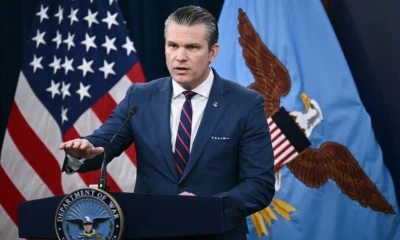
A storm is brewing inside the United States military establishment — and at the centre of it is Defense Secretary Pete Hegseth. In a move that has shocked senior military officials and legal experts alike, Hegseth has personally removed four decorated Army officers from a promotion list — two of them Black, two of them women. All four had already cleared a highly competitive selection process. And the reasons behind their removal are raising uncomfortable questions about politics, race, gender and the future of the US military.
Only 5% Ever Make It — These Four Did
To understand why this matters, you need to understand how rare it is to even make this list. Only about 5 percent of eligible colonels ever reach the rank of one-star general. These four officers had already survived a rigorous competitive board process conducted in November 2024 — meaning they were, by every institutional measure, among the very best in the United States Army.
Then Pete Hegseth stepped in and struck their names.
The New York Times, based on interviews with 11 current and former military and administration officials, first reported the details of what happened — and why.
The ‘Woke’ Agenda Hegseth Wants to Undo
Since arriving at the Pentagon, Hegseth has been explicit about his mission. He wants to dismantle what he describes as a “woke” culture that he believes took root in the military during the Biden administration. In his 2024 book The War on Warriors, he took direct aim at senior officers promoted under former Defense Secretary Lloyd J. Austin III, calling them “cowards hiding under stars.”
He also wrote — “The Left captured the military quickly, and we must reclaim it at a faster pace.”
This ideological posture appears to be directly shaping personnel decisions at the highest levels of the US military.
The Reasons — And They Are Troubling
Officer 1 — The Academic Paper
One of the removed officers, a Black armor officer, was flagged over an academic paper he had written nearly 15 years ago. In that paper, he analysed why African American officers have historically gravitated toward support roles rather than frontline combat positions. This was not advocacy — it was a scholarly analysis of a documented and well-known trend within the military. That paper was nonetheless used as grounds to block his promotion.
Officer 2 — The Afghanistan Withdrawal
A female logistics officer was removed despite having served during the chaotic 2021 withdrawal from Afghanistan. Multiple military officials told The New York Times that she performed her duties exceptionally well under extraordinarily difficult circumstances. However, Hegseth has publicly blamed officers involved in that withdrawal, calling the operation “disastrous and embarrassing” and stating his intent to hold them accountable — regardless of individual performance.
Officers 3 and 4 — Nobody Knows Why
The remaining two officers — a logistics officer and a finance specialist — were also removed. Even senior military officials, according to The New York Times, could not identify any clear reason why they were specifically singled out.
Is This Even Legal?
This is the question that legal and military experts are asking most urgently. Under existing military regulations, the Defense Secretary’s role in the promotion process is binary — he can either accept or reject the entire list. He is not legally permitted to cherry-pick individual names.
According to senior military officials cited by The New York Times, removing specific officers in this manner falls outside the legal options available to the Defense Secretary. The last time promotion decisions faced this level of external scrutiny was back in 2007 during the Iraq War — and even then, the approach was fundamentally different.
The promotion list is currently under review at the White House before it proceeds to the Senate for final approval.

The Pentagon Pushes Back — Sort Of
The Pentagon has defended the process, with spokesman Sean Parnell stating that military promotions go to those who have earned them and that the process is “apolitical and unbiased.”
White House press secretary Karoline Leavitt went further, praising Hegseth for “restoring meritocracy throughout the ranks.”
Critics, however, argue that blocking highly qualified officers based on the colour of their skin, their gender, or an academic paper written over a decade ago is the very opposite of meritocracy.
What Is at Stake
The US military promotion system was deliberately designed to be insulated from political interference. Officers are evaluated by senior leaders on the basis of performance, experience and leadership — not ideology, not race, and not gender. That principle exists precisely to ensure that politics does not determine who commands America’s armed forces.
What is unfolding now represents a direct challenge to that principle — and the implications go far beyond these four officers. If political and ideological litmus tests become standard in military promotions, the long-term consequences for the integrity, morale and effectiveness of the US military could be profound.
Dainik Diary will continue to follow this story as it develops.





US News
‘Dances With Wolves’ Actor Nathan Chasing Horse Sentenced to Life in Prison — Victim Says “The Life That Little Girl Could Have Lived Has Been Taken From Me Forever”
The former Hollywood actor who played Smiles a Lot in Kevin Costner’s Oscar-winning film used his status as a spiritual leader to prey on Indigenous women and girls for nearly two decades — and a Nevada judge has now made him pay for it

For the women who sat in that Nevada courtroom on Monday and read their statements aloud, it was the moment years in the making had finally arrived. For Nathan Chasing Horse, the former Hollywood actor turned convicted predator, it was the end of the line.
A Nevada judge has sentenced Chasing Horse, 49, to life in prison for the sexual assault of Indigenous women and girls — with the possibility of parole only after serving 37 years. He stared straight ahead as his victims spoke. He remained silent as he was escorted from the courtroom. And in his final words to the judge, he was defiant to the last: “This is a miscarriage of justice.”
Judge Jessica Peterson was unmoved.
“You preyed on these women’s trusts and their spirituality, and you manipulated them for your own personal gratification,” she told him before delivering the sentence. When the hearing adjourned, more than a dozen people in the courtroom broke into applause.
Chasing Horse is best known for his role as Smiles a Lot — a young Sioux tribe member — in Kevin Costner‘s Oscar-winning 1990 film Dances With Wolves. Born on the Rosebud Reservation in South Dakota, home of the Sicangu Sioux of the Lakota Nation, he leveraged both his fame and his reputation as a Lakota medicine man to travel across Indian Country — attending powwows, performing healing ceremonies, and, prosecutors say, building a network of abuse that spanned nearly two decades.
Deputy District Attorney Bianca Pucci told the jury during January’s trial that for almost 20 years, Chasing Horse “spun a web of abuse” that ensnared countless women.
Among those who came forward publicly was Corena Leone-LaCroix, who was just 14 years old when Chasing Horse assaulted her. She told the court that he had claimed the spirits wanted her to surrender her virginity to save her mother, who had been diagnosed with cancer — and warned her that if she told anyone, her mother would die. The assaults continued for years.
Standing before the court on Monday, Leone-LaCroix delivered words that silenced the room:
“There is no way to get back the youth, the childhood loss, my first time, my first kiss, the graduation I never got to have. The life that little girl could have lived has been taken from me forever.”
Another victim, Siera Begaye, described still facing medical complications from an ectopic pregnancy she suffered as a result of the assault, which required surgery. Despite everything, she chose to face her future with defiance of her own:
“I am choosing to see this moment as a fresh start. I will rebuild my life, reclaim my voice and continue fighting for the future I deserve.”
Begaye’s mother, Lynnette Adams, testified that the betrayal cut far deeper than the physical — it shattered something sacred. “Even to this day I struggle to regain my faith and spirituality,” she told the court.

A jury had previously convicted Chasing Horse on 13 charges, mostly related to the sexual assault of three women. He was acquitted on some counts. His attorney had filed a motion for a new trial, arguing that a key witness was unqualified and that the statute of limitations had expired. That motion was denied.
The sentencing closes a chapter in a case that first sent shockwaves across Indian Country when Chasing Horse was arrested and indicted in 2023 in Nevada. But it is far from the end of his legal troubles. Additional charges remain pending in Canada — specifically in British Columbia, where he faces a sexual assault charge related to a 2018 alleged offence near Keremeos, a village approximately four hours east of Vancouver. A warrant also remains outstanding in Alberta, confirmed by the Tsuut’ina Nation Police Service.
Both Canadian proceedings were paused while the United States case proceeded. Prosecutors in British Columbia say they will assess next steps once all of Chasing Horse’s American appeals have been exhausted.
For now, the man who once rode across cinema screens as a symbol of Indigenous dignity will spend the foreseeable future in a Nevada detention centre — convicted, sentenced, and out of appeals to hide behind.
US News
John Oliver Just Said What Half of America Is Thinking About Trump’s Iran ‘Military Operation’ and the ‘6-Year-Old’ Comparison Is Going Viral for a Reason…
With over 2,000 dead, 13 U.S. service members killed, and a $200 billion Pentagon funding request quietly sitting on the table, the Last Week Tonight host tore into President Trump’s word games — and the audience couldn’t stop laughing, even as the reality wasn’t funny at all.


Let’s be clear about something before we even get to the jokes. There is a war happening. It’s been going on for two months. People are dying — Iranian civilians, American soldiers, and everyone caught in between. And the President of the United States won’t call it a war.
That’s where John Oliver started Sunday night. And by the time he was done, the laughter in the studio had that particular edge it gets when something is simultaneously absurd and genuinely alarming.
‘I Won’t Use the Word War Because They Say That’s Maybe Not a Good Thing to Do’
Oliver kicked off the latest episode of Last Week Tonight by setting up the central contradiction of the entire U.S.-Iran conflict: “The Iran war entered its second month, though Trump tries not to use the word ‘war’ for reasons he probably shouldn’t be saying out loud.” The Hollywood Reporter
ALSO READ : Sen. Elizabeth Warren Calls It a ‘Cesspool of Corruption’ — Here’s Why Senators Are Now Fighting Back Against the DOJ’s Live Nation Deal That Left Every Fan Betrayed…
He then rolled the clip. And President Donald Trump, in his own words, explained his reasoning with the kind of blinding transparency that his advisers must have winced at: “I won’t use the word ‘war’ because they say if you use the word war, that’s maybe not a good thing to do. They don’t like the word war because you’re supposed to get approval, so I’ll use the word ‘military operation,’ which is really what it is.” The Hollywood Reporter
Oliver’s response landed instantly: “What? He really just talks like a 6-year-old speaking stream-of-consciousness to a stranger.” The Hollywood Reporter The comparison stung because it was hard to argue with. The President had just, on camera, explained that he was deliberately avoiding a word because using it would trigger a legal requirement for Congressional approval — and then said the quiet part loud enough for the whole country to hear.
‘Sometimes You Have to Start a War to Stop a War’
The semantic gymnastics didn’t stop with Trump. His allies have been working overtime to reframe the conflict too. When one official argued, “The president didn’t start a war. He was trying to stop a war,” Oliver had a field day: “Oh, I get it. Sometimes you have to start a war to stop a war. The same way you have to ‘spend money to make money’ or ‘fake it ’til you make it’ — you know, any of those things that people say when they’re in way over their heads.” The Hollywood Reporter
It’s the kind of joke that hits hardest not because it’s clever — though it is — but because the logic it’s mocking is real, and it’s coming from the people running the country.
‘Operation Epic Fury’ and the Name That Says Everything
If the wordplay around “war” wasn’t enough, Oliver turned his attention to what the Trump administration has officially dubbed this military campaign: “Operation Epic Fury.”
The Last Week Tonight host was merciless: “It’s definitely the stupidest name I’ve ever heard. It sounds like a VHS tape Hegseth put out of himself doing karate in a garage. It sounds like the name of an energy drink marketed to divorced monster-truck fans containing so much caffeine, it makes you shit your pants while having a heart attack.” The Hollywood Reporter
Defense Secretary Pete Hegseth had stood at a podium and declared with a straight face that the operation was “laser-focused” and “decisive.” Oliver noted that Trump and Hegseth have both been insisting this war is a success — even as it continues.
The Numbers They’re Not Talking About Enough
Behind all the wordplay and mockery is a set of facts that Oliver made sure his audience didn’t lose sight of.
More than 2,000 Iranians and 13 U.S. service members have been killed since the conflict began. Trump is reportedly considering sending an additional 10,000 troops to the region. The Hollywood Reporter And while the administration claims total military victory, the Pentagon has quietly requested $200 billion in extra funding for the operation — a number that rather directly contradicts any suggestion it will be wrapping up soon.

Trump has also claimed the U.S. has destroyed “100 percent of Iran’s military capability” — a claim Oliver called difficult to square with the fact that Iran is still striking multiple countries in the region. The Daily Beast
And then there were the former presidents. Trump claimed twice that a former president had endorsed his decision to go to war — a claim that was subsequently denied by representatives of all four living ex-presidents: Bill Clinton, George W. Bush, Barack Obama, and Joe Biden. The Daily Beast
“The lies are getting pretty flagrant here,” Oliver said, “even by this president’s standards.” Deadline
The Gas Station Moment That Went Viral
Perhaps the most quietly devastating moment of the entire segment wasn’t Oliver’s own words at all. He played footage of a woman at a gas station — where prices have been rising since the military operation began — who revealed she had voted for Trump three times. “That was my bad. Apparently I’m an idiot,” she said. Asked what she would tell Trump if he were watching, she replied with words that have since gone viral across the internet. The Hollywood Reporter
Oliver let the clip breathe. The audience didn’t know whether to laugh or go quiet. They did both.
‘When I Feel It in My Bones’
In one of his more earnest moments of the night, Oliver dropped the jokes briefly and said directly: “Trump is saying that the war will be over ‘when I feel it in my bones’ — whatever the f*** that means. And that’s a pretty thoughtless way to approach a conflict that’s already killed so many. It’s not just disrespectful to the Iranian people and to U.S. service members affected, it’s disrespectful to the rest of us to assume childish memes and sugarcoated headlines will change what we can all see with our own eyes. Because, at this point, we don’t deserve deflections; we deserve explanations and accountability.”
That’s the thing about John Oliver at his best. The jokes are real. But so is the point underneath them.
You can call it a military operation. You can name it Operation Epic Fury. You can avoid the word “war” on the advice of your lawyers. But when the body count climbs past two thousand and the Pentagon is asking for $200 billion, most people — including a three-time Trump voter at a gas station in Pennsylvania — can see exactly what it is.
Whatever word you use.
US News
USCIS Just Made the H-1B Visa Process Significantly Harder — Here’s Everything That Changed From April 1st and What It Means for You…
The updated I-129 form is now mandatory, older versions are no longer accepted, and employers must now disclose far more than before — from minimum job qualifications to the immigration history of every applicant. The rules of the game have quietly shifted.

If you are an employer who hires foreign workers, an immigration attorney, or someone whose entire career path runs through the H-1B visa system — you need to stop and read this carefully.
US Citizenship and Immigration Services (USCIS) has quietly but significantly tightened the H-1B visa process, introducing a revamped version of its non-immigrant worker petition form — the I-129 — with changes that took effect from April 1st, 2026.
And unlike many bureaucratic updates that exist mostly on paper, these changes carry real, immediate consequences.
The Old Form Is Gone — No Exceptions
The first thing to understand is simple and non-negotiable. USCIS will no longer accept the previous version of the I-129 form. From April 2nd, 2026 onwards, petitioners must submit only the new version.
There is one narrow exception — if your petition was filed before March 31st, 2026, the older version will still be considered. If it wasn’t? The new form is the only option. No grace period, no workarounds.
What Is the H-1B Visa — A Quick Refresher
For those less familiar, the H-1B visa is the primary mechanism through which US employers hire foreign workers on a temporary, nonimmigrant basis — typically in specialty occupations requiring at least a bachelor’s degree in a relevant field. It is the backbone of how companies in Silicon Valley and across corporate America access global tech and engineering talent.
Which is precisely why changes to the process carry such significant weight.
What Has Actually Changed — The Key Updates
1. Stricter Mandatory Disclosures
This is where the real teeth of the new rules lie. Employers filing H-1B petitions will now be required to disclose considerably more information than before, including the minimum qualifications for the job being offered, salaries being paid, the wage level as per industry standards or the Labour Condition Application (LCA), specific work locations, and the employment arrangement in place.
Crucially, employers must also now provide mandatory disclosure about the immigration history of the employee being petitioned for. Applications will face significantly stricter scrutiny across the board.
2. The New Wage Lottery System
The modifications to the H-1 classification section of the form are being introduced under a new wage lottery system, applicable from fiscal year 2027. The intent appears to be ensuring that H-1B slots go to higher-wage positions — a shift that could fundamentally alter which employers and which roles benefit most from the program.
3. F-1 Students Locked Out
One of the more significant and immediately impactful changes — US employers will no longer be permitted to hire F-1 students under the H-1B program. For international students studying in America and hoping to transition from a student visa to a work visa through this route, this closes a door that many had been counting on.
The new form does still permit students to file for a transition from study visa to work visa — but not under the H-1B classification.
Which Visa Categories Are Affected Beyond H-1B?
The ripple effects of the updated I-129 form extend well beyond the H-1B. The same form is used to petition across a wide range of non-immigrant worker categories, including H-2A, H-2B, H-3, L-1, O-1, O-2, P-1, P-2, P-3, Q-1, and R-1.
Applicants can also use the updated form to extend or change visa status to E-1, E-2, E-3, H-1B1, TN, and other classifications — meaning the reforms touch virtually every major employer-sponsored non-immigrant visa pathway into the United States.
Who Will Feel This the Most?
USCIS itself has acknowledged that the major impact of these reforms will be felt most acutely by employers and nations that supply high-skilled labor to perform services, training, and work in the United States.

Countries like India — which has historically dominated H-1B visa approvals, with Indian nationals receiving the lion’s share of petitions annually — will feel these changes profoundly. So will the major IT services and consulting companies that rely heavily on this pipeline to staff client projects across America.
The Bigger Picture
These changes don’t exist in a vacuum. They arrive at a moment when the H-1B program is under intense public scrutiny — with high-profile layoffs at companies like Oracle raising uncomfortable questions about whether the visa system is being used to replace American workers rather than supplement them.
The tighter disclosures, the wage lottery system, and the stricter scrutiny all point in one direction — an attempt to make the H-1B program function more as originally intended, focused on genuine specialty occupations at competitive wages, rather than as a tool for accessing cheaper labor at scale.
Whether these changes achieve that goal — or simply create more paperwork without changing the underlying incentives — remains to be seen. But one thing is certain: the H-1B process as of April 2026 is meaningfully different from what it was just weeks ago.

Trump Faces Fresh Iran War Rebuke as House Votes to Curb His War Powers: ‘Americans Are Sick of…’

ICE Arrests Southwest Airlines Flight Attendant at Work Over Alleged Visa Overstay: ‘He Was Building a Stable Life’

Diego Pavia Waived by Ravens: Heisman Runner-Up’s NFL Dream Takes Another Twist… What Happens Next?

Richard Carapaz Strikes Again! Ecuadorian Star Goes Solo to Win Tour de France Stage 18 as Pogacar Keeps Yellow…

Tesla’s FSD Hits a European Roadblock: France Says ‘Not Yet’ Over Safety Concerns as EU Decision Looms…

1-Iran Issues Dire Warning to Israel and Defies Trump on Nukes: “We’re Ready to Strike Deep Inside”

Donald Trump’s net worth reveals the fortune behind the former US President and business mogul

Sen. Elizabeth Warren Calls It a ‘Cesspool of Corruption’ — Here’s Why Senators Are Now Fighting Back Against the DOJ’s Live Nation Deal That Left Every Fan Betrayed…

“She Never Made It Out…” Albany House Fire Claims Woman’s Life as Family Pleads for Help to Bring Her Home

“Tomás Rodríguez Net Worth 2025: Panama’s Gold Cup Goal‑Machine’s Surprising Fortune Revealed”

Miss Jamaica Suffers Terrifying Fall Off Miss Universe Stage; Rushed to Hospital on Stretcher in Viral Video

Moana Live-Action Teaser Sparks Outrage as Fans Call Disney’s Move a ‘Clear Money Grab’ — What Went Wrong?

Ryan Gosling’s Project Hail Mary Trailer Stuns Fans with a Mysterious Alien Ally and a Mission That Could Save Earth

Apple delays Jessica Chastain thriller The Savant about domestic extremism after recent US violence

Avatar 3, Fire and Ash trailer reveals Jake Sully’s family facing terrifying new Na’vi enemies with deadly fire powers
-

 Sports1 week ago
Lionel Messi vs Diego Maradona: Is Argentina’s World Cup Hero Finally Above The Legend? Bhaichung Bhutia Gives His Verdict…
-

 Entertainment1 week ago
John Mulaney Makes Comedy History at Wrigley Field… Surprise Guests David Letterman and More Join Legendary Chicago Night
-

 Sports1 week ago
Thomas Tuchel Survives After England’s World Cup Heartbreak… FA Makes Major Decision on Manager’s Future
-

 Sports1 week ago
Thomas Müller Questions Thomas Tuchel’s Big Decision… Germany Legend Reacts After England’s World Cup Final Dream Ends
-

 Sports1 week ago
Spain Already Have an Edge Over England? The Key Advantage That Could Decide a Potential World Cup Final
-

 Sports1 week ago
FIFA World Cup 2026 Final Referee Revealed: Why Slavko Vinčić Could Be Argentina’s Biggest Concern Against Spain
-

 Entertainment1 week ago
Christopher Nolan Defends Modern Dialogue in The Odyssey After Fan Backlash
-

 Entertainment1 week ago
‘G.I. Joe’ Gets a Surprise New Commander… Danny McBride Takes the Director’s Chair for Paramount’s Reboot