
US News
Michigan Church Horror Mass Shooting and Fire Leave Worshippers Dead… What Police Revealed
A Sunday meant for peace turned into tragedy as a gunman rammed his truck, set fire, and opened fire inside a Grand Blanc chapel.


Sunday mornings are meant to be sacred. For members of the Church of Jesus Christ of Latter-day Saints in Grand Blanc, Michigan, this past weekend was supposed to be just that — a time of prayer, reflection, and fasting. Instead, it became the site of one of America’s most chilling tragedies in recent memory.
Authorities say a 40-year-old man, identified as Thomas Jacob Sanford, drove his pickup truck into the chapel’s front doors, carrying two American flags mounted on the vehicle. He then unleashed gunfire on terrified congregants, ignited the building with accelerants, and exchanged shots with police before being killed in the parking lot.
At least four people were killed and eight others wounded, with several still unaccounted for late Sunday.
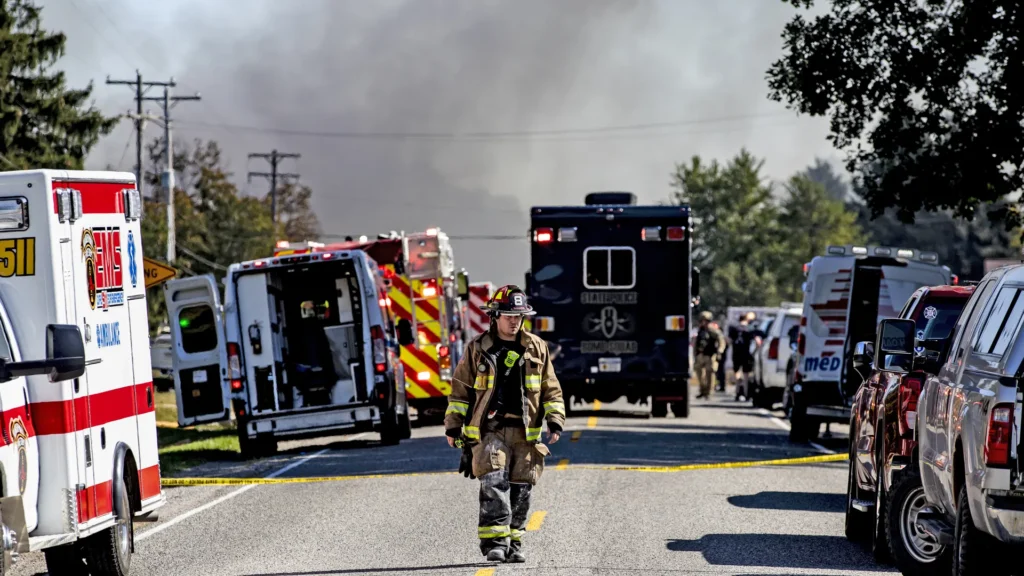
“A big bang, and the doors flew open”
Witnesses described the chaos with disbelief. Paula, a longtime member of the Grand Blanc congregation, told local station WXYZ that she heard a massive crash just after helping another woman to her car.
“We heard a big bang, and the doors flew open,” she said, recalling the moment Sanford rammed into the building.
Another worshipper, Brian, said he was escorting elderly women to safety when gunfire erupted. His shirt was stained with blood as he recounted seeing the shooter emerge:
“We were trying to gather as many people as we could. I saw the active shooter come out of the building, and at that point, I just started trying to drive away.”
Children were rushed to safety as congregants shielded them with their own bodies, Grand Blanc Township Police Chief William Renye confirmed.
Flames and gunfire
Gunshots weren’t the only danger. Within minutes, smoke began billowing from the red-brick chapel, its white spire vanishing in flames.
Neighbors like Cindy Walsh, who lives nearby, were horrified. “All of a sudden, I saw smoke coming out. And then people were coming out,” she told reporters.
Firefighters battled the blaze for hours as black smoke darkened the sky. The building is now considered a “total loss”, Renye said. Inside, debris replaced pews, and investigators later discovered suspected explosive devices.
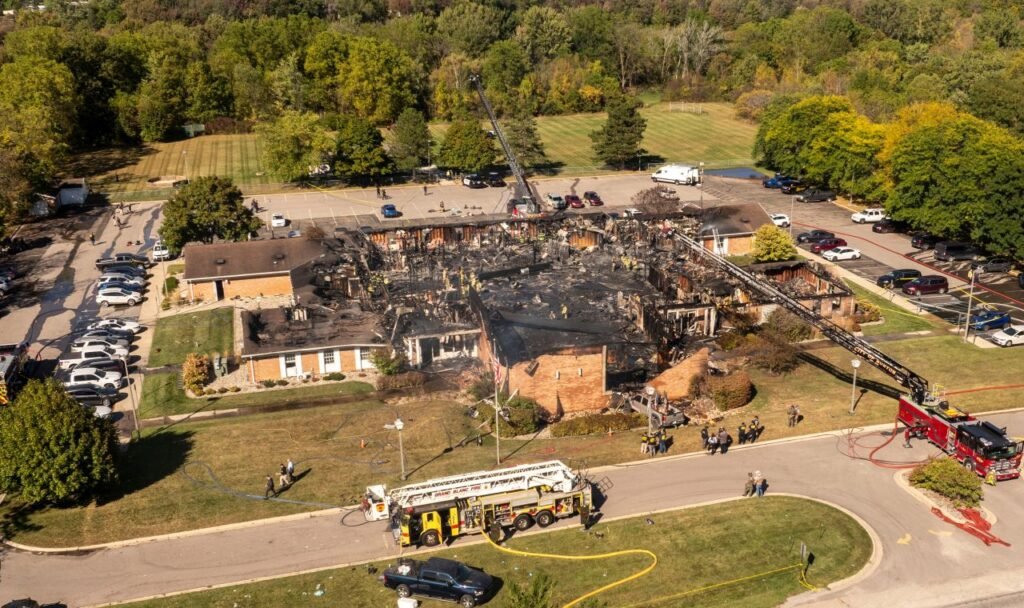
A tragic timing for the LDS community
The timing was especially painful for the LDS church, as worshippers were observing “fast Sunday,” a monthly tradition where members skip meals and donate to the poor. Just a day earlier, the global community had also mourned the passing of its leader, President Russell M. Nelson.
As historian Matthew Bowman of Claremont Graduate University noted, fasting is meant to inspire charity and compassion — making the violence during this ritual all the more unthinkable.
Investigation and aftermath
The FBI and the Bureau of Alcohol, Tobacco, Firearms and Explosives (ATF) are leading the investigation, treating the attack as targeted violence. Special Agent James Deir confirmed that Sanford used gasoline or a similar accelerant to start the fire deliberately.
Even as law enforcement praised the rapid police response — officers engaged Sanford within minutes — the devastation lingers. Survivors hugged one another at a reunification center while nurses from a nearby strike line abandoned their protest to assist the wounded.
“Human lives matter more than our labor dispute,” said Dan Glass, president of Teamsters Local 332, whose members helped first responders.
For long-time congregants like Paula, the grief is overwhelming: “It’s devastating to know I lost friends. I’ve been part of this church for 38 years.”
For more Update http://www.dailyglobaldiary.com













US News
John Oliver Just Said What Half of America Is Thinking About Trump’s Iran ‘Military Operation’ and the ‘6-Year-Old’ Comparison Is Going Viral for a Reason…
With over 2,000 dead, 13 U.S. service members killed, and a $200 billion Pentagon funding request quietly sitting on the table, the Last Week Tonight host tore into President Trump’s word games — and the audience couldn’t stop laughing, even as the reality wasn’t funny at all.


Let’s be clear about something before we even get to the jokes. There is a war happening. It’s been going on for two months. People are dying — Iranian civilians, American soldiers, and everyone caught in between. And the President of the United States won’t call it a war.
That’s where John Oliver started Sunday night. And by the time he was done, the laughter in the studio had that particular edge it gets when something is simultaneously absurd and genuinely alarming.
‘I Won’t Use the Word War Because They Say That’s Maybe Not a Good Thing to Do’
Oliver kicked off the latest episode of Last Week Tonight by setting up the central contradiction of the entire U.S.-Iran conflict: “The Iran war entered its second month, though Trump tries not to use the word ‘war’ for reasons he probably shouldn’t be saying out loud.” The Hollywood Reporter
ALSO READ : Sen. Elizabeth Warren Calls It a ‘Cesspool of Corruption’ — Here’s Why Senators Are Now Fighting Back Against the DOJ’s Live Nation Deal That Left Every Fan Betrayed…
He then rolled the clip. And President Donald Trump, in his own words, explained his reasoning with the kind of blinding transparency that his advisers must have winced at: “I won’t use the word ‘war’ because they say if you use the word war, that’s maybe not a good thing to do. They don’t like the word war because you’re supposed to get approval, so I’ll use the word ‘military operation,’ which is really what it is.” The Hollywood Reporter
Oliver’s response landed instantly: “What? He really just talks like a 6-year-old speaking stream-of-consciousness to a stranger.” The Hollywood Reporter The comparison stung because it was hard to argue with. The President had just, on camera, explained that he was deliberately avoiding a word because using it would trigger a legal requirement for Congressional approval — and then said the quiet part loud enough for the whole country to hear.
‘Sometimes You Have to Start a War to Stop a War’
The semantic gymnastics didn’t stop with Trump. His allies have been working overtime to reframe the conflict too. When one official argued, “The president didn’t start a war. He was trying to stop a war,” Oliver had a field day: “Oh, I get it. Sometimes you have to start a war to stop a war. The same way you have to ‘spend money to make money’ or ‘fake it ’til you make it’ — you know, any of those things that people say when they’re in way over their heads.” The Hollywood Reporter
It’s the kind of joke that hits hardest not because it’s clever — though it is — but because the logic it’s mocking is real, and it’s coming from the people running the country.
‘Operation Epic Fury’ and the Name That Says Everything
If the wordplay around “war” wasn’t enough, Oliver turned his attention to what the Trump administration has officially dubbed this military campaign: “Operation Epic Fury.”
The Last Week Tonight host was merciless: “It’s definitely the stupidest name I’ve ever heard. It sounds like a VHS tape Hegseth put out of himself doing karate in a garage. It sounds like the name of an energy drink marketed to divorced monster-truck fans containing so much caffeine, it makes you shit your pants while having a heart attack.” The Hollywood Reporter
Defense Secretary Pete Hegseth had stood at a podium and declared with a straight face that the operation was “laser-focused” and “decisive.” Oliver noted that Trump and Hegseth have both been insisting this war is a success — even as it continues.
The Numbers They’re Not Talking About Enough
Behind all the wordplay and mockery is a set of facts that Oliver made sure his audience didn’t lose sight of.
More than 2,000 Iranians and 13 U.S. service members have been killed since the conflict began. Trump is reportedly considering sending an additional 10,000 troops to the region. The Hollywood Reporter And while the administration claims total military victory, the Pentagon has quietly requested $200 billion in extra funding for the operation — a number that rather directly contradicts any suggestion it will be wrapping up soon.

Trump has also claimed the U.S. has destroyed “100 percent of Iran’s military capability” — a claim Oliver called difficult to square with the fact that Iran is still striking multiple countries in the region. The Daily Beast
And then there were the former presidents. Trump claimed twice that a former president had endorsed his decision to go to war — a claim that was subsequently denied by representatives of all four living ex-presidents: Bill Clinton, George W. Bush, Barack Obama, and Joe Biden. The Daily Beast
“The lies are getting pretty flagrant here,” Oliver said, “even by this president’s standards.” Deadline
The Gas Station Moment That Went Viral
Perhaps the most quietly devastating moment of the entire segment wasn’t Oliver’s own words at all. He played footage of a woman at a gas station — where prices have been rising since the military operation began — who revealed she had voted for Trump three times. “That was my bad. Apparently I’m an idiot,” she said. Asked what she would tell Trump if he were watching, she replied with words that have since gone viral across the internet. The Hollywood Reporter
Oliver let the clip breathe. The audience didn’t know whether to laugh or go quiet. They did both.
‘When I Feel It in My Bones’
In one of his more earnest moments of the night, Oliver dropped the jokes briefly and said directly: “Trump is saying that the war will be over ‘when I feel it in my bones’ — whatever the f*** that means. And that’s a pretty thoughtless way to approach a conflict that’s already killed so many. It’s not just disrespectful to the Iranian people and to U.S. service members affected, it’s disrespectful to the rest of us to assume childish memes and sugarcoated headlines will change what we can all see with our own eyes. Because, at this point, we don’t deserve deflections; we deserve explanations and accountability.”
That’s the thing about John Oliver at his best. The jokes are real. But so is the point underneath them.
You can call it a military operation. You can name it Operation Epic Fury. You can avoid the word “war” on the advice of your lawyers. But when the body count climbs past two thousand and the Pentagon is asking for $200 billion, most people — including a three-time Trump voter at a gas station in Pennsylvania — can see exactly what it is.
Whatever word you use.
US News
USCIS Just Made the H-1B Visa Process Significantly Harder — Here’s Everything That Changed From April 1st and What It Means for You…
The updated I-129 form is now mandatory, older versions are no longer accepted, and employers must now disclose far more than before — from minimum job qualifications to the immigration history of every applicant. The rules of the game have quietly shifted.


If you are an employer who hires foreign workers, an immigration attorney, or someone whose entire career path runs through the H-1B visa system — you need to stop and read this carefully.
US Citizenship and Immigration Services (USCIS) has quietly but significantly tightened the H-1B visa process, introducing a revamped version of its non-immigrant worker petition form — the I-129 — with changes that took effect from April 1st, 2026.
And unlike many bureaucratic updates that exist mostly on paper, these changes carry real, immediate consequences.
The Old Form Is Gone — No Exceptions
The first thing to understand is simple and non-negotiable. USCIS will no longer accept the previous version of the I-129 form. From April 2nd, 2026 onwards, petitioners must submit only the new version.
There is one narrow exception — if your petition was filed before March 31st, 2026, the older version will still be considered. If it wasn’t? The new form is the only option. No grace period, no workarounds.
What Is the H-1B Visa — A Quick Refresher
For those less familiar, the H-1B visa is the primary mechanism through which US employers hire foreign workers on a temporary, nonimmigrant basis — typically in specialty occupations requiring at least a bachelor’s degree in a relevant field. It is the backbone of how companies in Silicon Valley and across corporate America access global tech and engineering talent.
Which is precisely why changes to the process carry such significant weight.
What Has Actually Changed — The Key Updates
1. Stricter Mandatory Disclosures
This is where the real teeth of the new rules lie. Employers filing H-1B petitions will now be required to disclose considerably more information than before, including the minimum qualifications for the job being offered, salaries being paid, the wage level as per industry standards or the Labour Condition Application (LCA), specific work locations, and the employment arrangement in place.
Crucially, employers must also now provide mandatory disclosure about the immigration history of the employee being petitioned for. Applications will face significantly stricter scrutiny across the board.
2. The New Wage Lottery System
The modifications to the H-1 classification section of the form are being introduced under a new wage lottery system, applicable from fiscal year 2027. The intent appears to be ensuring that H-1B slots go to higher-wage positions — a shift that could fundamentally alter which employers and which roles benefit most from the program.
3. F-1 Students Locked Out
One of the more significant and immediately impactful changes — US employers will no longer be permitted to hire F-1 students under the H-1B program. For international students studying in America and hoping to transition from a student visa to a work visa through this route, this closes a door that many had been counting on.
The new form does still permit students to file for a transition from study visa to work visa — but not under the H-1B classification.
Which Visa Categories Are Affected Beyond H-1B?
The ripple effects of the updated I-129 form extend well beyond the H-1B. The same form is used to petition across a wide range of non-immigrant worker categories, including H-2A, H-2B, H-3, L-1, O-1, O-2, P-1, P-2, P-3, Q-1, and R-1.
Applicants can also use the updated form to extend or change visa status to E-1, E-2, E-3, H-1B1, TN, and other classifications — meaning the reforms touch virtually every major employer-sponsored non-immigrant visa pathway into the United States.
Who Will Feel This the Most?
USCIS itself has acknowledged that the major impact of these reforms will be felt most acutely by employers and nations that supply high-skilled labor to perform services, training, and work in the United States.

Countries like India — which has historically dominated H-1B visa approvals, with Indian nationals receiving the lion’s share of petitions annually — will feel these changes profoundly. So will the major IT services and consulting companies that rely heavily on this pipeline to staff client projects across America.
The Bigger Picture
These changes don’t exist in a vacuum. They arrive at a moment when the H-1B program is under intense public scrutiny — with high-profile layoffs at companies like Oracle raising uncomfortable questions about whether the visa system is being used to replace American workers rather than supplement them.
The tighter disclosures, the wage lottery system, and the stricter scrutiny all point in one direction — an attempt to make the H-1B program function more as originally intended, focused on genuine specialty occupations at competitive wages, rather than as a tool for accessing cheaper labor at scale.
Whether these changes achieve that goal — or simply create more paperwork without changing the underlying incentives — remains to be seen. But one thing is certain: the H-1B process as of April 2026 is meaningfully different from what it was just weeks ago.
US News
Oracle Filed 3,000+ H-1B Visa Requests — Then Laid Off 16,000 Workers With a 6 AM Email. People Are Furious…
The tech giant’s mass layoff via a cold, corporate email has ignited a firestorm — but it’s the H-1B visa filings happening at the same time that have pushed public outrage to an entirely different level.

There are bad ways to fire someone. And then there is what Oracle did.
The software giant terminated 16,000 corporate employees via a single email — sent at 6:00 in the morning. No meeting. No warning. No in-person conversation. Just a message in your inbox before most people have had their first cup of coffee, telling you that today is your last day.
That alone would have been enough to spark outrage. But then came the report that made it so much worse.
3,126 H-1B Petitions — Filed Around the Same Time
According to a New York Post report citing data from US Citizenship and Immigration Services (USCIS), Oracle filed approximately 3,126 H-1B visa petitions for foreign workers during fiscal years 2025 and 2026. Of those, 436 petitions were filed this year alone.
To be clear about what H-1B visas are — the US Department of Labor defines the program as one that “applies to employers seeking to hire nonimmigrant aliens as workers in specialty occupations.” In plain English, it is the mechanism American companies use to bring in skilled workers from abroad — most commonly in tech, engineering, and IT roles.
The timing of these filings, set against the backdrop of laying off 16,000 American employees, is what has ignited a level of public fury that shows no sign of cooling down.
Social Media Explodes
The reaction online has been swift, emotional, and — in some corners — genuinely volcanic.
One user wrote — “Maybe it is time to ban all products from companies that have laid off US workers and replaced them with H-1B visa workers or outsourcing all labour overseas. As we observe the finances of CEOs swell over several billion, it is time to reevaluate our investments.”
Another was more personal — “This is sickening. No loyalty to the workers who helped build that company. I hope they get exactly what they paid for.”
A third commenter put it in human terms that cut through the corporate noise — “The workers getting laid off have names and dreams. The ones being brought in do too. The only one without a face in this story is Oracle’s bottom line — and that’s exactly who’s making the decisions.”
And a fourth went further still — “These treasonous CEOs will keep doing this until they are arrested and their bank accounts and stock holdings are wiped clean to zero. That’s how you fix that problem.”
These are not fringe views. They are representative of a broader anger that has been building in America around the intersection of mass layoffs and foreign worker visa programs — and Oracle has now become the face of that frustration.
The Email That 16,000 People Woke Up To
Perhaps the most clinical aspect of this entire story is the layoff email itself — a document so sanitized and impersonal that it reads almost like a parody of corporate communication, except it was very real for the people who received it.
“We are sharing some difficult news regarding your position. After careful consideration of Oracle’s current business needs, we have made the decision to eliminate your role as part of a broader organizational change. As a result, today is your last working day.”
It then immediately pivoted to paperwork — instructing employees to submit a personal email address to receive separation documents, warning them that access to their computers, email, voicemail, and files would be “deactivated soon,” and reminding them they were “prohibited from downloading, copying or retaining any Oracle confidential information.”
The email closed with — “Thank you for your contributions to our organization. Oracle Leadership.”
Sixteen thousand people. One email. Sent at dawn. Signed by “Leadership” — a word that, in this context, many would argue is being used very loosely.

The Bigger Question Nobody Wants to Answer
What this Oracle story has forced back into the public conversation is a question that Silicon Valley and corporate America have long preferred to keep quiet — are large tech companies systematically using H-1B visas not to fill genuine skill gaps, but to replace higher-paid domestic workers with cheaper foreign labor?
Oracle, led by billionaire founder Larry Ellison — one of the wealthiest people on the planet — has not publicly addressed the juxtaposition of the layoffs and the H-1B filings. The company has not explained whether the roles being filled through H-1B petitions overlap with the roles being eliminated.
That silence, for tens of thousands of people watching this story unfold online, is an answer in itself.
What Happens Now
For the 16,000 people who woke up to that 6 AM email, the immediate priority is navigating severance paperwork and figuring out what comes next. For the wider tech community, this story has become a rallying point — a symbol of what workers fear most about the direction corporate America is heading.
And for Oracle — a company with a market capitalization in the hundreds of billions — the reputational damage from this week may take considerably longer to process than any severance agreement.

Ken Jennings Finally Confesses the Truth About His Shocking Jeopardy! Loss After 74 Wins — ‘This Gentleman Has Been Thinking I Took a…’

American Pie’s Shannon Elizabeth Joins OnlyFans at 52 and Says ‘This Is the Future’ — ‘No One Has Seen This Side of…’

Toluca’s Coach Breaks Silence After 7-2 Demolition of LA Galaxy: ‘We Don’t Shy Away From the Pressure of…

Northern Lights Could Light Up the Sky Across 10 U.S. States Tonight — Here’s Exactly Where to Look and What Time to…

From Wool to Wires: Allbirds Stock Explodes 600% After Ditching Sneakers for AI — ‘The Market is Struggling to Meet…’

1-Iran Issues Dire Warning to Israel and Defies Trump on Nukes: “We’re Ready to Strike Deep Inside”

Donald Trump’s net worth reveals the fortune behind the former US President and business mogul

“She Never Made It Out…” Albany House Fire Claims Woman’s Life as Family Pleads for Help to Bring Her Home

“Tomás Rodríguez Net Worth 2025: Panama’s Gold Cup Goal‑Machine’s Surprising Fortune Revealed”

Caitlin Clark Sidelined with Quad Strain, Set to Miss Two Weeks of WNBA Action

Miss Jamaica Suffers Terrifying Fall Off Miss Universe Stage; Rushed to Hospital on Stretcher in Viral Video

Moana Live-Action Teaser Sparks Outrage as Fans Call Disney’s Move a ‘Clear Money Grab’ — What Went Wrong?

Ryan Gosling’s Project Hail Mary Trailer Stuns Fans with a Mysterious Alien Ally and a Mission That Could Save Earth

Apple delays Jessica Chastain thriller The Savant about domestic extremism after recent US violence

Avatar 3, Fire and Ash trailer reveals Jake Sully’s family facing terrifying new Na’vi enemies with deadly fire powers
-
 Entertainment6 days ago
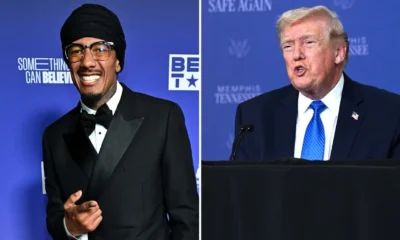
Nick Cannon Just Called the Democratic Party ‘the Party of the KKK’ on Camera and What He Said About Trump Next Made It Even More Controversial…
-

 Entertainment7 days ago
Noah Wyle Breaks Silence on The Pitt ICE Episode Edits… What HBO Changed and Why It Matters
-

 Entertainment1 week ago
He’s Back! John Hannah Is Returning to ‘The Mummy’ Universe And What He Just Revealed About Reprising His Role Has Fans of the Original Completely Losing It…
-

 Entertainment7 days ago
The Oscar Ballot Nobody Was Meant to See Has Leaked And One Voter’s Confession About ‘Sentimental Value’ Is Turning Heads…
-

 Entertainment6 days ago
Hollywood Just Revealed Where the World Is Vacationing Next and the List Will Shock You…
-

 Entertainment1 week ago
Kim Novak Finally Speaks on Sydney Sweeney Playing Her in ‘Scandalous!’ — And What She Said About the Casting Will Leave You Speechless…
-

 Entertainment4 days ago
Dark Winds Season 4 Finale Just Solved the Big Case Then Dropped a Murder Bombshell in the Final Seconds That No One Saw Coming…
-

 Entertainment1 week ago
“After an emotional year”: Aubrey Plaza expecting first child with partner Chris Abbott following husband Jeff Baena’s tragic death