
US News
Oracle Filed 3,000+ H-1B Visa Requests — Then Laid Off 16,000 Workers With a 6 AM Email. People Are Furious…
The tech giant’s mass layoff via a cold, corporate email has ignited a firestorm — but it’s the H-1B visa filings happening at the same time that have pushed public outrage to an entirely different level.


There are bad ways to fire someone. And then there is what Oracle did.
The software giant terminated 16,000 corporate employees via a single email — sent at 6:00 in the morning. No meeting. No warning. No in-person conversation. Just a message in your inbox before most people have had their first cup of coffee, telling you that today is your last day.
That alone would have been enough to spark outrage. But then came the report that made it so much worse.
3,126 H-1B Petitions — Filed Around the Same Time
According to a New York Post report citing data from US Citizenship and Immigration Services (USCIS), Oracle filed approximately 3,126 H-1B visa petitions for foreign workers during fiscal years 2025 and 2026. Of those, 436 petitions were filed this year alone.
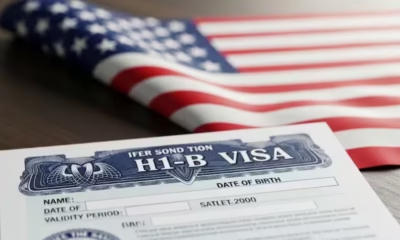
To be clear about what H-1B visas are — the US Department of Labor defines the program as one that “applies to employers seeking to hire nonimmigrant aliens as workers in specialty occupations.” In plain English, it is the mechanism American companies use to bring in skilled workers from abroad — most commonly in tech, engineering, and IT roles.
The timing of these filings, set against the backdrop of laying off 16,000 American employees, is what has ignited a level of public fury that shows no sign of cooling down.
Social Media Explodes
The reaction online has been swift, emotional, and — in some corners — genuinely volcanic.
One user wrote — “Maybe it is time to ban all products from companies that have laid off US workers and replaced them with H-1B visa workers or outsourcing all labour overseas. As we observe the finances of CEOs swell over several billion, it is time to reevaluate our investments.”
Another was more personal — “This is sickening. No loyalty to the workers who helped build that company. I hope they get exactly what they paid for.”
A third commenter put it in human terms that cut through the corporate noise — “The workers getting laid off have names and dreams. The ones being brought in do too. The only one without a face in this story is Oracle’s bottom line — and that’s exactly who’s making the decisions.”
And a fourth went further still — “These treasonous CEOs will keep doing this until they are arrested and their bank accounts and stock holdings are wiped clean to zero. That’s how you fix that problem.”
These are not fringe views. They are representative of a broader anger that has been building in America around the intersection of mass layoffs and foreign worker visa programs — and Oracle has now become the face of that frustration.
The Email That 16,000 People Woke Up To
Perhaps the most clinical aspect of this entire story is the layoff email itself — a document so sanitized and impersonal that it reads almost like a parody of corporate communication, except it was very real for the people who received it.
“We are sharing some difficult news regarding your position. After careful consideration of Oracle’s current business needs, we have made the decision to eliminate your role as part of a broader organizational change. As a result, today is your last working day.”
It then immediately pivoted to paperwork — instructing employees to submit a personal email address to receive separation documents, warning them that access to their computers, email, voicemail, and files would be “deactivated soon,” and reminding them they were “prohibited from downloading, copying or retaining any Oracle confidential information.”
The email closed with — “Thank you for your contributions to our organization. Oracle Leadership.”
Sixteen thousand people. One email. Sent at dawn. Signed by “Leadership” — a word that, in this context, many would argue is being used very loosely.

The Bigger Question Nobody Wants to Answer
What this Oracle story has forced back into the public conversation is a question that Silicon Valley and corporate America have long preferred to keep quiet — are large tech companies systematically using H-1B visas not to fill genuine skill gaps, but to replace higher-paid domestic workers with cheaper foreign labor?
Oracle, led by billionaire founder Larry Ellison — one of the wealthiest people on the planet — has not publicly addressed the juxtaposition of the layoffs and the H-1B filings. The company has not explained whether the roles being filled through H-1B petitions overlap with the roles being eliminated.
That silence, for tens of thousands of people watching this story unfold online, is an answer in itself.
What Happens Now
For the 16,000 people who woke up to that 6 AM email, the immediate priority is navigating severance paperwork and figuring out what comes next. For the wider tech community, this story has become a rallying point — a symbol of what workers fear most about the direction corporate America is heading.
And for Oracle — a company with a market capitalization in the hundreds of billions — the reputational damage from this week may take considerably longer to process than any severance agreement.





US News
USCIS Just Made the H-1B Visa Process Significantly Harder — Here’s Everything That Changed From April 1st and What It Means for You…
The updated I-129 form is now mandatory, older versions are no longer accepted, and employers must now disclose far more than before — from minimum job qualifications to the immigration history of every applicant. The rules of the game have quietly shifted.

If you are an employer who hires foreign workers, an immigration attorney, or someone whose entire career path runs through the H-1B visa system — you need to stop and read this carefully.
US Citizenship and Immigration Services (USCIS) has quietly but significantly tightened the H-1B visa process, introducing a revamped version of its non-immigrant worker petition form — the I-129 — with changes that took effect from April 1st, 2026.
And unlike many bureaucratic updates that exist mostly on paper, these changes carry real, immediate consequences.
The Old Form Is Gone — No Exceptions
The first thing to understand is simple and non-negotiable. USCIS will no longer accept the previous version of the I-129 form. From April 2nd, 2026 onwards, petitioners must submit only the new version.
There is one narrow exception — if your petition was filed before March 31st, 2026, the older version will still be considered. If it wasn’t? The new form is the only option. No grace period, no workarounds.
What Is the H-1B Visa — A Quick Refresher
For those less familiar, the H-1B visa is the primary mechanism through which US employers hire foreign workers on a temporary, nonimmigrant basis — typically in specialty occupations requiring at least a bachelor’s degree in a relevant field. It is the backbone of how companies in Silicon Valley and across corporate America access global tech and engineering talent.
Which is precisely why changes to the process carry such significant weight.
What Has Actually Changed — The Key Updates
1. Stricter Mandatory Disclosures
This is where the real teeth of the new rules lie. Employers filing H-1B petitions will now be required to disclose considerably more information than before, including the minimum qualifications for the job being offered, salaries being paid, the wage level as per industry standards or the Labour Condition Application (LCA), specific work locations, and the employment arrangement in place.
Crucially, employers must also now provide mandatory disclosure about the immigration history of the employee being petitioned for. Applications will face significantly stricter scrutiny across the board.
2. The New Wage Lottery System
The modifications to the H-1 classification section of the form are being introduced under a new wage lottery system, applicable from fiscal year 2027. The intent appears to be ensuring that H-1B slots go to higher-wage positions — a shift that could fundamentally alter which employers and which roles benefit most from the program.
3. F-1 Students Locked Out
One of the more significant and immediately impactful changes — US employers will no longer be permitted to hire F-1 students under the H-1B program. For international students studying in America and hoping to transition from a student visa to a work visa through this route, this closes a door that many had been counting on.
The new form does still permit students to file for a transition from study visa to work visa — but not under the H-1B classification.
Which Visa Categories Are Affected Beyond H-1B?
The ripple effects of the updated I-129 form extend well beyond the H-1B. The same form is used to petition across a wide range of non-immigrant worker categories, including H-2A, H-2B, H-3, L-1, O-1, O-2, P-1, P-2, P-3, Q-1, and R-1.
Applicants can also use the updated form to extend or change visa status to E-1, E-2, E-3, H-1B1, TN, and other classifications — meaning the reforms touch virtually every major employer-sponsored non-immigrant visa pathway into the United States.
Who Will Feel This the Most?
USCIS itself has acknowledged that the major impact of these reforms will be felt most acutely by employers and nations that supply high-skilled labor to perform services, training, and work in the United States.

Countries like India — which has historically dominated H-1B visa approvals, with Indian nationals receiving the lion’s share of petitions annually — will feel these changes profoundly. So will the major IT services and consulting companies that rely heavily on this pipeline to staff client projects across America.
The Bigger Picture
These changes don’t exist in a vacuum. They arrive at a moment when the H-1B program is under intense public scrutiny — with high-profile layoffs at companies like Oracle raising uncomfortable questions about whether the visa system is being used to replace American workers rather than supplement them.
The tighter disclosures, the wage lottery system, and the stricter scrutiny all point in one direction — an attempt to make the H-1B program function more as originally intended, focused on genuine specialty occupations at competitive wages, rather than as a tool for accessing cheaper labor at scale.
Whether these changes achieve that goal — or simply create more paperwork without changing the underlying incentives — remains to be seen. But one thing is certain: the H-1B process as of April 2026 is meaningfully different from what it was just weeks ago.
US News
Trump Admits His ‘Favourite Thing’ in the Iran War Is ‘Taking the Oil’ — and He’s Already Eyeing Kharg Island to Do It…
The US President has openly said what no commander-in-chief has dared say before — and now the world is watching to see if he actually follows through.

There are things world leaders think. There are things they say in closed rooms. And then there are things Donald Trump says — out loud, on the record, to the Financial Times.
In a stunning interview published Sunday, the US President made a confession that decades of American foreign policy had carefully avoided: the real prize in the Iran war isn’t security, it isn’t nuclear deterrence — it’s the oil.
“To be honest with you, my favourite thing is to take the oil in Iran,” Trump told the Financial Times, adding with characteristic bluntness, “but some stupid people back in the US say: ‘why are you doing that?’ But they’re stupid people.”
That’s not diplomatic language. That’s not spin. That’s a sitting US President casually announcing what critics have alleged for generations — that American military might in the Middle East has always had an energy agenda lurking beneath the surface.
A Dream 38 Years in the Making
What makes this moment even more striking is that Trump has been thinking about Kharg Island — Iran’s primary oil export hub — since before most of his current staff were born. Way back in 1988, he told The Guardian: “I’d do a number on Kharg Island. I’d go in and take it.” Nearly four decades later, he’s the Commander-in-Chief with the Marines and the warships to actually try.
The island — a five-mile-long coral outcrop sitting less than 20 miles off Iran’s coastline — handles more than 90% of the country’s oil exports, making it the economic jugular of the Islamic Republic. NBC News
On March 13, Trump announced that the US had already bombed Kharg Island, targeting its most critical oil terminal in a strike that Tehran warned would escalate the conflict. The Washington Post But crucially, the oil infrastructure itself was left untouched — for now.
‘We Could Take It Very Easily’
Trump’s Sunday comments went further than a mere bombing. He suggested a ground seizure of the island was on the table. When asked about Iranian defences there, he shrugged it off: “I don’t think they have any defence. We could take it very easily.”
Military experts aren’t quite so breezy about it. Francis Galgano, a military geography specialist at Villanova University, told CNBC that seizing and holding the island would require moving approximately 5,000 ground combat troops into the region.
Defense Secretary Pete Hegseth has refused to rule out ground forces in Iran, though he has insisted the US would not get “bogged down” in the country.
Meanwhile, one source with knowledge of White House thinking put it in stark terms: “We need about a month to weaken the Iranians more with strikes, take the island and then get them by the balls and use it for negotiations.”
The Venezuela Comparison
Trump compared his Iran ambitions directly to what the US is already doing in Venezuela. After the capture of Nicolás Maduro in January, Washington intends to control Venezuelan oil “indefinitely.” For Trump, Kharg Island appears to be the Persian Gulf version of that playbook.
He also revealed that Iran had made a gesture of goodwill — offering 20 boatloads of oil to be shipped to the US, which Trump said would begin arriving “tomorrow,” as Tehran attempts to signal it is serious about negotiations.
The Stakes for the World

This isn’t just a US-Iran issue. The ripple effects are being felt globally.
Goldman Sachs projects that if the war stretches on five or six more weeks, it will lead to a 14% contraction of the GDP of Qatar and several other Gulf countries — a domino effect that analysts compare to the global economic shock of COVID-19.
Oil prices have already surged dramatically. Brent crude has risen above $116 a barrel, near its highest point since the conflict began on February 28.
Analysts at JPMorgan warned that if Kharg Island were disabled, the loss of Iran’s storage buffer could put as much as half of the country’s national oil output at risk, with no viable export alternatives available to fill the gap.
Gulf allies, meanwhile, are privately sounding the alarm. A senior official from a Gulf country, speaking anonymously, said Iran was “not weak enough yet” for a US takeover of Kharg, warning that the regime is “weaker, but it’s not cracking.”
History Watching
There’s a reason no US president before Trump has said out loud that taking a country’s oil is the “favourite thing” about a war. Because saying it — and then doing it — rewrites the rules of international conflict in ways that go far beyond the Persian Gulf.
Whether Trump follows through on Kharg Island or walks it back into negotiating theatre, one thing is now undeniable: the mask is off, and the oil was always part of the plan.
US News
Pete Hegseth Blocked 2 Black and 2 Female Officers From Army Promotions — Here’s What’s Really Going On Inside the Pentagon
A 15-Year-Old Academic Paper, the Afghanistan Withdrawal, and ‘Woke’ Culture — The Controversial Reasons Behind Defense Secretary’s Unprecedented Move

A storm is brewing inside the United States military establishment — and at the centre of it is Defense Secretary Pete Hegseth. In a move that has shocked senior military officials and legal experts alike, Hegseth has personally removed four decorated Army officers from a promotion list — two of them Black, two of them women. All four had already cleared a highly competitive selection process. And the reasons behind their removal are raising uncomfortable questions about politics, race, gender and the future of the US military.
Only 5% Ever Make It — These Four Did
To understand why this matters, you need to understand how rare it is to even make this list. Only about 5 percent of eligible colonels ever reach the rank of one-star general. These four officers had already survived a rigorous competitive board process conducted in November 2024 — meaning they were, by every institutional measure, among the very best in the United States Army.
Then Pete Hegseth stepped in and struck their names.
The New York Times, based on interviews with 11 current and former military and administration officials, first reported the details of what happened — and why.
The ‘Woke’ Agenda Hegseth Wants to Undo
Since arriving at the Pentagon, Hegseth has been explicit about his mission. He wants to dismantle what he describes as a “woke” culture that he believes took root in the military during the Biden administration. In his 2024 book The War on Warriors, he took direct aim at senior officers promoted under former Defense Secretary Lloyd J. Austin III, calling them “cowards hiding under stars.”
He also wrote — “The Left captured the military quickly, and we must reclaim it at a faster pace.”
This ideological posture appears to be directly shaping personnel decisions at the highest levels of the US military.
The Reasons — And They Are Troubling
Officer 1 — The Academic Paper
One of the removed officers, a Black armor officer, was flagged over an academic paper he had written nearly 15 years ago. In that paper, he analysed why African American officers have historically gravitated toward support roles rather than frontline combat positions. This was not advocacy — it was a scholarly analysis of a documented and well-known trend within the military. That paper was nonetheless used as grounds to block his promotion.
Officer 2 — The Afghanistan Withdrawal
A female logistics officer was removed despite having served during the chaotic 2021 withdrawal from Afghanistan. Multiple military officials told The New York Times that she performed her duties exceptionally well under extraordinarily difficult circumstances. However, Hegseth has publicly blamed officers involved in that withdrawal, calling the operation “disastrous and embarrassing” and stating his intent to hold them accountable — regardless of individual performance.
Officers 3 and 4 — Nobody Knows Why
The remaining two officers — a logistics officer and a finance specialist — were also removed. Even senior military officials, according to The New York Times, could not identify any clear reason why they were specifically singled out.
Is This Even Legal?
This is the question that legal and military experts are asking most urgently. Under existing military regulations, the Defense Secretary’s role in the promotion process is binary — he can either accept or reject the entire list. He is not legally permitted to cherry-pick individual names.
According to senior military officials cited by The New York Times, removing specific officers in this manner falls outside the legal options available to the Defense Secretary. The last time promotion decisions faced this level of external scrutiny was back in 2007 during the Iraq War — and even then, the approach was fundamentally different.
The promotion list is currently under review at the White House before it proceeds to the Senate for final approval.

The Pentagon Pushes Back — Sort Of
The Pentagon has defended the process, with spokesman Sean Parnell stating that military promotions go to those who have earned them and that the process is “apolitical and unbiased.”
White House press secretary Karoline Leavitt went further, praising Hegseth for “restoring meritocracy throughout the ranks.”
Critics, however, argue that blocking highly qualified officers based on the colour of their skin, their gender, or an academic paper written over a decade ago is the very opposite of meritocracy.
What Is at Stake
The US military promotion system was deliberately designed to be insulated from political interference. Officers are evaluated by senior leaders on the basis of performance, experience and leadership — not ideology, not race, and not gender. That principle exists precisely to ensure that politics does not determine who commands America’s armed forces.
What is unfolding now represents a direct challenge to that principle — and the implications go far beyond these four officers. If political and ideological litmus tests become standard in military promotions, the long-term consequences for the integrity, morale and effectiveness of the US military could be profound.
Dainik Diary will continue to follow this story as it develops.

‘Uncontested Airspace?’ Downed US Jets Over Iran Raise Tough Questions for Trump and Pentagon

‘High Chances of Casualties’ After US-Israeli Strikes Hit Iran’s Petrochemical Zone — Second US Jet Down, Oracle Building in Dubai Targeted…

Kevin Pietersen Is Flying Between Delhi, Bengaluru and Kolkata on Consecutive Days for IPL 2026 — and His Reaction to ‘Don’t You Get Tired?’ Is Pure KP…

‘Bro, That’s Not My Fault!’ — IShowSpeed Almost Crashed His Car Live in Front of Millions, and His Reaction Made It So Much Worse…

USCIS Just Made the H-1B Visa Process Significantly Harder — Here’s Everything That Changed From April 1st and What It Means for You…

1-Iran Issues Dire Warning to Israel and Defies Trump on Nukes: “We’re Ready to Strike Deep Inside”

Donald Trump’s net worth reveals the fortune behind the former US President and business mogul

“She Never Made It Out…” Albany House Fire Claims Woman’s Life as Family Pleads for Help to Bring Her Home

“Tomás Rodríguez Net Worth 2025: Panama’s Gold Cup Goal‑Machine’s Surprising Fortune Revealed”

Caitlin Clark Sidelined with Quad Strain, Set to Miss Two Weeks of WNBA Action

Miss Jamaica Suffers Terrifying Fall Off Miss Universe Stage; Rushed to Hospital on Stretcher in Viral Video

Moana Live-Action Teaser Sparks Outrage as Fans Call Disney’s Move a ‘Clear Money Grab’ — What Went Wrong?

Ryan Gosling’s Project Hail Mary Trailer Stuns Fans with a Mysterious Alien Ally and a Mission That Could Save Earth

Apple delays Jessica Chastain thriller The Savant about domestic extremism after recent US violence

Avatar 3, Fire and Ash trailer reveals Jake Sully’s family facing terrifying new Na’vi enemies with deadly fire powers
-

 Entertainment5 days ago
‘Love Story’ Finale Leaves the World in Tears The Last Words Carolyn Said to JFK Jr. Before the Plane Went Dark Will Break Your Heart…
-

 Entertainment5 days ago
Netflix Boss Ted Sarandos Quietly Pivots to Europe After Warner Deal Falls Apart — and His Message to Regulators Is Hard to Miss…
-

 Entertainment1 week ago
Sean Penn Won His Third Oscar on Sunday — Then Vanished. Now We Think We Know Exactly Where He Was and Who He Was With…
-

 Entertainment5 days ago
Stranger Things Is Back And the New Show Coming to Netflix in April Has a Twist Nobody Saw Coming…
-

 science1 week ago
“America Will Never Give Up the Moon…”: NASA’s Bold Artemis Reset Signals New Space Race Reality
-

 Automobile1 week ago
Tom Selleck’s Legendary ‘Magnum P.I.’ Ferrari Heads to Auction… and It’s the One Everyone Dreamed Of
-

 Entertainment5 days ago
Steven Knight Admits He Nearly Brought Tom Hardy Back as a Ghost in ‘Peaky Blinders: The Immortal Man’ — and the Reason He Didn’t Will Surprise You…
-

 Health1 week ago
‘A New COVID Variant Enters the US…’ Mutated BA.3.2 Strain Detected at San Francisco Airport Raises Fresh Questions