
Sports
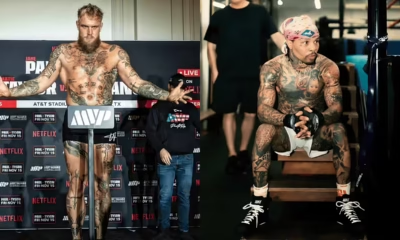
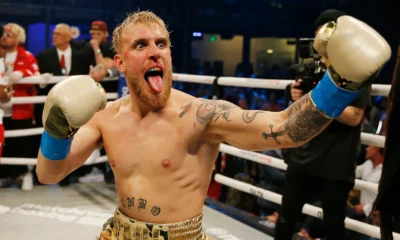
Jake Paul and Ryan Garcia trade brutal words over Tank Davis fight – “Boxing is officially WWE”
Jake Paul clapped back at Ryan Garcia after Garcia slammed his upcoming fight with Gervonta “Tank” Davis as a “dishonest” mismatch.


The hype around Jake Paul’s exhibition fight against Gervonta Davis just got louder, but not because of ticket sales or training highlights. Instead, it was sparked by a war of words between Paul and fellow lightweight star Ryan Garcia.
Garcia fires first shots
On September 23, Garcia took to X (formerly Twitter) to criticize Paul’s handling of the glaring weight difference between him and Davis. Paul, who has fought close to 200 pounds, will be stepping into the ring against Davis, who competes under 135 pounds.
ALSO READ : Top 5 Real Madrid Scorers Against Levante Will Surprise You with Their Records
“It’s really sad to see how dishonest he is,” Garcia posted. “You are 200 pounds plus, you’ll make the 195 pound limit then shoot to 215 most likely. And you lie to yourself to hype yourself up, you are fighting a 135 pound fighter, but you don’t see how that is a bit misleading. Lying to yourself sucks.”
This wasn’t Garcia’s first swipe. When the Paul-Davis fight was announced last month, he mocked the matchup online: “Boxing is officially the WWE.”
He went further, adding: “This just proves that the new blueprint is get popular, be a decent fighter, pick fights to win that give you advantage and continue to rack in money. Integrity of the sport is getting ruined everyday.”

Jake Paul fires back
Paul, never one to back down from criticism, finally responded during an interview in New York on September 22.
“I think he’s just mad that I’m going to get an opportunity to beat Tank,” Paul said. “And he obviously got knocked out and embarrassed (in Garcia’s loss to Davis in 2023), so his insecurities are coming out.”
Paul’s words referenced Garcia’s highly publicized knockout loss to Davis, a fight that drew millions of views and left Garcia answering tough questions about his performance.
A brewing feud outside the ring
While Paul vs. Davis is billed as an exhibition spectacle, the verbal jabs between Paul and Garcia are starting to feel like a fight of their own. With Garcia branding Paul as “dishonest” and Paul accusing Garcia of jealousy, the feud reflects deeper tensions about boxing’s shifting culture.

Paul, a YouTube-star-turned-boxer, has often been accused of blurring the lines between sport and entertainment. Garcia’s critique that “integrity is getting ruined everyday” echoes concerns shared by purists who see Paul’s career as opportunistic rather than competitive.
Still, Paul’s popularity and ability to draw massive audiences are undeniable, and that’s precisely why Davis agreed to this unusual matchup. For Garcia, who already fell short against Davis, the spectacle only adds salt to the wound.
What’s next?
The Paul-Davis fight is already a lightning rod for controversy, and Garcia’s fiery comments have only amplified attention. Whether fans see it as a sham or as entertainment, one thing is certain: the noise surrounding this fight is only getting louder.
If Paul defeats Davis, critics will cry foul over the weight gap. If Davis wins, Paul’s credibility as a fighter could take another hit. And in the middle of it all, Garcia seems eager to remind fans that he believes boxing’s soul is at stake.








Cricket
‘If Only I’d Had a Word With Trump…’ — The Iran War Is Now Causing a Cricket Ball Shortage in England, and the ECB Is Rattled
Rockets over the Gulf, tripled freight charges, and half-empty stockrooms — the last thing anyone expected the Iran war to hit was English cricket’s most iconic piece of equipment.


When Donald Trump ordered strikes on Iran in June 2025, the consequences were expected to be felt in oil markets, Gulf diplomacy, and US military circles. Nobody — absolutely nobody — expected the ripple to reach the cricket pitches of England.
But here we are.
The England and Wales Cricket Board (ECB) is staring down an unexpected and rather extraordinary crisis: a shortage of Dukes cricket balls — the handcrafted leather balls used in home Tests and the County Championship — with the new season just days away and only half the usual stock available.
The culprit? The Gulf War.
‘A Major Crisis’ — The Man Who Makes the Balls Speaks Out
Dilip Jajodia, who owns British Cricket Balls Ltd — the makers of the iconic Dukes ball — has spoken candidly about the chaos engulfing his supply chain.
“We’ve got a major crisis right now with this bloody Gulf War nonsense. We’ve got to ration clubs by giving them 50 per cent of their balls at the start of the season, and then manage the problem. We’ve got plenty of stuff in the factories in the subcontinent ready to go, but the airlines are not taking the freight, because there’s a logjam,” Jajodia told DailyMail.
In other words: the balls exist. They’re made, stitched, and ready. They just can’t get here.
Why the Gulf War Is Grounding Cricket Ball Shipments
To understand the problem, you need to understand how a Dukes ball is made — because it is anything but a simple factory job.
The journey begins with British cowhide, which is treated and tanned in Chesterfield, England. The leather is then shipped to South Asia, where highly skilled craftsmen hand-stitch each ball individually — a painstaking, artisanal process that cannot be rushed or automated. Once completed, the finished balls are transported back to the UK for final preparation and distribution.
That return journey is where everything has broken down.
The most efficient freight routes from South Asia to the UK pass directly through Middle Eastern airspace — airspace that is now laced with uncertainty, disruptions, and in some corridors, actual rockets.
Airlines have responded predictably: many are simply refusing to take the freight. Those still willing to fly the route are charging a premium that has left Jajodia reeling.
“The rates have gone up too. A box of 120 cricket balls would be charged normally by airlines at about $5 a kilo. The last quote I got was $15 a kilo. Most of the stuff goes through the Middle East, but if you’ve suddenly got rockets flying around, you’ve got a major problem,” he said.
That’s a 200% increase in freight costs — for cricket balls.

‘I’d Have Had a Word With Trump’
To his credit, Jajodia managed to find some dark humour in the situation.
“If only I had known this was going to happen, I’d have had a word with Donald Trump. Please don’t attack anybody before the cricket season starts!”
It drew a laugh — but the underlying frustration was real. The English cricket season is due to begin on April 3, involving all 18 first-class counties, and the supply chain crisis couldn’t have arrived at a worse moment.
ECB Admits It’s Been a ‘Wake-Up Call’
An ECB official, speaking to DailyMail, didn’t try to downplay the situation.
“It’s been a bit of a wake-up call for everybody.”
Counties have already been informed they will receive just 50% of their usual ball allocation at the start of the season, with the rest to follow as the supply chain situation is managed. Whether that normalises quickly — or drags on — depends almost entirely on how the situation in the Gulf develops.
The Bigger Picture: War Has Unexpected Victims
This story is, in many ways, a perfect illustration of something that gets lost in the noise of geopolitical conflict: wars don’t just hit battlefields.
They hit freight routes, supply chains, small businesses, and industries that have nothing to do with the conflict — and the people running those industries are left to pick up the pieces.
The ongoing US-Iran war, which has already disrupted oil markets, shut down the Strait of Hormuz, and rattled Gulf economies, has now — in its own small but telling way — put English cricket on notice.
From the battlefields of Iran to the pitches of Lord’s — the consequences of this war are spreading further than anyone anticipated.
Sports
‘It Is a Big Blow for Us’ — CSK Rocked as Nathan Ellis Ruled Out of IPL 2026 With Hamstring Injury, Frantic Hunt for Replacement Begins
Chennai Super Kings are already under pressure ahead of IPL 2026 — and losing their key death-over bowler before the season even begins has made a difficult rebuild suddenly look even harder.

Chennai Super Kings have been hit with a brutal pre-season blow — Australian pace bowler Nathan Ellis has been ruled out of IPL 2026 due to a hamstring injury, and the franchise is now in a frantic race against time to find a worthy replacement before the tournament kicks off.
The news comes at the worst possible moment for a team that is already in the middle of a significant rebuild — and with the season just days away, options are narrowing fast.
‘Ellis Is a Crucial Bowler’ — CSK CEO Speaks Out
The man who broke the news publicly was none other than CSK CEO Kasi Viswanathan, who didn’t sugarcoat the situation.
“It is a big blow for us. Ellis is a crucial bowler, especially in the death overs. We are looking at replacements,” Viswanathan told Sportstar.
Nathan Ellis, who was part of Australia’s T20 World Cup squad, had been earmarked as a key weapon in CSK’s bowling arsenal — particularly in the death overs, where his ability to execute yorkers and slower balls under pressure made him a highly valued asset. A hamstring injury has ended those plans entirely.
A Forgettable 2025 to Forget — And a 2026 That Must Be Different
To understand just how much pressure CSK are under, look no further than their 2025 IPL campaign — arguably one of the worst in franchise history.
Out of 14 matches, the five-time champions managed just four wins, losing 10 and finishing dead last on the points table. It was a season that exposed deep cracks — in balance, execution, and squad depth.
The franchise has since made bold moves to reset. The most dramatic? A blockbuster trade involving Ravindra Jadeja and Sam Curran, with wicketkeeper-batter Sanju Samson coming in as part of the shake-up. It signals that CSK are serious about building a more dynamic, flexible squad — one that doesn’t rely on the same old formula.

Dhoni at 44: The Last Dance?
Amid all the uncertainty, one familiar face brings hope — MS Dhoni, now 44 years old, is set to return for yet another IPL season. For millions of fans across the country, that alone is reason enough to tune in.
Whether this is truly his final season remains an open question — but within the CSK camp, his presence is expected to bring the calm and leadership the team desperately needs after a turbulent year.
The franchise is targeting a record-extending sixth IPL title — a goal that now looks considerably harder without Ellis in the attack.
IPL 2026: CSK’s Full Schedule So Far
CSK open their campaign away from home, facing Rajasthan Royals at Barsapara Cricket Stadium in Guwahati on March 30, before returning to the fortress of MA Chidambaram Stadium for their home opener against Punjab Kings on April 3.
| Match | Date | Time (IST) | Venue |
|---|---|---|---|
| RR vs CSK | March 30 | 7:30 PM | Barsapara Cricket Stadium, Guwahati |
| CSK vs PBKS | April 3 | 7:30 PM | MA Chidambaram Stadium, Chennai |
| RCB vs CSK | April 5 | 7:30 PM | M Chinnaswamy Stadium, Bengaluru |
| CSK vs DC | April 11 | 7:30 PM | MA Chidambaram Stadium, Chennai |
The Clock Is Ticking
With March 30 just around the corner, CSK have very little time to identify, clear, and integrate a replacement for Ellis. Finding a death-over specialist of his calibre at this stage of the window — when most international players are already committed or unavailable — will be no easy feat.
The IPL replacement window does allow franchises to bring in substitutes for injured overseas players, but the pool of available quality options shrinks rapidly this close to the season.
For now, all eyes are on Chennai — and the clock is ticking.
Sports
“5-0 Statement!”: Chivas Humiliate León to Reclaim Top Spot… and Send a Warning to Liga MX
A ruthless performance at Estadio Akron sees Guadalajara storm back to first place, with rising stars and clinical finishing stealing the spotlight.


There are wins—and then there are statements.
On a charged night at the Estadio Akron, Club Deportivo Guadalajara delivered the kind of performance that doesn’t just earn three points—it reshapes the title race.
A stunning 5-0 demolition of Club León pushed Chivas back to the summit of the Liga MX Clausura 2026 standings, sending a clear message to every contender: the Sacred Flock is back—and flying high.
Patience Pays Off in the First Half
Despite dominating possession early, Chivas had to wait for their breakthrough.
León initially held firm, frustrating the home side with disciplined defending. But persistence paid off in the 36th minute when Brian Gutiérrez unleashed a sensational strike from distance—his first Liga MX goal.
It wasn’t just a goal; it was a release of pressure and a signal of what was to come.
Second Half Turns Into a Rout
If the first half belonged to patience, the second belonged to complete domination.
Moments after the restart, Santiago Sandoval doubled the lead with a sharp finish, effectively breaking León’s resistance.
The match tilted decisively in Chivas’ favor when Jordi Cortizo was sent off following a VAR review. Down to ten men, León had no answer to Guadalajara’s relentless attack.
Goals Keep Flowing as Confidence Soars
With numerical advantage and momentum on their side, Chivas began to enjoy themselves.
Armando González calmly converted a penalty to make it three, bringing his tally to nine goals and putting him firmly in the race for the golden boot.
Then came the flourish.

Ángel Sepúlveda added the fourth after reacting quickest to a rebound, before youngster Hugo Camberos capped off the night deep into stoppage time with a composed finish.
Five goals. Total control. No reply.
VAR, Drama, and Turning Points
While the scoreline suggests simplicity, the match had its share of key moments shaped by technology.
Referee Jorge Camacho relied heavily on VAR—overturning a first-half penalty decision and later confirming both the red card and a second penalty.
Each intervention ultimately worked in Chivas’ favor, reinforcing their dominance while leaving León chasing shadows.
A Night of Milestones and Emotion
Beyond the goals, the match carried emotional weight.
Defender José Castillo celebrated his 100th Liga MX appearance, marking a significant milestone in his growing career.
Meanwhile, former Chivas midfielder Fernando Beltrán returned to the stadium—but not to a warm welcome. Once a fan favorite, he was greeted with boos, highlighting how quickly football loyalties can shift.
Fans Turn Out in Force
Despite being a midweek fixture, the energy inside Estadio Akron was electric.
Over 35,000 fans packed the stands, turning the venue into a fortress—and the players responded in kind. The connection between team and supporters was evident, fueling an already dominant performance.

What This Means for the Title Race
With 27 points from 11 matches, Chivas now sits firmly at the top of the table, reclaiming a position they briefly lost in recent weeks.
More importantly, this victory showcases a team hitting peak form at the right time—combining attacking flair, squad depth, and tactical discipline.
For León, however, the defeat raises serious questions. With a new coach still finding his footing, the team must regroup quickly to avoid further setbacks.
Looking Ahead
Chivas now turn their attention to a crucial away clash against Monterrey, a match that could further solidify their title credentials.
León, meanwhile, face a quick turnaround as they prepare to take on Atlético San Luis, hoping to bounce back from one of their toughest nights this season.
For more Update- DAILY GLOBAL DIARY

Iran Bombs Qatar’s Ras Laffan and India Is Counting the Cost — ‘88% Import Dependent on Crude Oil, Half on Gas…’

‘If Only I’d Had a Word With Trump…’ — The Iran War Is Now Causing a Cricket Ball Shortage in England, and the ECB Is Rattled

US F-35 Fighter Jet Makes Emergency Landing After ‘Suspected Iranian Fire’ Mid-Combat Mission — ‘The Aircraft Landed Safely…’

Noida Man Promised Singapore, Europe, Vietnam Tours — Then Pocketed ₹12 Lakh and Cancelled Every Ticket: ‘He Was Doing This for Years…’

Indian-Origin Man Sital Singh Sentenced to 4 Years for Scamming Elderly Americans Out of Millions — ‘They Lost Everything They Saved…’

1-Iran Issues Dire Warning to Israel and Defies Trump on Nukes: “We’re Ready to Strike Deep Inside”

Donald Trump’s net worth reveals the fortune behind the former US President and business mogul

“She Never Made It Out…” Albany House Fire Claims Woman’s Life as Family Pleads for Help to Bring Her Home

Caitlin Clark Sidelined with Quad Strain, Set to Miss Two Weeks of WNBA Action

“Tomás Rodríguez Net Worth 2025: Panama’s Gold Cup Goal‑Machine’s Surprising Fortune Revealed”

Miss Jamaica Suffers Terrifying Fall Off Miss Universe Stage; Rushed to Hospital on Stretcher in Viral Video

Moana Live-Action Teaser Sparks Outrage as Fans Call Disney’s Move a ‘Clear Money Grab’ — What Went Wrong?

Ryan Gosling’s Project Hail Mary Trailer Stuns Fans with a Mysterious Alien Ally and a Mission That Could Save Earth

Apple delays Jessica Chastain thriller The Savant about domestic extremism after recent US violence

Avatar 3, Fire and Ash trailer reveals Jake Sully’s family facing terrifying new Na’vi enemies with deadly fire powers
-

 Entertainment1 week ago
BBC Boss Finally Explains Why the Racial Slur Was Never Cut From the BAFTA Broadcast — “No One in the Truck Even Heard It…”
-

 Sports1 week ago
“Last-Minute Heartbreak for Rayados…”: Juárez Snatch 2–2 Draw as Estupiñán Penalty Cancels Monterrey’s Lead
-

 Entertainment1 week ago
Pixar Legend Andrew Stanton Is Back Directing Live-Action And He Quietly Admits He Cut a Political Scene That Would Have ‘Changed Everything’… Plus His Toy Story 5 Update Will Make Fans Very Happy
-

 Business1 week ago
“Tesla Is Not Going Away…”: After a Rough 2025, A Surprising Data Point Gives Tesla Investors a Reason to Smile
-

 Entertainment1 week ago
Harvey Weinstein Breaks His Silence From Rikers Island and Says ‘I’m Dying Here’ — But His Shocking Promise About Innocence Will Leave You Speechless…
-

 Automobile1 week ago
“Is This Tesla’s Next Headache?”: Rivian R2 Targets Model Y With More Power, Longer Range… and a Surprisingly Lower Price
-

 Automobile1 week ago
Stop Sale After Tragedy”: Hyundai Halts 2026 Palisade SUV Sales in U.S. and Canada Following Child Death Investigation
-

 Entertainment1 week ago
Kanye ‘Ye’ West Was Actually Falling Asleep in Court During His Own Trial — What Happened When the Judge Noticed Has Everyone Talking…
Pingback: Pregnant women told to “fight like hell” by Donald Trump before taking Tylenol… doctors warn this advice could be deadly - Daily Global Diary - Authentic Global News